2026 Guide: Styling Hanbok Skirts & Ao Dai for Modern Workwear
The Renaissance of Heritage Workwear in 2026
The global fashion landscape in 2026 has decisively moved past the era of treating traditional Asian garments solely as ceremonial costumes or fleeting streetwear novelties. Today, the integration of heritage pieces into daily, professional wardrobes represents a sophisticated intersection of cultural pride and modern minimalism. As hybrid work models solidify and office dress codes embrace expressive individuality, garments like the Korean Hanbok skirt (chima) and the Vietnamese Áo Dài tunic have been reimagined for the contemporary professional. This evolution is not about diluting tradition; rather, it is about adapting the architectural brilliance of Asian tailoring to meet the functional demands of the 2026 workday.
Mixing these traditional elements with structured modern workwear requires an understanding of proportion, fabric technology, and color theory. Whether you are navigating the creative agencies of Seoul, the corporate hubs of Ho Chi Minh City, or the hybrid offices of New York, mastering this fusion will elevate your sartorial presence. Below, we explore actionable strategies for styling these iconic pieces in a modern professional context.
The Modern Hanbok Chima: Volume Meets Structure
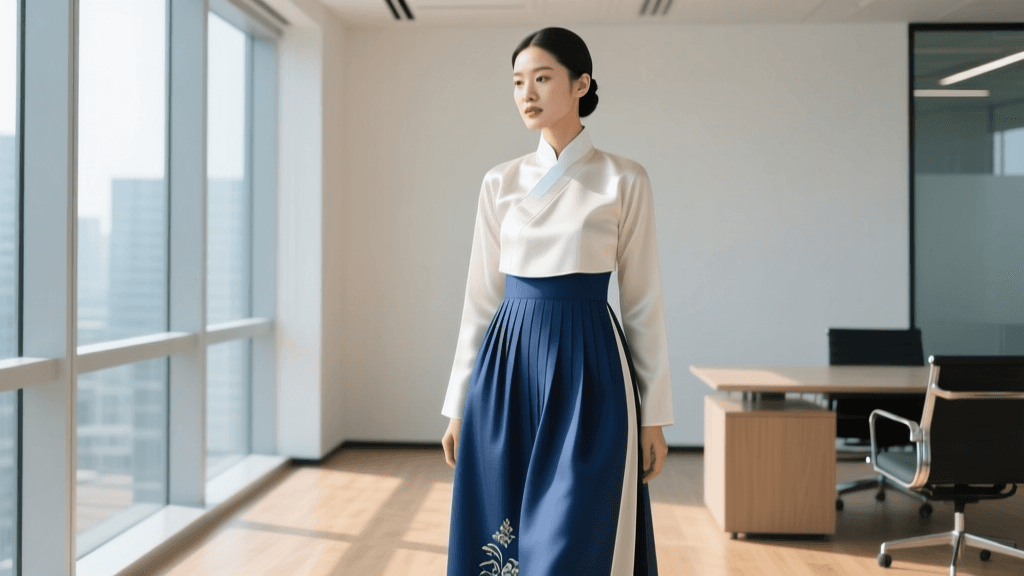
The chima, or traditional Hanbok skirt, is renowned for its high waist and voluminous, bell-like silhouette. In a traditional context, this volume is achieved through extensive gathering and the wearing of multiple undergarments (sokgot). However, for the 2026 office environment, the modern fusion chima relies on architectural cutting rather than excessive layering to maintain its shape.
Proportions and Hemlines
When pairing a chima with office attire, proportion is your most critical tool. A traditional floor-length chima can be hazardous in fast-paced office corridors and visually overwhelming when paired with modern tailoring. For 2026 workwear, opt for a midi-length fusion chima that rests exactly three inches below the knee or at the mid-calf. This hemline provides the elegant sweep of the traditional garment while maintaining practical mobility.
To balance the inherent volume of the skirt, your top half must remain highly structured. Pair a high-waisted, matte-crepe chima with a sharply tailored, single-breasted wool blazer. The blazer should feature strong, padded shoulders and a nipped waist to create an hourglass silhouette that honors the traditional Hanbok shape without relying on the traditional, voluminous jeogori (jacket). A crisp, poplin button-down shirt tucked seamlessly into the chima’s waistband provides a clean, professional anchor.
Waistband Mechanics
Modern fusion chimas have largely abandoned the traditional fabric ties (goreum) in favor of discreet, structured waistbands. Look for skirts with a 1.5-inch wide, reinforced cotton-twill waistband that fastens with a side-seam zipper and an interior hook-and-bar closure. This ensures the heavy skirt remains securely anchored at your natural waist throughout an eight-hour workday, preventing the fabric from slipping or bunching under a blazer.
The Áo Dài Tunic: A Masterclass in Linear Elegance
While the Hanbok skirt plays with volume, the Vietnamese Áo Dài is a study in linear elegance and fluid movement. Traditionally worn as a floor-length tunic over wide-legged trousers, the 2026 iteration of the Áo Dài for the workplace has been thoughtfully cropped and tailored to serve as a sophisticated alternative to the standard blouse or tunic.
The Cropped Tunic and Tailored Trousers
The most striking way to incorporate the Áo Dài into a modern capsule wardrobe is through the mid-thigh cropped tunic. This version retains the iconic mandarin collar, the asymmetric diagonal front closure, and the high side slits, but ends gracefully at the mid-thigh. This length allows it to be worn over high-waisted, wide-leg crepe trousers or even dark-wash, straight-leg denim for a business-casual Friday.
The side slits of the Áo Dài are not merely decorative; they provide essential ease of movement. When seated at a desk or moving between meetings, the slits ensure the fabric drapes beautifully without pulling across the hips. Pair this tunic with a sleek, leather belt worn low on the hips over the trousers to visually separate the tunic from the pant and add a contemporary Western styling element.
Collar and Fastening Details
The mandarin collar is a defining feature of the Áo Dài, but in a professional setting, a collar that is too high or stiff can appear restrictive and uncomfortable. Seek out 2026 designs that feature a soft-banded mandarin collar, measuring no more than 1.25 inches in height. Furthermore, while traditional snap buttons or hooks are common, modern luxury fusion pieces often utilize hidden magnetic closures along the diagonal flap. This preserves the seamless, unbroken line of the embroidery or fabric pattern while making the garment significantly easier to put on and remove in a professional environment.
2026 Fabric Innovations and Color Palettes
The success of mixing traditional Asian garments with modern workwear hinges heavily on fabric choice. The glossy, heavily embroidered silks of ceremonial wear are inappropriate for the boardroom. Instead, the 2026 market offers advanced textiles that bridge the gap between heritage aesthetics and modern performance.
- Matte Crepe and Tencel Blends: These fabrics offer the beautiful, fluid drape required for both the chima and the Áo Dài, but with a subdued, professional luster. Tencel blends are particularly popular in 2026 due to their temperature-regulating properties and wrinkle resistance.
- Bio-Washed Linens: For the spring and summer 2026 seasons, bio-washed linens provide a structured yet breathable option. The bio-washing process softens the fibers, eliminating the harsh stiffness of traditional linen while retaining its elegant, lived-in texture.
- Subtle Jacquards: Instead of overt embroidery, look for tone-on-tone jacquard weaves. A slate-grey chima featuring a subtle, woven floral motif visible only in direct light adds depth and luxury without compromising professional minimalism.
Regarding color, the 2026 palette for heritage workwear has shifted toward grounded, earthy neutrals and muted jewel tones. Think matcha green, deep terracotta, slate blue, and charcoal. These colors integrate effortlessly with standard workwear staples like navy blazers, camel trench coats, and black leather loafers.
Comparison Chart: Traditional vs. 2026 Fusion Styling
| Garment Element | Traditional Context | 2026 Office Fusion Application | Recommended Modern Pairing |
|---|---|---|---|
| Hanbok Chima (Skirt) | Floor-length, high volume, bright silk, tied with fabric ribbons | Midi-length, structured matte crepe, 1.5-inch zippered waistband | Tucked poplin shirt, tailored single-breasted wool blazer |
| Áo Dài Tunic | Floor-length, high side slits, worn over wide silk trousers | Mid-thigh cropped, soft mandarin collar, hidden magnetic closures | High-waisted wide-leg crepe trousers, low-slung leather belt |
| Collars & Necklines | Stiff, high V-necks (Hanbok) or tight, high mandarin collars (Áo Dài) | Lowered soft-bands, open V-necks for breathability and comfort | Minimalist gold pendant necklaces, silk pocket squares |
| Color & Pattern | Highly saturated colors, contrasting panels, heavy metallic embroidery | Muted earth tones, monochromatic layering, tone-on-tone jacquard | Neutral leather accessories (black, oxblood, or tan) |
Layering for Transitional Weather
One of the most common challenges when integrating traditional Asian garments into a year-round wardrobe is adapting them for transitional weather and heavily air-conditioned offices. The sleeveless or short-sleeved nature of many modern fusion tunics requires strategic layering.
"The key to modernizing heritage wear is treating it not as a costume to be preserved, but as a foundational textile to be manipulated within the rules of contemporary layering." — 2026 Global Textile & Heritage Report, Victoria and Albert Museum Collections.
For the Áo Dài, avoid wearing standard cardigans over the top, as this obscures the beautiful diagonal closure and mandarin collar. Instead, layer a fitted, fine-gauge merino wool turtleneck underneath the tunic. This not only provides warmth but also creates a striking, modern contrast between the structured collar of the tunic and the soft folds of the knitwear. For the Hanbok chima, a longline, belted wool trench coat worn over the skirt and blouse creates a dramatic, sweeping silhouette that is entirely appropriate for high-level corporate environments during the autumn and winter months.
Sourcing, Pricing, and Garment Care
Investing in high-quality fusion pieces requires knowing where to look and how to maintain them. In 2026, the market for modern heritage wear is robust, with specialized boutiques and contemporary Asian designers leading the charge.
Pricing and Investment
Expect to invest between $120 and $250 for a high-quality, ready-to-wear fusion chima or mid-thigh Áo Dài tunic from established contemporary brands. Bespoke or made-to-measure pieces, which are highly recommended for the Áo Dài to ensure the side slits and shoulder seams sit perfectly, typically range from $280 to $450. When ordering bespoke, allow a lead time of six to eight weeks, especially if you are targeting the busy spring 2026 wedding and conference season.
Care and Maintenance
While traditional silks demand rigorous dry-cleaning, the modern Tencel and matte-crepe blends used in 2026 fusion workwear are designed for easier maintenance. Most high-end crepe chimas can be hand-washed in cold water with a pH-neutral detergent and hung to dry, saving you significant time and money. However, garments featuring structured waistbands or hidden magnetic closures should always be dry-cleaned to preserve the integrity of the internal hardware and prevent the waistband from warping. Always store your chimas on padded hangers to maintain the waistband's shape, and fold your Áo Dài tunics along the natural seam lines to prevent permanent creasing across the torso.
Conclusion
Mixing traditional Asian pieces with modern workwear in 2026 is a powerful statement of cultural continuity and personal style. By respecting the architectural origins of the Hanbok chima and the Áo Dài while adapting their proportions, fabrics, and styling for the contemporary office, you can create a wardrobe that is as functional as it is meaningful. Embrace the muted palettes, invest in structured tailoring, and let the elegant lines of Asian heritage elevate your daily professional attire.