Top Kyoto Nishijin Weaving Apprenticeships & Schools 2026
The Renaissance of Nishijin-ori in 2026 Global Fashion
In 2026, the global fashion industry has witnessed a profound pivot toward hyper-artisanal, sustainable textiles, placing Kyoto’s legendary Nishijin-ori (Nishijin weaving) at the absolute forefront of luxury design. Originating over a millennium ago, this intricate silk weaving technique is no longer confined to ceremonial kimonos or obi sashes. Today, international heritage houses and avant-garde designers are actively seeking out graduates of Japanese fashion education schools and traditional apprenticeships to integrate these complex brocades into contemporary haute couture and sustainable ready-to-wear collections. For aspiring textile artists and fashion designers, mastering this craft in Japan offers an unparalleled education in patience, precision, and material science.
The educational landscape for traditional Japanese garments and textiles has evolved significantly. While the ancient master-apprentice model remains the gold standard for preserving intangible cultural properties, modern institutions have successfully hybridized this with digital textile design, sustainable sericulture, and global fashion business acumen. If you are looking to immerse yourself in the rhythmic, meditative world of the Japanese loom, understanding the distinct pathways available in 2026 is critical to your career trajectory.
Premier Institutions for Japanese Textile Education
Choosing the right environment to study traditional Japanese weaving depends heavily on your end goals: do you seek the quiet mastery of a traditional artisan, or the disruptive innovation of a contemporary fashion designer? Here are the top three pathways dominating the 2026 educational landscape.
1. Nishijin Textile Association (Traditional Apprenticeship Route)
For those seeking absolute authenticity, the apprenticeships facilitated through the Nishijin Textile Association remain the most rigorous and rewarding path. In 2026, the association has streamlined its intake for international and domestic students who have achieved JLPT N2 or higher. Apprentices are placed directly into multi-generational family workshops (orimoto) in Kyoto’s Kamigyo ward. Here, you will spend your first year solely on thread preparation, dyeing, and warp threading before ever touching the beater of a Jacquard loom. This route is heavily focused on the preservation of intangible cultural heritage, emphasizing hand-drawn pattern drafting and the operation of traditional wooden takahata looms alongside modern computerized Jacquard systems.
2. Kyoto Seika University (Academic & Contemporary Design)
The Faculty of Design at Kyoto Seika University offers a premier four-year Bachelor of Arts in Textile Design, highly regarded for its balance of traditional craft and contemporary application. In 2026, their curriculum features a specialized module on 'Heritage Textiles in Modern Silhouettes,' where students learn to weave Nishijin-ori fabrics specifically engineered for Western-style tailoring and drape. The university boasts state-of-the-art weaving studios equipped with both traditional hand-looms and digital TC2 Jacquard looms, allowing students to simulate complex brocade patterns using AI-assisted software before committing to the physical weaving process. This is the ideal route for those who wish to become textile directors or independent fashion designers with a deep grounding in Japanese craft.
3. Bunka Fashion College (Avant-Garde Integration)
Located in Tokyo, Bunka Fashion College is globally renowned for producing avant-garde fashion visionaries. While not a traditional weaving school, Bunka’s advanced Fashion Textile courses in 2026 feature intensive collaborations with master weavers from Kyoto and Fukui. Students here focus on the manipulation of traditional textiles—deconstructing Nishijin brocades, combining them with experimental synthetic fibers, and utilizing zero-waste pattern cutting. Bunka is the premier choice for students whose ultimate goal is to launch a disruptive fashion label that utilizes traditional Japanese materials in radical, futuristic ways.
2026 Comparison: Apprenticeship vs. University Degree
To help you navigate your options, the following table outlines the core differences between the traditional apprenticeship model and contemporary university education for textile design in Japan as of 2026.
| Feature | Traditional Nishijin Apprenticeship | University Textile Degree (e.g., Kyoto Seika) |
|---|---|---|
| Duration | 3 to 5 Years (Full-time immersion) | 4 Years (Bachelor's) / 2 Years (Master's) |
| Primary Focus | Technical mastery, heritage preservation, workshop operations | Conceptual design, digital integration, fashion theory, business |
| 2026 Est. Cost | Low tuition; often includes a monthly stipend (~60,000 JPY) | ~1,450,000 JPY/year (Tuition) + Material fees |
| Language Requirement | JLPT N2 minimum (N1 highly recommended for nuance) | JLPT N2 or EJU (English tracks available for grad students) |
| Career Outcome | Master Artisan, Workshop Heir, Heritage Textile Consultant | Fashion Designer, Textile Director, Brand Creative Director |
Actionable Steps to Secure Your 2026 Placement
Gaining entry into these prestigious programs requires meticulous preparation. The application cycles for 2026 intakes are highly competitive, particularly as global interest in sustainable, artisanal fashion peaks.
Language and Cultural Prerequisites
Fluency in Japanese is non-negotiable for the traditional apprenticeship route. The terminology used in Nishijin weaving is highly specialized, utilizing archaic Kyoto dialects and specific artisanal jargon that is not covered in standard language textbooks. Prospective apprentices should spend at least a year at a Kyoto-based language school, specifically seeking out courses that offer 'Traditional Arts and Crafts' vocabulary modules. For university applicants, while some graduate programs offer English instruction, achieving JLPT N2 will vastly improve your ability to source materials from local Kyoto thread merchants and understand the subtleties of guest lectures by Living National Treasures.
Portfolio Preparation: The 'Sensory' Submission
In 2026, admissions committees and master weavers are looking for portfolios that demonstrate a profound respect for materiality. Do not just submit digital sketches. Your portfolio must include physical swatches, documented experiments with natural dyes (such as ai indigo or shibori resist techniques), and evidence of your understanding of warp and weft tension. Include a detailed 'process journal' that highlights your failures and material problem-solving. Master artisans value patience and resilience over raw, unrefined talent.
Financial Planning: Tuition and Living Costs
Living in Kyoto in 2026 requires careful budgeting. While university tuition averages around 1,450,000 JPY per year, living expenses in the Kamigyo and Nishijin districts typically range from 120,000 to 150,000 JPY per month, covering a modest apartment, utilities, and groceries. Apprenticeships often provide a modest stipend and subsidized workshop housing, but you must prove you have sufficient savings (usually around 2,000,000 JPY in a bank account) to secure your student or cultural activities visa through the Japanese immigration bureau.
The Zen Spirituality and Sensory Experience of the Loom
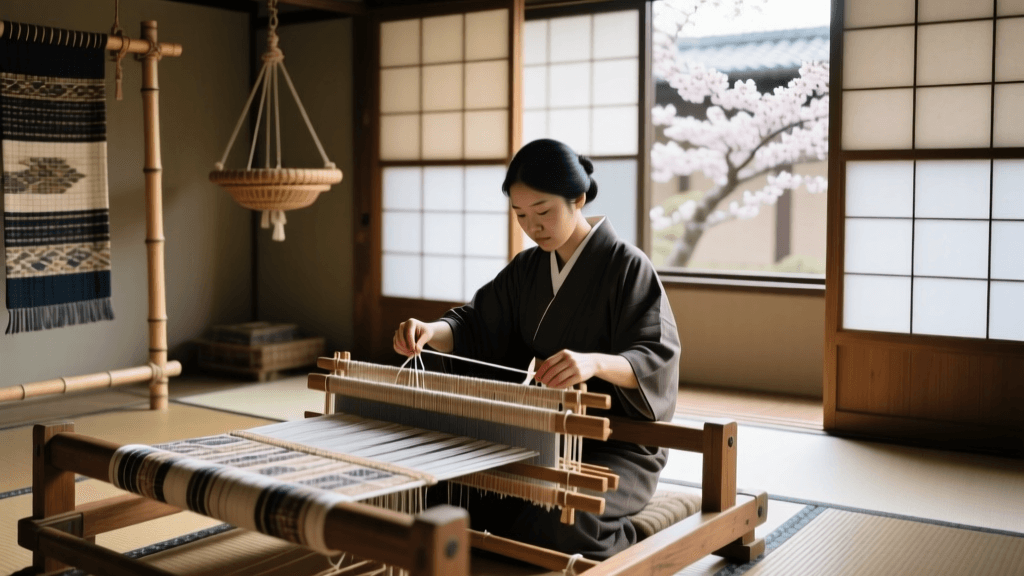
To study Nishijin-ori is to engage in a deeply spiritual and sensory practice. The weaving studio is a sanctuary of focused energy. The air is thick with the distinct, earthy scent of boiled sericin (raw silk protein) and the sharp, clean tang of natural indigo vats. When you sit at a traditional wooden loom, the physical exertion is immense; throwing the shuttle and pulling the heavy wooden beater (battan) requires core strength and rhythmic breathing.
Master weavers often describe the act of weaving as a form of moving Zen meditation. Achieving mushin (no-mind) is essential. If your mind wanders, the tension of the warp threads will fluctuate, resulting in visible flaws in the brocade pattern. The rhythmic clack-clack of the loom becomes a metronome for your heartbeat. This sensory immersion teaches a profound lesson in mindfulness that translates directly into the quality and soul of the garments you eventually create. It is this spiritual connection to the garment's creation that international luxury brands are desperately trying to capture in the 2026 market.
Essential Tools and Materials for the Modern Weaver
Whether you are in a university studio or a traditional workshop, you will become intimately familiar with specialized tools. In 2026, the modern Nishijin weaver’s toolkit is a fascinating blend of the ancient and the cutting-edge:
- The TC2 Jacquard Loom: A digital hand-loom that allows students to weave complex, custom-designed brocades directly from CAD software, bridging the gap between digital design and physical textile.
- Hibako (Thread Storage Boxes): Traditional cedar boxes used to store precious silk threads, protecting them from humidity and pests while allowing the wood's natural oils to subtly condition the silk.
- Karakusa Silk Threads: High-twist crepe silk threads used to create the textured, pebbled surface (chirimen) often used as the base for elaborate Nishijin brocades.
- AI Pattern Simulation Software: Proprietary 2026 software used by Kyoto Seika and Bunka students to predict how specific silk threads will catch the light and drape on a human body before a single thread is dyed.
Conclusion: Weaving Your Future
The pursuit of Nishijin-ori weaving and traditional Japanese fashion education in 2026 is not merely about learning a historical technique; it is about securing the future of sustainable, meaningful luxury. Whether you choose the quiet, rigorous path of a Kyoto workshop apprenticeship or the innovative, conceptual halls of a Tokyo fashion college, you are stepping into a lineage of artisans who view textiles as the very fabric of culture. By mastering the loom, you are not just making clothes; you are weaving history, spirituality, and the future of global fashion into every single thread.