How to Start and Run a Successful Kimono Rental Shop
The Intersection of Heritage and Hospitality
The intersection of traditional Japanese garments and modern cultural tourism has created a booming industry in cities like Kyoto, Tokyo, and Kamakura. For many international and domestic visitors, wearing a kimono is not merely a photo opportunity; it is an immersive way to connect with Japanese history, aesthetics, and craftsmanship. Starting a kimono rental business requires a delicate balance of cultural respect, operational efficiency, and acute business acumen. According to data and cultural tourism initiatives highlighted by the Japan National Tourism Organization (JNTO), hands-on cultural experiences consistently rank among the top desired activities for inbound tourists, making the kimono rental sector a highly viable and lucrative enterprise.
However, running a successful shop goes far beyond simply purchasing a few colorful garments and opening your doors. It involves mastering the art of 'kitsuke' (kimono dressing), understanding complex fabric seasonality, managing rigorous garment care protocols, and designing a retail space that facilitates a seamless customer experience. This comprehensive guide will walk you through the foundational steps of starting and operating a kimono rental shop, providing actionable metrics, cost breakdowns, and industry best practices.
Business Planning and Initial Investment
Before acquiring your first bolt of silk, you must establish a robust business plan. Location is paramount. High-foot-traffic areas near major temples, shrines, and historic districts (such as Asakusa in Tokyo or Higashiyama in Kyoto) are ideal, though they command premium commercial lease rates. When registering your business and navigating local commercial leases, consulting resources like the Japan External Trade Organization (JETRO) can provide invaluable guidance on legal structures, taxation, and setting up a retail enterprise in Japan.
You must also budget for interior design, specialized fitting rooms, inventory acquisition, and marketing. Below is a detailed breakdown of the estimated startup costs for a mid-sized boutique rental shop capable of servicing 30 to 40 customers per day.
| Expense Category | Estimated Cost (USD) | Details and Notes |
|---|---|---|
| Commercial Lease & Deposit | $15,000 - $25,000 | First month, deposit, and key money in historic districts. |
| Interior & Fitting Rooms | $20,000 - $35,000 | Custom mirrors, lighting, tatami mats, and privacy partitions. |
| Initial Inventory (150 sets) | $25,000 - $45,000 | Mix of polyester and silk kimono, yukata, and hakama. |
| Accessories & Undergarments | $8,000 - $12,000 | Zori, tabi, obi, datejime, koshihimo, and hair ornaments. |
| Licensing & Insurance | $2,000 - $4,000 | Business registration, liability insurance, and permits. |
| Marketing & Website | $5,000 - $10,000 | Multi-language booking engine, SEO, and social media setup. |
| Working Capital | $15,000 - $20,000 | Reserve for staff salaries, utilities, and cleaning for 3 months. |
Sourcing and Building Your Inventory
Your inventory is the lifeblood of your business. A common mistake new owners make is purchasing only high-end, authentic silk garments. While silk offers unparalleled beauty and prestige, it is notoriously difficult to maintain, expensive to clean, and easily damaged by sweat or rain. A smart rental inventory consists of a strategic mix: 70% high-quality polyester (which is machine washable, durable, and vibrant) and 30% authentic silk for premium tier rentals.
When sourcing authentic textiles, it is important to understand the distinction of regional craftsmanship. The Ministry of Economy, Trade and Industry (METI) designates specific Traditional Craft Products, such as Nishijin-ori from Kyoto or Yuki-tsumugi from Ibaraki. Offering a premium rental tier featuring these METI-recognized textiles allows you to charge a higher margin and attract serious cultural enthusiasts.
Anatomy of a Standard Rental Set
You cannot simply rent out a kimono; you must provide a complete, wearable set. For each customer, a standard women's rental set must include:
- Hadajuban & Susoyoke: The base layer undergarments (often replaced by a one-piece 'kimono slip' for modern rental convenience).
- Nagajuban: The inner kimono, featuring a decorative 'han-eri' (half-collar) that peeks out at the neckline.
- Kimono: The main outer garment (komon or houmongi depending on the tier).
- Koshihimo (3-4 pieces): Thin cotton ties used to secure the kimono and nagajuban in place.
- Datejime (2 pieces): Wide elastic or silk belts to flatten the ties and prepare the torso for the obi.
- Obi-ita: A stiff board inserted into the obi to prevent wrinkling.
- Obi: The sash (Nagoya or Fukuro, often pre-tied with a wire frame for quick dressing in rental settings).
- Obiage & Obijime: The decorative silk scarf and braided cord that secure and adorn the obi.
- Zori & Tabi: Traditional sandals and split-toe socks (rental shops often gift the tabi to the customer for hygiene reasons).
Shop Layout and Fitting Room Specifications
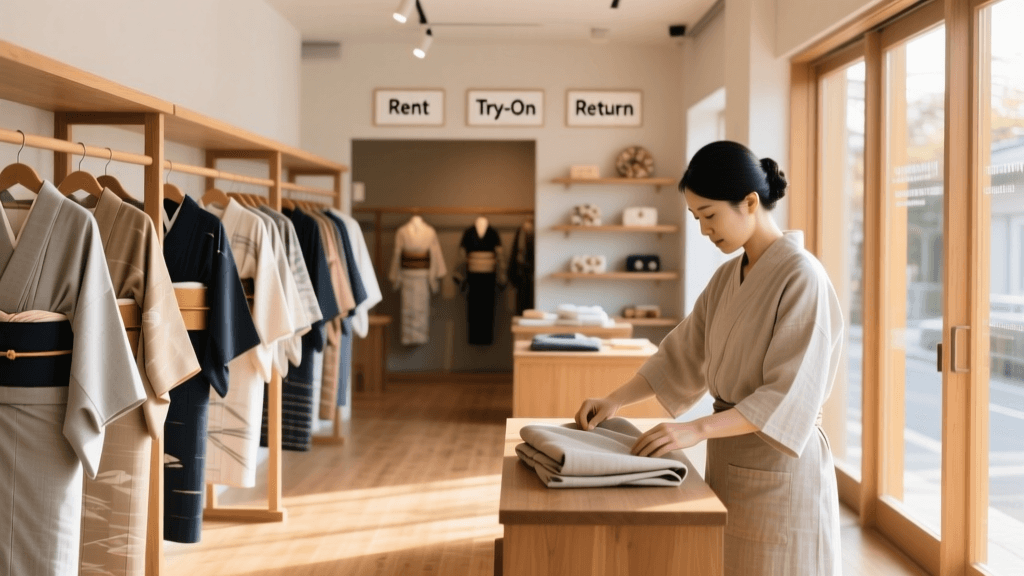
The physical layout of your shop directly impacts your daily throughput and customer satisfaction. Kimono dressing requires space, privacy, and specific environmental controls.
Fitting Room Dimensions: A standard dressing station must be at least 2.5 meters by 2.5 meters. The dresser needs ample room to walk 360 degrees around the client, pull the 'ohashori' (the waist fold), and tie the obi without bumping into walls or furniture.
Mirrors and Lighting: Install full-length, floor-to-ceiling mirrors. Lighting is critical; avoid warm, yellow-tinted bulbs that distort the colors of the garments. Use LED lighting with a Color Rendering Index (CRI) of 90 or above, set to a neutral daylight temperature (4000K-5000K). This ensures the vibrant dyes of the silk and polyester look accurate in person and in customer photographs.
Climate Control: Kimono dressing involves multiple layers, and customers can easily overheat, especially in summer. The dressing area must have powerful, directed air conditioning to keep clients cool and prevent perspiration, which can stain delicate silk garments.
Operations: Kitsuke (Dressing) and Staffing
The 'kitsuke' process is a highly specialized skill. A professional dresser can complete a full women's kimono outfit in 15 to 20 minutes, while men's hakama sets take about 10 minutes. During peak seasons (such as the spring cherry blossom or autumn foliage seasons), your shop's profitability is dictated entirely by how efficiently your staff can dress customers.
It is highly recommended to hire staff who hold certifications from recognized institutions, such as the All Japan Kimono Consultants Association. If you are training staff in-house, expect a rigorous three-month training period before they can dress customers at commercial speed. To streamline operations, many rental shops utilize 'tsukuri-obi' (pre-tied obi sashes attached to a flexible wire frame). While traditionalists may scoff at pre-tied obi, they reduce dressing time by 5 to 8 minutes per customer and guarantee a uniform, aesthetically pleasing bow shape, which is crucial for high-volume rental operations.
Navigating Seasonality and Fabric Choices
Japanese traditional dress is deeply tied to the seasons, and your inventory must reflect this to maintain cultural authenticity. Operating a rental shop requires a bi-annual, sometimes tri-annual, complete turnover of your floor inventory.
- Awase (October to May): Lined kimono made of opaque silk or polyester. These provide warmth and structure during the cooler months.
- Hitoe (June and September): Unlined kimono. The fabric is lighter, and the absence of a lining allows for better airflow during the transitional, humid months.
- Ro and Sha (July and August): Sheer, woven summer fabrics featuring tiny gaps in the weave that allow the breeze to pass through. These are worn over a lightweight, breathable summer nagajuban.
- Yukata (Summer Casual): Made of lightweight cotton, yukata are worn without a nagajuban and are secured with a simple, narrow 'hanhaba-obi'. They are the most popular and cost-effective rental item during summer festivals.
Garment Care, Maintenance, and Storage
Garment maintenance will be one of your highest ongoing operational expenses. Polyester kimono can be gently machine-washed in specialized nets using neutral detergents, drastically reducing cleaning costs. However, silk garments require professional 'maru-arai' (a specialized dry-cleaning process for whole kimono) which can cost between $30 and $60 per garment.
Between cleanings, spot cleaning is essential. Staff must be trained to use specialized benzine-based cleaners to remove makeup stains from the 'han-eri' (collar) and sweat from the underarm gussets. When not in use, kimono must be folded along their precise seam lines and stored in specialized paper envelopes called 'tatou-shi'. Never store silk in plastic, as it traps moisture and leads to mold. Place natural cedar blocks in your storage cabinets to regulate humidity and repel insects.
Marketing and Strategic Partnerships
To ensure a steady stream of bookings, look beyond walk-in traffic. Establish B2B partnerships with local ryokans (traditional inns), boutique hotels, and concierge services. Offer them a 15% commission for every guest they refer to your shop. Additionally, partner with local freelance photographers to offer 'Kimono + Photoshoot' packages. Many tourists are willing to pay a premium for a guided two-hour walking tour through historic streets with a professional photographer capturing their experience.
Finally, invest heavily in a multi-language booking engine. A seamless English, Traditional Chinese, and Korean interface will capture the vast majority of the inbound market. By combining cultural reverence with sharp operational logistics, your kimono rental shop can become a beloved staple in the local tourism ecosystem, preserving and sharing the beauty of Japanese sartorial traditions with the world.