Top Heritage Fabric Mills for Burgundian Houppelandes in 2026
The Resurgence of Late Medieval Sartorial Accuracy in 2026
The landscape of historical European dress recreation has undergone a seismic shift by 2026. Moving far beyond the synthetic costumes and approximated silhouettes of the early 2020s, today's historical reenactors, museum consultants, and master tailors demand absolute textile authenticity. At the forefront of this movement is the recreation of Late Medieval and Renaissance court dress, specifically the iconic 15th-century Burgundian houppelande. As documented by the Victoria and Albert Museum's Medieval and Renaissance collections, the Burgundian court under Philip the Good set the standard for European luxury, characterized by voluminous garments, rich silk velvets, and intricate linings.
For the modern maker, achieving the distinctive, heavy drape of a museum-quality houppelande requires sourcing from heritage mills that still utilize traditional looms and natural fibers. This guide explores the premier European textile mills operating in 2026, providing actionable advice on sourcing, budgeting, and constructing this magnificent garment.
Understanding the Anatomy of the Houppelande
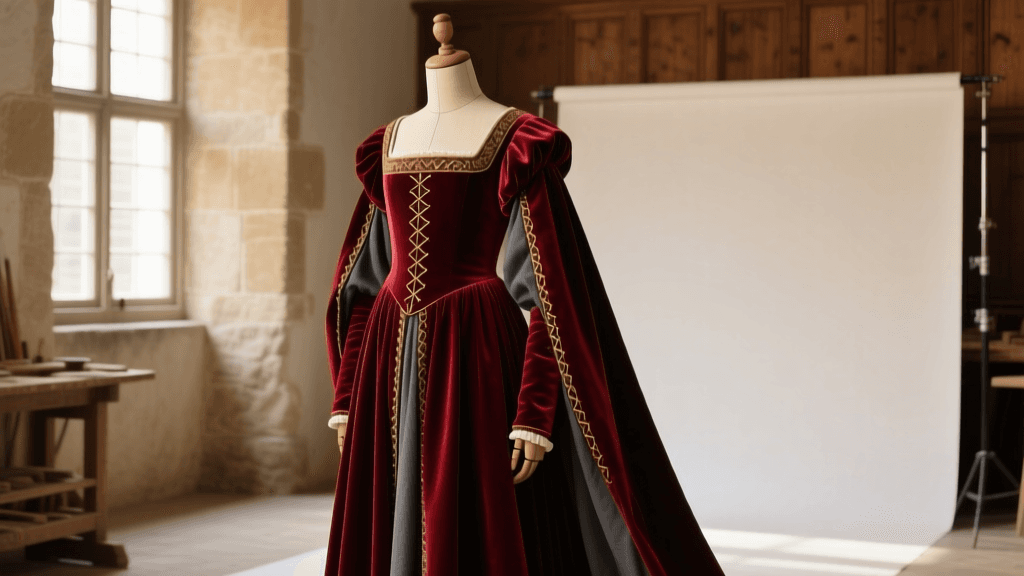
Before purchasing textiles, one must understand the structural demands of the houppelande. Originating in the late 14th century and peaking in the 15th century, this overgown is defined by several key features:
- Floor-Length Cut: Often featuring a trailing hem for nobility, requiring significant yardage.
- High-Waisted Silhouette: Cinched just below the bust or chest with a wide, ornate belt.
- Bombard Sleeves: Massive, bell-shaped sleeves that hang to the floor, heavily lined to maintain their structural bell shape.
- Cartridge Pleating: Deep, tubular pleats gathered at the high waist and collar, requiring a fabric that can hold a stiff, rounded fold without collapsing.
To achieve this, the outer fabric must possess substantial weight and body, while the lining must provide structural support and contrast.
Top Heritage Mills for Authentic Textiles in 2026
Tessitura Luigi Bevilacqua (Venice, Italy)
For the outer shell of a noble's houppelande, nothing surpasss authentic Italian silk velvet. Tessitura Luigi Bevilacqua remains the gold standard in 2026, operating original 18th-century handlooms in Venice to produce velluto tagliato (cut velvet) and velluto liscio (smooth velvet). Their pure silk velvets possess a density and light-absorbing depth that modern power looms simply cannot replicate. In 2026, their custom historical colorways—such as madder-dyed crimson and weld-dyed gold—cost approximately €480 per meter. While expensive, the drape and historical accuracy are unmatched for high-status court reproductions.
Whitchurch Silk Mill (Hampshire, United Kingdom)
A houppelande requires an equally magnificent lining, as the bombard sleeves are constantly turned back to reveal the interior. Whitchurch Silk Mill, still utilizing its 19th-century water-powered looms, produces exceptional silk taffetas and lightweight linens. Their silk taffeta provides the necessary 'crispness' required to support the heavy velvet sleeves without sagging. Priced at around £95 per meter in 2026, their unweighted, pure silk taffetas are ideal for historically accurate linings and the underlying kirtles worn beneath the gown.
Harris Tweed Hebrides (Scotland, United Kingdom)
Not all houppelandes were made of silk; winter variants and garments worn by the wealthy merchant class utilized dense, fulled wools. Harris Tweed Hebrides offers hand-woven, 100% pure virgin wool that perfectly mimics the heavy, felted broadcloths of the 15th century. Their heritage broadcloth equivalents, weighing in at a massive 550g/m², provide the windproof warmth and rigid pleat-holding capabilities required for winter court dress. At £55 per meter, this is a highly accessible option for makers focusing on practical, cold-weather historical accuracy.
2026 Textile Sourcing Comparison Chart
| Heritage Mill | Primary Fabric Type | 2026 Price (per meter) | Best Garment Component | Weight & Drape Profile |
|---|---|---|---|---|
| Tessitura L. Bevilacqua | Pure Silk Velvet | €480 / $520 | Outer Shell (Nobility) | Heavy, fluid, light-absorbing |
| Whitchurch Silk Mill | Silk Taffeta & Linen | £95 / $120 | Sleeve Linings & Kirtles | Crisp, structural, rustling |
| Harris Tweed Hebrides | Fulled Virgin Wool | £55 / $70 | Outer Shell (Winter/Merchant) | Dense, rigid, excellent pleat retention |
| Svensk Hemslöjd | Heritage Linen Canvas | €40 / $43 | Interfacing & Base Layers | Stiff, supportive, breathable |
Modern Construction Techniques for Historical Accuracy
With your heritage textiles sourced, the construction phase in 2026 blends historical hand-sewing techniques with modern precision tools. The most critical element of the houppelande is the cartridge pleating at the waist and collar.
Laser-Cut Pleating Templates
Historically, makers would spend dozens of hours marking and stitching uniform gathering threads. In 2026, historical tailors utilize laser-cut acrylic templates to mark the exact 3mm spacing required for deep cartridge pleats. This ensures that when the heavy silk velvet or wool is gathered onto the waistband, the tubular folds remain perfectly uniform, creating the iconic 'organ pipe' effect seen in 15th-century tapestries.
Structural Bag-Lining
To prevent the heavy Bevilacqua velvet from dragging down the delicate Whitchurch silk taffeta lining, modern historical dressmakers employ a 'compartmentalized bag-lining' technique. Instead of sewing the lining and outer shell as one flat piece, the sleeves and bodice are lined in separate, floating compartments. This allows the crisp taffeta to act as an internal corset for the sleeve bell, maintaining the bombard shape even when the wearer's arms are in motion.
Thread and Notions
Synthetic polyester threads are strictly forbidden in museum-grade 2026 reproductions. Makers must use 100% silk thread (such as Güttermann Silk) for sewing the velvet, as it possesses the necessary tensile strength and historical sheen. For the heavy wool variants, heavily waxed linen thread is required to prevent the fibers from sawing through the fulled wool over time.
Budgeting for a Museum-Quality Replica in 2026
Creating a historically accurate Burgundian houppelande is a significant financial investment. Based on 2026 market rates for heritage textiles and artisanal notions, here is a realistic budget breakdown for a full-length, silk-velvet noble's gown:
- Outer Silk Velvet (8 meters): $4,160
- Silk Taffeta Lining (10 meters): $1,200
- Linen Canvas Interfacing (4 meters): $172
- Silk Thread & Linen Gathering Thread: $150
- Artisanal Bronze Belt Buckle & Aglets: $350
- Total Estimated Material Cost: $6,032
For makers on a stricter budget, substituting the Italian silk velvet for a high-quality cotton/viscose velvet blend from specialized theatrical mills can reduce the outer shell cost to approximately $600, though this sacrifices the historical light-refraction and pure fiber accuracy demanded by top-tier European heritage festivals.
Natural Dyeing and Color Fastness
The 2026 revival of natural dyeing has perfectly complemented the heritage textile movement. The vibrant, jewel-toned colors of the Burgundian court were achieved through expensive imported dyes. Today, master dyers utilize aluminum acetate mordants alongside traditional madder root (for deep crimsons) and weld (for brilliant yellows). Unlike the historical use of simple alum, modern mordanting techniques ensure that these natural dyes are completely colorfast, allowing the heavy velvets and wools to be gently dry-cleaned or professionally wet-cleaned without fear of the colors bleeding or fading under modern exhibition lighting.
Conclusion
The pursuit of the perfect 15th-century houppelande in 2026 is a testament to the enduring fascination with European folk and court dress. By partnering with heritage mills like Tessitura Luigi Bevilacqua and Whitchurch Silk Mill, modern makers are not merely sewing costumes; they are actively preserving centuries-old textile traditions. Whether you are constructing a heavy wool merchant's gown for a winter heritage festival or a sweeping silk velvet court gown for museum exhibition, the foundation of your success lies in the uncompromising quality of your raw materials.