Chiton & Stola Construction Guide for 2026 Historical Reenactors
The Renaissance of Classical Antiquity Dress in 2026
The year 2026 has seen a massive resurgence in historical reenactment, with classical antiquity festivals across Europe and North America demanding higher standards of authenticity than ever before. Gone are the days when a simple bedsheet wrapped around the waist was acceptable for portraying ancient Greeks or Romans. Today, enthusiasts, theater costumers, and living historians prioritize accurate textile weights, precise draping mechanics, and historically grounded accessories. Whether you are preparing for the Athens Hellenic Festival this summer or a Roman legionary muster in the UK, understanding the architectural nuances of the Greek chiton and the Roman stola is essential.
This comprehensive guide breaks down the construction, fabric sourcing, and draping techniques required to recreate ancient Mediterranean garments. According to the World History Encyclopedia on Greek Dress, ancient clothing was rarely cut or sewn; instead, it was an art form based entirely on the geometry of the loom and the skill of the draper. Let us explore how to translate these ancient techniques into modern, wearable accuracy.
Understanding the Greek Chiton: Doric vs. Ionic
The chiton was the foundational garment for both men and women in ancient Greece. However, it was not a single, uniform design. The two primary variations—the Doric and the Ionic—require entirely different fabric dimensions and pinning strategies.
The Doric Chiton (Peplos)
The Doric chiton, often referred to as a peplos when worn by women, is the older and heavier of the two styles. It is traditionally made from a single rectangular piece of woolen fabric. The defining feature of the Doric chiton is the apoptygma, an overfold at the top of the garment that drapes down over the chest and back. To construct a historically accurate Doric chiton in 2026, you must calculate your fabric dimensions based on your body measurements rather than using standard modern yardage.
- Width: Measure your arm span from elbow to elbow, then add 12 inches for the side overlap.
- Height: Measure from your shoulder to the floor, then add 12 to 15 inches to allow for the apoptygma (overfold) and the kolpos (the bloused pouch created by the belt).
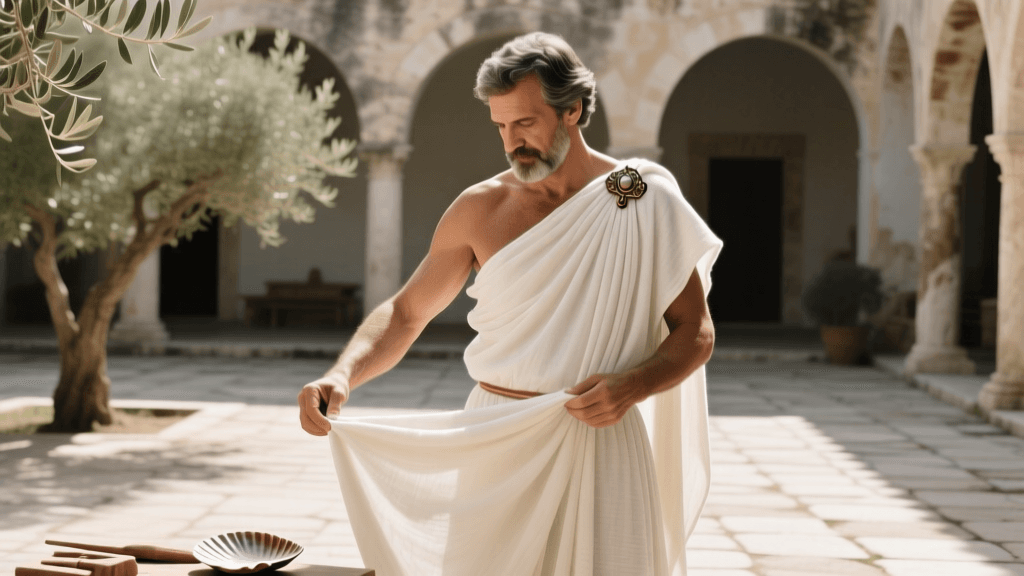
The garment is folded in half vertically, sewn or pinned up the side, and then fastened at the shoulders using fibulae (ancient brooches). The heavy weight of historically accurate wool is crucial here, as it provides the necessary tension to keep the overfold in place without modern tailoring.
The Ionic Chiton
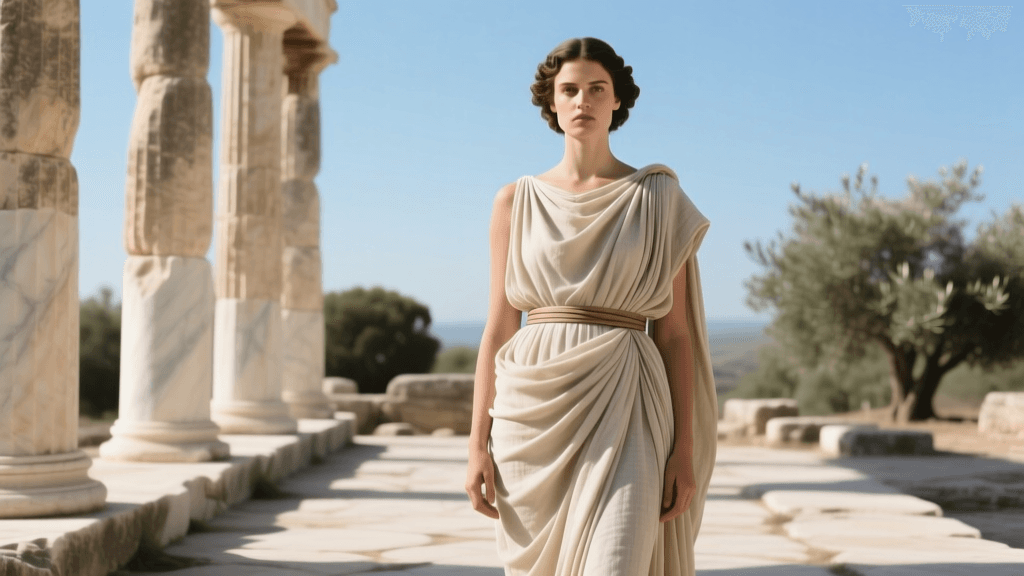
In contrast, the Ionic chiton is made from much lighter, wider fabric, typically linen. It lacks the apoptygma and instead relies on multiple pins or small stitches along the upper arms to create voluminous, flowing sleeves. According to the World History Encyclopedia on Roman Clothing, the influence of lighter eastern Mediterranean textiles eventually made the Ionic style popular across the broader Hellenistic world. For a modern reenactor, the Ionic chiton requires a fabric width that is at least twice the distance between your outstretched wrists, allowing for the deep, elegant folds that characterize the style.
The Roman Stola and Toga: Engineering the Drape
While Greek dress focused on vertical draping and geometric simplicity, Roman dress was highly codified, serving as a visual indicator of citizenship, gender, and social status.
The Stola and Tunica
For Roman women, the tunica was the base layer, but the stola was the ultimate symbol of the respectable matron. The stola was a long, sleeveless overdress suspended from the shoulders by small straps called anadesmalia. In 2026, accurate reconstruction of the stola requires attention to the instita, a contrasting colored border or flounce at the hem that denoted the wearer's status. When sourcing materials, look for lightweight linen or fine wool in natural, unbleached tones, reserving deep reds or saffron yellows for the borders.
The Toga: Beyond the Bedsheet Myth
The Roman toga is perhaps the most misunderstood garment in historical costuming. As detailed in the World History Encyclopedia on the Toga, the toga was never a simple semicircle; by the Imperial period, it was a massive, complex ellipse of wool that required a specific draping technique to create the sinus (a deep pouch used to carry items) and the umbo (a decorative fold at the chest). A proper Imperial toga requires roughly 18 to 20 feet of fabric in width and 8 to 10 feet in height. Attempting to drape a standard semicircular sheet will result in a costume that looks sloppy and historically inaccurate. The weight of the wool must be substantial enough to hold the umbo in place through friction and gravity alone.
2026 Fabric Sourcing and Material Comparison
Selecting the right textile is the single most important decision you will make for your classical garment. The modern textile market in 2026 offers a variety of options, but not all are suitable for historical draping. Below is a comparison chart to help you choose the best material for your specific garment and climate.
| Fabric Type | Historical Accuracy | Drape Quality | Breathability | 2026 Avg Cost/Yard |
|---|---|---|---|---|
| 100% European Linen | High (Ionic/Roman) | Excellent | Very High | $22 - $35 |
| Lightweight Wool Flannel | High (Doric/Toga) | Superior | Moderate | $28 - $45 |
| Cotton-Linen Blend | Low (Modern Sub) | Good | High | $12 - $18 |
| Raw Silk | Moderate (Elite) | Excellent | Low | $40 - $65 |
For the highest level of authenticity, avoid cotton entirely. Cotton was virtually unknown in ancient Greece and Rome. Instead, invest in European-grown flax linen or lightweight merino wool, which mimic the hand-woven textiles of antiquity far better than modern synthetic blends.
Essential Accessories: Fibulae, Belts, and Footwear
A chiton or stola is incomplete without the hardware and accessories that hold it together. In 2026, advancements in lost-wax casting and 3D modeling have made museum-quality replicas accessible to the public.
- Fibulae (Brooches): Do not use modern safety pins. Invest in cast bronze or iron fibulae. The petasos and bow fibulae are excellent choices for Greek and early Roman garments. Ensure the pin mechanism is tight, as the weight of wool can pull weak pins open.
- Cinctus (Belting): Greek chitons are belted high under the bust or at the natural waist using simple woven wool cords or thin leather straps. The belt is hidden beneath the kolpos (the bloused fabric), creating the illusion of a tailored waist.
- Footwear: Complete your ensemble with krepides (strappy leather sandals that wrap up the calf) for Greek impressions, or calcei (enclosed leather shoes) for Roman patrician impressions. Avoid modern gladiator sandals with rubber soles; seek out bespoke leatherworkers who use vegetable-tanned leather and hand-stitching.
Step-by-Step Draping Guide for Modern Reenactors
Pinning the Doric Chiton
- Lay your rectangular wool fabric flat. Fold the top edge down by 12 inches to create the apoptygma.
- Wrap the fabric around your body, ensuring the fold sits at the top and the open edge falls on your left side.
- Pull the front and back layers together over your left shoulder. Fasten them with a bronze fibula, catching both the overfold and the main body of the fabric.
- Repeat the pinning process on the right shoulder, leaving enough space for your head and neck.
- Tie a woven wool cord around your waist. Pull the fabric above the belt up and over the cord to create the kolpos, adjusting the hem so it falls evenly at your ankles.
Draping the Toga with a Perfect Umbo
- Begin with your elliptical wool toga. Drape one end over your left shoulder, letting it fall to the floor in front of your feet.
- Wrap the bulk of the fabric around your back, under your right arm, and across your chest.
- Throw the remaining fabric over your left shoulder again. The fabric should cascade down your back, reaching your calves.
- Adjust the folds across your chest to create the umbo, a dense, structured knot of fabric that acts as a counterweight to keep the heavy wool from slipping off your shoulder.
- Allow the sinus (the lower drape) to hang loosely across your thighs, deep enough to serve as a functional pouch.
Conclusion
Recreating the garments of ancient Greece and Rome is a rewarding exercise in textile engineering and historical empathy. By abandoning modern tailoring conventions and embracing the geometric purity of the loom, you can achieve a level of authenticity that honors the classical world. Whether you are pinning a heavy wool Doric chiton or engineering the complex folds of an Imperial toga, the key to success in 2026 lies in respecting the materials, mastering the drape, and understanding the cultural significance of every fold and border.