2026 Guide to Sourcing Authentic Broadcloth for Medieval Cotehardies
The Renaissance of Medieval Tailoring in 2026
As we navigate the historical costuming and European folk dress landscape in 2026, there has been a definitive shift away from synthetic, mass-produced festival wear toward museum-quality, historically grounded garments. Reenactors, living historians, and textile enthusiasts are increasingly demanding hyper-authentic materials that mirror the drape, weight, and tactile experience of the Middle Ages. Nowhere is this more evident than in the recreation of the 14th-century cotehardie, a garment that revolutionized European fashion by introducing the fitted silhouette. Sourcing the correct textiles is the single most critical step in this process, and the 2026 market for heritage woolens and historically processed linens offers both incredible opportunities and unique challenges for the modern tailor.
Understanding the 14th-Century Cotehardie
Before purchasing yardage, it is essential to understand the structural demands of the cotehardie. Emerging in the mid-14th century, this garment transitioned European dress from the loose, draped tunics of the early medieval period to sharply tailored, body-hugging silhouettes. According to the extensive archival research on English Heritage, this tailoring revolution was made possible by two main factors: the invention of the set-in sleeve and the widespread use of curved seams and functional buttoning. The cotehardie was designed to be worn tightly fitted through the torso and arms, flaring out into a voluminous skirt via the strategic insertion of triangular gores. Because the garment relies entirely on the fabric's structural integrity to support the body and maintain its shape without modern interfacing or synthetic boning, the choice of wool is paramount. A flimsy, modern suit-weight wool will collapse and wrinkle, whereas a properly fulled historical broadcloth will mold to the body and hold the dramatic flare of the skirt.
The Anatomy of Historical Broadcloth
The term 'broadcloth' in a modern fabric store usually refers to a lightweight, plain-woven cotton or poly-blend shirting. However, in the context of medieval European folk dress, broadcloth refers to a highly specific, labor-intensive woolen textile. Historically, broadcloth was woven on wide looms using coarse, greasy wool yarns. The magic happened after the weaving process: the fabric was subjected to 'fulling' or 'milling,' a process of soaking the cloth in an alkaline solution (often stale urine or fuller's earth) and agitating it. This caused the wool fibers to shrink, mat, and felt together, resulting in a dense, weather-resistant, and incredibly durable fabric that did not fray when cut. In 2026, finding true fulled wool broadcloth requires looking beyond mainstream textile suppliers and turning to specialized heritage mills that have revived these traditional finishing techniques.
2026 Sourcing Guide for Heritage Woolens
The current year has seen a remarkable resurgence in small-batch, heritage weaving operations across the British Isles and Scandinavia, driven by the demands of the high-end historical reenactment community. When sourcing wool for a cotehardie, you must look for fabrics woven from long-staple fleece, such as Wensleydale, Cheviot, or Romney, which provide the necessary luster and strength. The weave should be a dense 2/2 twill or a heavily beaten tabby, subjected to a modern mechanical fulling process that replicates the historical wet-finishing.
Top Mill Recommendations for 2026
- Welsh Heritage Weavers: Mills operating in the Welsh valleys continue to produce heavy, fulled twills that are perfect for outerwear cotehardies. Their use of local, undyed fleeces provides an excellent base for custom botanical dyeing.
- Scottish Estate Tweeds and Woolens: While often associated with later periods, several Scottish mills now offer 'medieval finish' woolens that are heavily milled and brushed, providing the exact felt-like edge stability required for 14th-century tailoring.
- Eastern European Woolen Mills: For those on a stricter budget, mills in Poland and Romania have begun exporting heavily fulled, 100% virgin wool broadcloths that offer exceptional density and drape at a more accessible price point than their British counterparts.
Fabric Weight and Drape Comparison
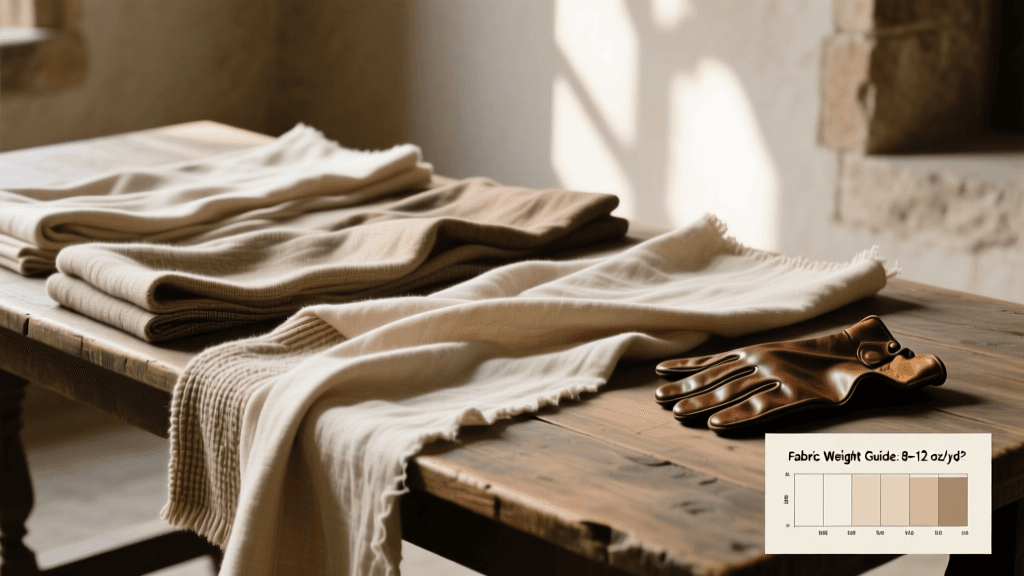
Selecting the correct weight is crucial. A cotehardie requires a fabric heavy enough to swing and flare, but pliable enough to be gathered and fitted. Below is a guide to help you choose the right textile for your specific historical impression.
| Fabric Type | Weight (oz/yd) | Drape Quality | Best Historical Use |
|---|---|---|---|
| Lightweight Fulled Twill | 10 - 12 oz | Fluid, soft drape | Summer kirtles, lined cotehardies, women's fitted gowns |
| Medium Broadcloth | 14 - 16 oz | Structured, excellent swing | Standard unisex cotehardies, everyday 14th-century wear |
| Heavy Melton/Broadcloth | 18 - 22 oz | Stiff, sculptural, heavy | Winter outerwear, male martial cotehardies, houppelandes |
| Beaver/Felted Wool | 24+ oz | Rigid, minimal drape | Hoods, chaperons, heavy cloaks (not recommended for fitted bodices) |
Linen: The Unsung Hero of Medieval Layering
While the wool cotehardie is the star of the ensemble, the undergarments and linings are what make the garment wearable and historically accurate. The 14th-century wardrobe relied heavily on linen for shifts, braies, coifs, and the crucial inner lining of the cotehardie itself. In 2026, the push for sustainable, regenerative agriculture has greatly improved the availability of high-quality, long-staple flax linen. When sourcing linen for medieval garments, avoid the slubby, uneven 'craft store' linens that are often blended with cotton or rayon. Instead, seek out 'line linen,' which is woven from the longest, smoothest flax fibers, resulting in a strong, lustrous, and historically appropriate textile. For lining a heavy wool cotehardie, a medium-weight (5 to 7 oz) tabby-weave linen is ideal, as it provides a smooth barrier against the skin and adds structural support to the wool shell.
Botanical Dyes and Color Fastness in 2026
The visual impact of a cotehardie is deeply tied to its color. As detailed by the textile archives at The Metropolitan Museum of Art, the medieval palette was rich and varied, dictated by the availability of local flora and expensive imported dyestuffs. In 2026, the historical costuming community has largely moved away from harsh, synthetic aniline dyes in favor of authentic botanical dyeing. If you are commissioning a dyer or purchasing pre-dyed broadcloth, look for colors achieved through traditional mordanting and dye baths. Madder root yields the iconic brick reds and deep russets; weld and dyer's broom provide vibrant yellows; and woad or indigo creates the spectrum of blues. A true historical broadcloth dyed with madder and alum will possess a depth and complexity of color that modern synthetic dyes simply cannot replicate, shifting subtly in different lighting conditions and aging beautifully over years of wear.
Tailoring Techniques for the Fitted Silhouette
Once you have sourced your authentic broadcloth and linen, the construction process requires specific techniques to maximize the fabric's historical properties. Because properly fulled broadcloth does not fray, medieval tailors did not need to hem or overcast their raw edges in the same way modern sewists do. Instead, seams were often left raw on the inside or finished with a simple running stitch and flat-felled technique to reduce bulk. When fitting the cotehardie, flat pattern drafting is often insufficient to capture the complex curves of the human body. The most historically accurate method, and the one yielding the best results in 2026, is draping directly on the body or a custom dress form. Pinning the muslin mock-up, and subsequently the wool, directly to the wearer allows the tailor to manipulate the bias and straight grain, ensuring the fabric molds perfectly to the bust, waist, and hips without the need for modern darts.
The Importance of Functional Buttoning
The cotehardie's tight fit was made possible by the widespread adoption of the button. Unlike modern decorative buttons, 14th-century buttons were functional, tightly spaced, and often made from the same fabric as the garment. Cloth buttons, created by gathering small circles of wool or linen into tight spheres and securing them with a cross-stitch, are the gold standard for historical accuracy. They must be spaced closely together—often no more than an inch apart—from the wrist to the elbow and from the neckline to the hip. This dense line of buttons not only secures the garment but acts as a structural reinforcement, preventing the tight wool from stretching out or tearing at the stress points.
Conclusion: Building a Sustainable Historical Wardrobe
Creating an authentic 14th-century cotehardie in 2026 is an investment in both history and sustainable craftsmanship. By bypassing fast-fashion textiles and supporting heritage mills, traditional dyers, and regenerative flax farmers, you are participating in a living tradition that honors the ingenuity of medieval European textile workers. The resulting garment will not only provide a profoundly accurate silhouette for your historical interpretations but will also be a durable, heirloom-quality piece of European folk dress capable of withstanding decades of wear, weather, and historical exploration.