Song Brocade Drawloom Weaving Guide 2026: Artisan Revival
The Enduring Legacy of the Song Brocade Drawloom
In 2026, the global fascination with the Xin Zhongshi (new Chinese style) movement has catalyzed an unprecedented revival of ancient textile crafts. At the heart of this renaissance is the Song Brocade, or Songjin, a luxurious fabric originating from the Song Dynasty (960–1279 CE). Renowned for its intricate geometric patterns, subdued elegance, and structural durability, Song Brocade is experiencing a massive surge in demand among contemporary fashion houses and independent artisans. However, producing authentic Songjin requires mastering the traditional Chinese drawloom, known as the Hua Lou (花楼). This comprehensive guide explores the mechanics, setup, and weaving techniques of the Song brocade drawloom for modern artisan studios in 2026.
The complexity of this ancient technology is a testament to early Chinese engineering. Recognizing its profound cultural significance, the UNESCO Intangible Cultural Heritage list includes Chinese sericulture and silk craftsmanship, underscoring the global imperative to preserve these intricate weaving methodologies. Today, a new generation of weavers is bridging the gap between historical preservation and modern wearable art.
Anatomy of the Traditional Drawloom (Hua Lou)
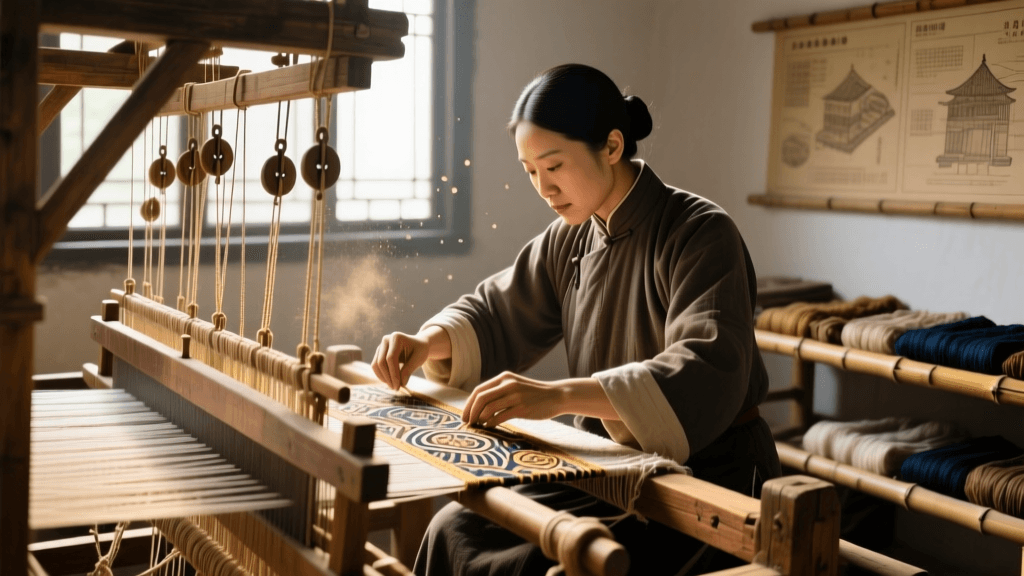
The traditional drawloom is a massive, multi-tiered wooden structure designed to manage thousands of warp threads simultaneously. Unlike standard floor looms, the drawloom requires a specialized harness system to create the complex, repeating motifs characteristic of Song Brocade. A standard artisan replica loom built in 2026 typically measures 280 cm in length, 150 cm in width, and stands 220 cm tall to accommodate the overhead pattern harness.
Key Components and Measurements
- The Flower Tower (Hua Ben): The elevated platform at the top of the loom where the pattern harness is stored. It houses the "memory" of the design, utilizing a system of knotted cords that correspond to individual warp threads.
- Warp Beam and Cloth Beam: Crafted from dense camphor or elm wood, these beams must withstand immense tension. The warp beam typically holds up to 12,000 individual silk ends for a standard 75 cm fabric width.
- Quills and Shuttles: Song Brocade utilizes multiple weft colors. Artisans use lightweight bamboo shuttles, measuring roughly 35 cm in length, to carry the bobbin threads through the shed.
- The Reed (Kou): A finely spaced bamboo or metal comb used to beat the weft into place. For high-density Songjin, a 60-dent reed is standard, yielding approximately 80 warp ends per centimeter.
2026 Artisan Studio Setup: Sourcing and Calibration
Setting up a drawloom studio in 2026 requires balancing historical authenticity with modern environmental controls. Silk is highly hygroscopic; therefore, maintaining the correct studio climate is non-negotiable. The ambient relative humidity (RH) must be kept strictly between 55% and 65%, with a temperature of 20°C to 24°C. If the air is too dry, the silk warp threads will snap under tension; if too humid, the threads will stick together, ruining the shed.
Comparison: Traditional Wood vs. 2026 Hybrid Studio Looms
While purists advocate for entirely hand-carved wooden looms, many 2026 studios have adopted hybrid models to streamline the warp preparation process without compromising the hand-woven quality of the final textile.
| Feature | Traditional Camphor Wood Loom | 2026 Hybrid CNC-Assisted Loom |
|---|---|---|
| Frame Material | 100% aged camphor or elm wood | Wood frame with aerospace-grade aluminum joints |
| Pattern Harness | Hand-tied cotton/linen cords | Laser-cut synthetic cordage for zero-stretch memory |
| Warp Tensioning | Manual wooden ratchet and pawl | Calibrated micro-tension ratchets (measured in grams) |
| Heddle Eyes | Hand-twisted silk or cotton loops | Polished stainless steel micro-heddles |
| Setup Time | 3 to 4 weeks for warp dressing | 7 to 10 days with digital warp-mapping assistance |
Step-by-Step Weaving Technique: The "Tiao Hua" Process
Weaving Song Brocade on a drawloom is inherently a two-person operation. The master weaver sits at the front of the loom, managing the shuttles and the reed, while the "draw assistant" (historically called the drawboy or drawgirl) sits atop the Flower Tower, manipulating the pattern harness.
1. Pattern Drawing (Tiao Hua)
The assistant reads the design sequence and pulls the specific bundle of pattern cords that correspond to the required warp threads. This action lifts the designated warp threads, creating the "pattern shed." In 2026, some studios use digital projection mapping to illuminate the exact cords the assistant needs to pull, reducing human error in complex 40-shaft geometric drafts.
2. Ground Shed Formation
Simultaneously, the master weaver uses the foot treadles to lift the ground heddles. This creates a secondary shed for the foundation weave, typically a warp-faced or weft-faced twill that forms the structural backbone of the brocade.
3. Shuttle Throwing and Weft Insertion
The weaver throws the shuttle carrying the ground weft thread through the combined shed. For the pattern weft, a separate, thicker, and often multicolored silk thread is inserted using a specialized brocading shuttle. The weaver must carefully interlock the pattern weft with the ground weave to ensure the motif sits flush against the fabric surface.
4. Beating the Reed (Da Wei)
Using the overhead beater, the weaver pulls the heavy wooden frame forward to pack the weft threads tightly against the fell of the cloth. For Song Brocade, the beating force must be precisely calibrated—approximately 18 grams of tension per warp thread. Too much force will distort the geometric patterns; too little will result in a flimsy, unstable fabric.
Material Selection for Modern Xin Zhongshi Garments
The contemporary Xin Zhongshi movement demands fabrics that drape beautifully while retaining structural integrity. According to insights from the Victoria and Albert Museum's Chinese Textiles collection, historical Song Brocade was prized for its mat-like finish and lack of excessive sheen, distinguishing it from the highly reflective cloud brocades (Yunjin) of the later Ming and Qing dynasties.
For 2026 garment production, artisans are selecting specific silk weights to optimize drape and durability:
- Warp Threads: 22-momme, tightly twisted mulberry silk (Z-twist). The high twist provides the necessary tensile strength to withstand the drawloom's tension while giving the final garment a crisp, structured hand-feel.
- Ground Weft: 16-momme, lightly twisted mulberry silk. This creates a dense, stable foundation.
- Pattern Weft: Untwisted, lustrous silk floss or metallic threads (such as modern tarnish-resistant silver-coated copper wire) to make the geometric motifs pop against the matte ground.
Loom Maintenance and Preservation
A wooden drawloom is a living piece of equipment that expands and contracts with the seasons. Proper maintenance is critical to ensuring the longevity of both the loom and the textiles it produces. The Metropolitan Museum of Art's Heilbrunn Timeline of Art History notes that the survival of ancient silk textiles is deeply tied to the environmental conditions of their creation and storage; the same principle applies to the wooden machinery used to create them.
Actionable Maintenance Checklist for 2026 Studios
- Monthly Oiling: Apply cold-pressed camellia oil to all wooden moving parts, especially the ratchets, pawls, and treadle hinges. Avoid synthetic lubricants, which can attract dust and degrade the wood fibers over time.
- Quarterly Cord Inspection: Inspect the pattern harness cords for fraying. In high-friction areas, replace cotton cords with modern waxed linen or synthetic equivalents to prevent mid-weave snapping.
- Reed Cleaning: After every 10 meters of woven cloth, remove the bamboo or metal reed and clean it with a soft brush and compressed air to remove silk lint and sizing residue.
- Tension Release: When the studio is closed for extended periods, release the tension on the warp beam to prevent the wooden beam from warping and to preserve the elasticity of the silk warp threads.
Conclusion: The Future of Ancient Mechanics
The revival of the Song brocade drawloom in 2026 is more than a nostalgic pursuit; it is a vital continuation of a highly sophisticated technological lineage. By understanding the intricate anatomy of the Hua Lou, mastering the two-person weaving choreography, and adapting studio environments to support these ancient machines, modern artisans are ensuring that the subtle elegance of Songjin continues to grace contemporary fashion. As the Xin Zhongshi movement evolves, the rhythmic clatter of the wooden drawloom remains the authentic heartbeat of Chinese textile heritage.