Mastering Kimono Tanmono Zero-Waste Cutting in 2026
The global fashion industry in 2026 is under unprecedented pressure to eliminate textile waste, with new international sustainability mandates forcing designers to rethink pattern drafting. Yet, long before the modern zero-waste movement gained traction, traditional Japanese garment construction had already perfected the art of waste-free tailoring. At the heart of this enduring tradition is the Tanmono, a standardized bolt of fabric that serves as the foundation for the iconic Japanese kimono. By understanding and applying the geometric precision of Tanmono cutting, modern sewists and designers can create garments that are not only culturally resonant but also entirely sustainable.
The Philosophy of Tanmono: Zero-Waste Before It Was a Trend
Unlike Western pattern drafting, which relies on curved armholes, shaped darts, and complex grading that inevitably leaves behind 15% to 20% in fabric offcuts, the traditional kimono is constructed entirely from straight, rectangular panels. According to The Metropolitan Museum of Art's Heilbrunn Timeline of Art History, the kimono's T-shaped, straight-line construction evolved to maximize the use of hand-woven silk while allowing the garment to be easily disassembled, cleaned, and resewn. In 2026, as the Ellen MacArthur Foundation's circular fashion overview highlights the urgent need for modular and recyclable clothing, the kimono's reversible and zero-waste architecture offers a masterclass in sustainable engineering.
Standard Tanmono Measurements and Fabric Requirements
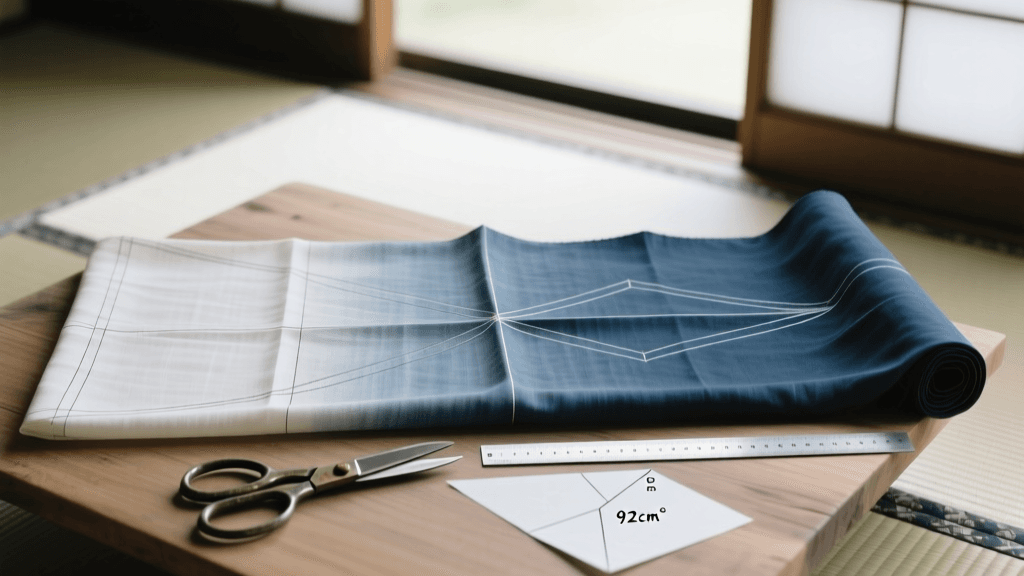
A standard bolt of kimono fabric, known as a Tanmono, is woven to highly specific dimensions. Historically dictated by the width of the traditional loom and the method of wrapping the garment around the body, a single bolt measures approximately 38 centimeters (about 15 inches) in width and 12 meters (about 13.1 yards) in length. This exact yield is designed to produce one complete adult kimono with absolutely zero fabric left over. The narrow width means that the fabric is never cut to shape the body; instead, it is folded and wrapped, with excess width folded inward at the side seams to allow for future alterations or resizing.
The Zero-Waste Cutting Layout (Tansu)
The cutting layout of a kimono is a triumph of geometric efficiency. The 12-meter bolt is divided into eight primary rectangular panels and a collar. Because there are no curved cuts, every single centimeter of the woven silk is utilized in the final garment or hidden within the generous seam allowances. Below is the standard breakdown of panels required for a basic women's kimono.
| Panel Component | Japanese Term | Quantity | Standard Dimensions (cm) |
|---|---|---|---|
| Main Body Panels | Migoro | 2 | 38 x 1200 |
| Sleeve Panels | Sode | 2 | 38 x 1000 |
| Front Overlap Panels | Okumi | 2 | 19 x 1000 |
| Neckband / Collar | Eri | 1 | 11 x 1100 |
Notice that the front overlap panels (Okumi) are exactly half the width of the main body panels. This is achieved by cutting one 38cm wide strip down the center, yielding two perfectly symmetrical 19cm panels without destroying any woven edges (selvedges). The selvedges are left entirely intact and are often visible on the inside of the garment, serving as a natural, fray-proof finish that eliminates the need for modern overlocking or serging.
Step-by-Step Kimono Construction Techniques
Marking and Basting (Shitsuke)
Before any permanent stitching occurs, the panels must be marked and basted. In 2026, while laser-guided cutting tables are available in high-end Kyoto ateliers, traditional hand-basting remains the gold standard for silk chirimen (crepe). Using a fine, contrasting silk thread, sewists apply long, loose running stitches to hold the panels together. This step is non-negotiable; the slippery nature of woven silk will shift under a presser foot, leading to misaligned patterns and puckered seams if basting is skipped.
Sewing the Main Seams (Waki and Honbuse)
The side seams (Waki-nui) and the center-back seam (Se-roi) are sewn using a straight running stitch if done by hand, or a standard 2.5mm straight stitch on a modern machine. The true genius of the kimono lies in its seam allowances. Unlike Western garments that trim allowances to 1.5cm, the kimono side seams fold up to 15cm of excess fabric inward. This massive internal allowance acts as a structural weight, helping the garment drape beautifully and hang straight. More importantly, it preserves the fabric. If the wearer's body shape changes, or if the garment is passed down to a taller descendant, the deep seams can be let out, extending the garment's lifespan across generations.
The Kuke Blind Hemming Technique
The bottom hem of the kimono is finished using Kuke, a specialized blind-hemming technique. The hem allowance is folded up and secured using a single thread that catches only one or two warp threads of the main fabric. This creates an invisible hem on the outside of the garment. In 2026, mastering the Kuke stitch is a hallmark of a skilled artisan, as it maintains the unbroken visual flow of the textile's dyed or woven motifs.
Troubleshooting Silk Chirimen Tension in 2026 Machines
While traditionalists sew entirely by hand, many modern practitioners use advanced computerized sewing machines to construct the long, straight seams of the kimono. However, feeding delicate silk chirimen through a 2026 machine requires specific adjustments. Use a Microtex needle (size 60/8 or 70/10) to prevent snagging the tightly twisted crepe yarns. Engage your machine's dual-feed or walking foot system to ensure the top and bottom layers of silk feed at the exact same rate. If your machine lacks a built-in dual-feed, a detachable Teflon-coated walking foot is essential to prevent the bias-cut collar and slippery body panels from stretching out of alignment during assembly.
2026 Sourcing: Vintage Bolts and Digital Printing
Sourcing authentic Tanmono bolts has evolved significantly. As documented in the Kyoto Costume Institute Digital Archives, historical textiles are highly prized. Today, upcycling vintage, uncut Tanmono bolts from the Nishijin weaving district is a major trend among sustainable designers. These vintage bolts, often stored in cedar chests for decades, offer pristine, zero-waste canvases. For new production, 2026 digital textile printers now offer custom printing directly onto 38cm wide silk crepe bolts, allowing independent designers to create small-batch, zero-waste kimono collections without the massive minimum order quantities required by traditional Yuzen dye houses.
Care and Deconstruction: The Arai-Hari Method
The ultimate testament to the kimono's sustainable construction is the Arai-Hari (wash and stretch) method. Because the garment is made of straight panels sewn with a single continuous thread type, it can be completely deconstructed back into its original 12-meter bolt. The individual panels are then washed, stretched on wooden frames to restore the silk's tension, and dried flat. Once dry, the panels are re-basted and sewn back together, resulting in a garment that looks and feels brand new. This cyclical maintenance process means a single high-quality silk kimono can easily remain in active rotation for over a century, entirely defying the modern concept of planned obsolescence.
Conclusion
The construction techniques of the Japanese kimono prove that sustainability and luxury are not mutually exclusive. By adopting the Tanmono zero-waste cutting layout, respecting the integrity of the selvedge, and utilizing deep, reversible seam allowances, modern sewists can create garments that honor Asian dress traditions while meeting the stringent ecological demands of 2026. Whether you are hand-stitching a silk crepe masterpiece or adapting the rectangular geometry for a modern linen wrap coat, the principles of the Tanmono offer a timeless blueprint for mindful, waste-free fashion.