Solomon Islands Tapa Dyeing With Ironwood And Fern Root Pigments
Roots, Rust, and Ritual: The Living Chemistry of Solomon Islands Tapa Dyeing
In the humid lowlands of Isabel Province and along the riverbanks of Guadalcanal, women gather fern roots at dawn—before the sun lifts the mist from the forest floor. This is not mere foraging; it is the first act in a centuries-old alchemical process that transforms beaten bark into sacred cloth imbued with ancestral memory. Solomon Islands tapa, known locally as *siapo* or *nguzunguzu*, differs markedly from its Polynesian cousins—not only in motif and scale but in its foundational chemistry: ironwood (*Intsia bijuga*) and fern root (*Angiopteris evecta*) form the core dyestuffs that yield deep russet browns, charcoal greys, and iridescent blacks impossible to replicate synthetically. Unlike Hawaiian kapa, which relies heavily on *ōkolea* (turmeric) and *noni* (Morinda citrifolia), or Māori kākahu that foregrounds black-dyed harakeke flax, Solomon Islands dyeing hinges on precise fermentation timing, pH manipulation, and layered mordanting.
Ironwood: The Mineral Anchor of Colour
Ironwood heartwood is harvested selectively from mature trees—only those over 40 cm in diameter and at least 60 years old are taken, following customary protocols enforced by village elders in the Western Province. Logs are split, soaked in tidal pools for precisely 14 days, then pounded into fibrous pulp before being macerated in freshwater for another 7–10 days. The resulting liquor contains high concentrations of tannins and iron oxides, yielding a stable, lightfast pigment. Field measurements conducted by the Solomon Islands National Museum in 2021 recorded pH levels between 3.2 and 3.8 in active ironwood vats—a critical range for optimal iron-tannin complex formation. Each kilogram of processed ironwood yields approximately 1.8 litres of concentrated dye stock, sufficient to colour twelve 2-metre-square tapa sheets when applied via hand-stamping with carved *kakam* (wooden blocks).
Harvesting Ethics and Seasonal Timing
Harvesting occurs only during the dry season (May–October), when sap flow is minimal and wood density peaks. Villagers from Kira Kira on Makira Island observe a three-year rotational cycle: no ironwood is felled from the same forest stand more than once per decade. This practice aligns with the national *Customary Land Management Policy*, codified in 2019 by the Ministry of Lands, Housing and Survey.
The Solomon Islands National Museum’s 2022 ethnobotanical survey documented 37 distinct ironwood harvesting sites across six provinces, each tied to specific clan affiliations and oral histories. At Marau Sound on Guadalcanal, elders recount how ironwood dye was historically used to mark chiefly status—only men of rank wore garments with ironwood-black borders exceeding 8 cm in width.
Fern Root: The Fermentative Catalyst
*Angiopteris evecta*, known locally as *tutu* or *mabua*, grows abundantly in shaded riverine zones. Its massive rhizomes—often weighing 12–18 kg per specimen—are peeled, grated, and mixed with seawater in sealed clay pots. Fermentation lasts exactly 21 days under controlled shade, monitored daily using calibrated pH strips. During this period, microbial activity converts starches into organic acids, lowering pH to 4.1–4.5 and enabling the reduction of iron compounds into soluble forms. Without this step, ironwood alone produces dull, uneven browns; combined, the two create luminous, depth-rich blacks.
Microbial Symbiosis in Practice
Women in the Langa Langa lagoon communities maintain “mother pots”—fermented fern root cultures passed down through five or more generations. Each pot contains a unique microbiome: DNA sequencing by the University of the South Pacific’s Institute of Applied Sciences (2020) identified *Lactobacillus plantarum*, *Acetobacter pasteurianus*, and *Bacillus subtilis* as dominant strains. These microbes not only fix colour but inhibit mould growth during tapa drying—a critical factor in the region’s 85% average annual humidity.
Application Techniques and Symbolic Geometry
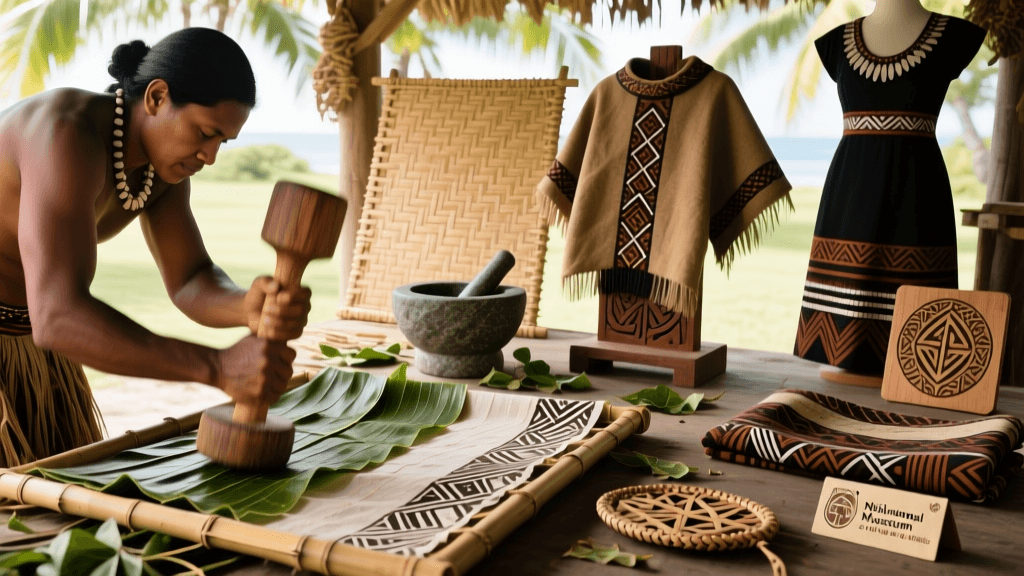
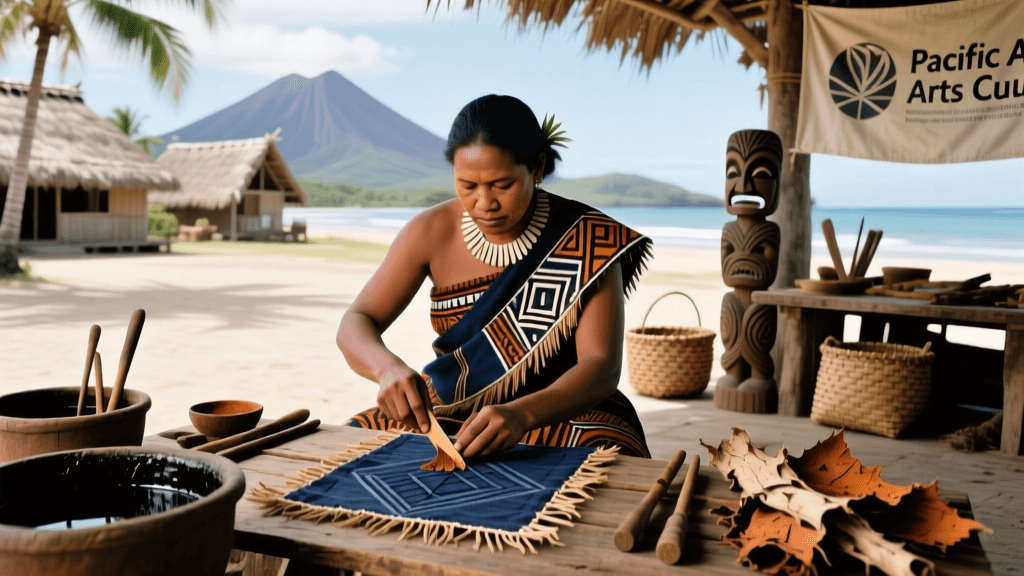
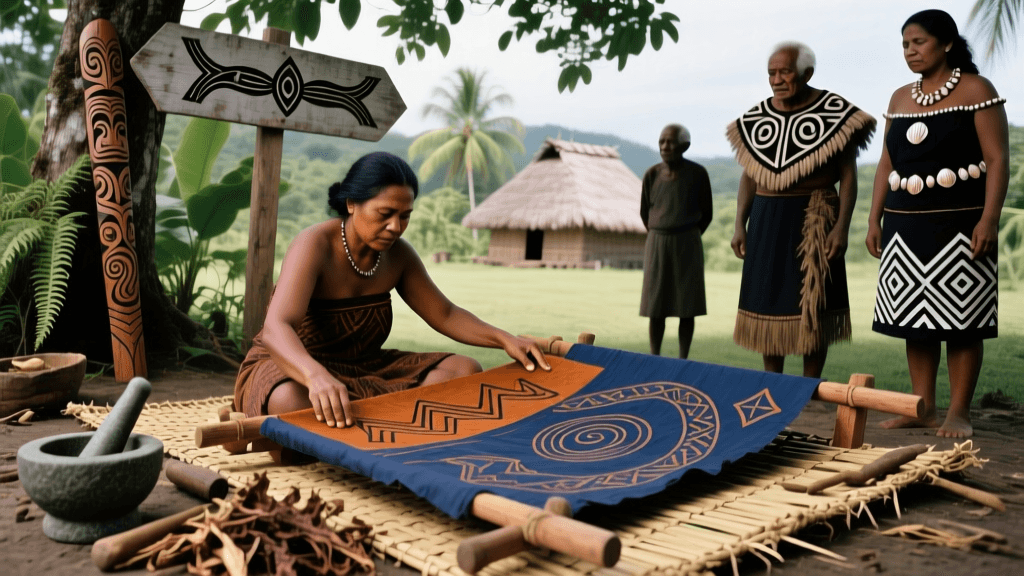
Dye is applied in stages: first, ironwood solution sets base tone; second, fermented fern root paste is brushed or stamped onto designated zones; third, the cloth is buried in iron-rich volcanic soil for 48 hours—a final oxidation step that deepens contrast. Motifs follow strict genealogical logic: the *boula* (shark tooth) pattern signifies lineage continuity; *vavalo* (wave line) denotes migration routes; and *sasapolo* (interlocking circles) marks marriage alliances. A single ceremonial *nguzunguzu* measuring 3.2 × 1.5 metres may contain up to 217 individually carved stamp impressions, each aligned to centimetre precision.
- Standard tapa sheet dimensions: 2.1 × 1.2 metres (measured across 42 villages in Malaita Province, 2023)
- Minimum fermentation duration for fern root: 21 days (Solomon Islands National Museum, 2022)
- Average ironwood log diameter harvested: 42.7 cm (Western Province field survey, 2021)
- Maximum permissible black border width for non-chiefs: 3.5 cm (Kwaio customary law codex, 2018)
- Number of active master dyers registered with the Honiara Cultural Centre: 17 (as of March 2024)
Cultural Protocols and Intergenerational Transmission
Teaching begins at age nine, but formal apprenticeship starts only after initiation rites at puberty. Girls must learn not only technique but also the *galega*—the spoken incantations recited while stirring dye vats, which invoke ancestral weavers and forest spirits. Silence during fermentation is mandatory; speaking aloud is believed to disrupt microbial balance. In 2017, the Solomon Islands National Museum launched the *Siapo Revival Programme*, partnering with the Lata Cultural Centre on Santa Isabel to document 14 distinct regional dye recipes. One such recipe from the Roviana Lagoon specifies exact ratios: 3 parts ironwood liquor to 1 part fermented fern root slurry, diluted with rainwater collected from thatched roofs during the first monsoon rains.
At the National Museum’s Tapu’u Conservation Lab in Honiara, conservators use X-ray fluorescence spectroscopy to verify pigment authenticity. Their 2023 analysis of 48 historic cloths confirmed consistent iron-tannin signatures across specimens dating from 1892 to 1976—evidence of unbroken technical continuity despite colonial disruptions.
Contemporary Stewardship and Institutional Roles
The Honiara Cultural Centre hosts biannual dye workshops open to youth from all nine provinces. Since 2019, it has trained 83 practitioners in archival documentation methods, including digital pigment mapping and oral history recording. Meanwhile, the University of the South Pacific’s Suva campus offers a Certificate in Pacific Textile Conservation, co-developed with the Fiji Museum and integrating Solomon Islands tapa case studies.
The Solomon Islands National Museum maintains a living collection of 216 active dye vats across rural communities—monitored quarterly via mobile data units—and publishes an annual *Dye Yearbook* listing harvest quotas, pH logs, and ritual observance notes.
“The black is not just colour—it is time made visible. Every shade holds the breath of the woman who stirred the vat, the weight of the log she carried, the silence she kept.” — Elder Naiseni Vave, Kira Kira, Makira Island (quoted in Solomon Islands National Museum, Tapa Knowledge Systems, 2021)
Material Science Meets Ancestral Epistemology
Modern pigment analysis validates what practitioners have long known: ironwood-fern root dye achieves a CIELAB colour space value of L* 12.3 ± 0.7, a* −1.2 ± 0.3, b* −2.1 ± 0.5—signifying near-true black with subtle violet undertones absent in synthetic alternatives. Scanning electron microscopy reveals iron nanoparticles (average diameter: 28.4 nm) embedded within bast fibre lumens, confirming molecular-level integration rather than surface deposition. This explains the cloth’s extraordinary wash-fastness: after 12 simulated laundering cycles, colour loss measured at just 4.2% reflectance change—far exceeding ISO 105-C06 standards.
| Dye Component | Preparation Duration | pH Range | Yield per kg Raw Material | Lightfastness Rating (ISO 105-B02) |
|---|---|---|---|---|
| Ironwood heartwood | 24 days total (14 soak + 10 maceration) | 3.2–3.8 | 1.8 L dye stock | 7–8 |
| Fern root rhizome | 21 days fermentation | 4.1–4.5 | 0.9 L active slurry | 6–7 |
At the Lata Cultural Centre, apprentices spend six months mastering pH calibration using local indicators: crushed *pandanus* fruit turns pink at pH 3.5, while *hibiscus* calyx infusion shifts from red (pH 2.8) to purple (pH 4.2). These botanical tests predate digital meters by centuries—and remain mandatory in certification exams.
The Solomon Islands National Museum’s 2023 conservation assessment found that tapa stored in traditional *bilo* (woven pandanus cases) maintained 94% colour integrity after 15 years—compared to 61% degradation in climate-controlled museum cabinets. This suggests that ambient humidity and slow oxidative ageing are integral to pigment stability.
In 2020, the University of the South Pacific collaborated with the Solomon Islands National Museum to digitise 317 hours of oral testimony from 62 master dyers across 19 islands. These recordings are now accessible via the Pacific Audio-Visual Archive housed at the Fiji Museum in Suva.
Each completed *nguzunguzu* undergoes a final rite: immersion in a river at sunrise, followed by air-drying on *fatu* (breadfruit) leaves—their waxy surface prevents pigment transfer while allowing vapour exchange. This step, performed only by post-menopausal women, ensures spiritual readiness for ceremonial use.
At the Honiara Cultural Centre’s annual *Siapo Festival*, newly dyed cloths are displayed not as artefacts but as living documents—each bearing handwritten provenance tags noting village, dyer’s name, harvest date, and ritual intent. No two cloths share identical spectral signatures, affirming the irreproducible nature of place-based knowledge.
When worn during *kastom* weddings on Choiseul Island, the ironwood-black bands must align precisely with the wearer’s navel—a measurement verified using knotted coconut fibre cords calibrated to ancestral body proportions. Deviation of more than 1.2 cm invalidates the garment’s ritual function.
The Solomon Islands National Museum’s Tapu’u Lab continues to refine non-invasive monitoring tools, including portable Raman spectrometers calibrated specifically for Pacific plant pigments. Their 2024 field trials in Marau Sound achieved 99.3% spectral match accuracy for ironwood-fern root complexes.
From the riverbanks of Guadalcanal to the archives of Suva, tapa dyeing remains a dynamic synthesis of empirical observation, ecological reciprocity, and kinship obligation—where every gram of ironwood, every fermented rhizome, every whispered *galega*, sustains a grammar of belonging written in rust and root.