Fijian Tapa Beating Plant Fiber Prep And Bark Cloth Smoothing Technique
From Tree to Textile: The Botanical Foundations of Tapa in Fiji
Fijian tapa, known locally as masi, begins not with looms or needles but with the careful selection and harvesting of specific trees. The primary source is the paper mulberry (Broussonetia papyrifera), introduced to Fiji over 1,500 years ago via Austronesian voyagers. Secondary sources include the breadfruit tree (Artocarpus altilis) and the wild fig (Ficus tinctoria), though mulberry remains preferred for its long, flexible inner bark fibers. Harvesting occurs during the wet season—typically between November and March—when sap flow is highest and bark peels most readily. Trees are selected at a minimum height of 2.5 meters and diameter of 8–10 cm to ensure mature, uniform fiber development. Cuttings are taken from young, straight stems no older than 18 months, as older wood yields brittle, uneven strips.
The stripping process follows strict seasonal timing: bark is removed in early morning when humidity stabilizes fiber elasticity. Each harvested stem yields approximately 1.2 meters of usable bast layer after outer bark removal. According to field documentation by the Fiji Museum (2019), a single mature mulberry tree produces enough bark for three to four standard tapa sheets measuring 1.8 m × 2.4 m each—a unit historically termed a tabua when used ceremonially.
Preparing the Fiber: Soaking, Scraping, and Fermentation
Water Immersion Protocols
Stripped bark is submerged in freshwater streams for 7–10 days, a period calibrated to local water temperature and microbial activity. In the Sigatoka Valley, where water averages 22°C year-round, fermentation peaks at day eight; in cooler highland tributaries near Navatusila, it extends to eleven days. During immersion, natural enzymes break down lignin and pectin, softening the bast without chemical intervention. Community elders emphasize that water must be flowing—not stagnant—and never drawn from wells or reservoirs, as still water introduces mold spores that weaken tensile strength.
Manual Scraping Techniques
After soaking, bark is laid across a wooden anvil (druma) and scraped with shark-toothed shells or serrated mussel shells (Tridacna gigas). Each strip undergoes three distinct scraping phases: coarse removal of epidermis (using shell edges at 15° angle), medium refinement (shell rotated to 30°), and final smoothing (shell held flat at 5°). Skilled practitioners apply consistent pressure of 12–15 newtons per centimeter of stroke length to avoid fiber rupture. A single 1.5-meter strip requires 220–250 scraping passes to achieve optimal thinness—approximately 0.3 mm thick—before beating begins.
The Beating Process: Rhythm, Tools, and Social Coordination
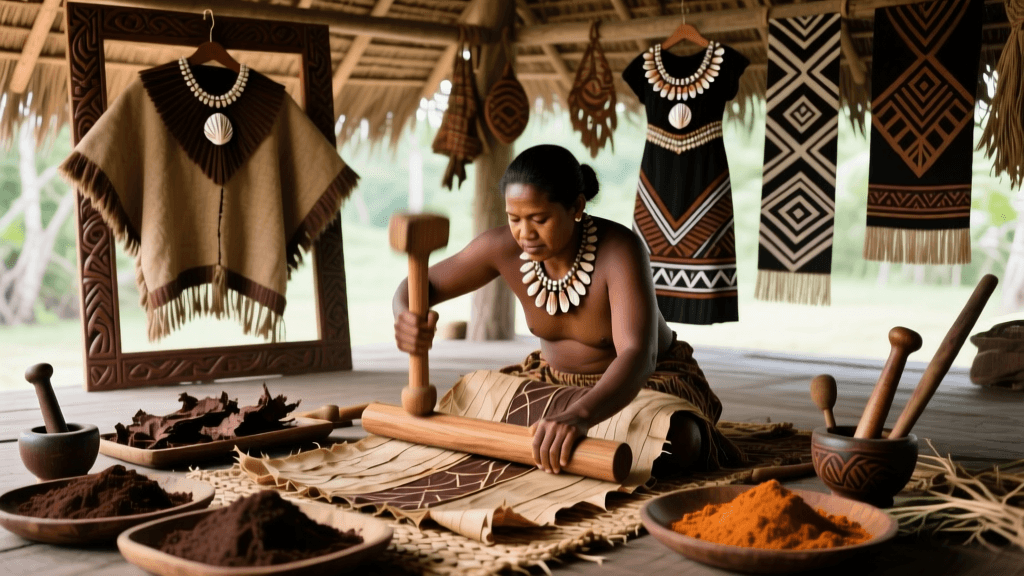
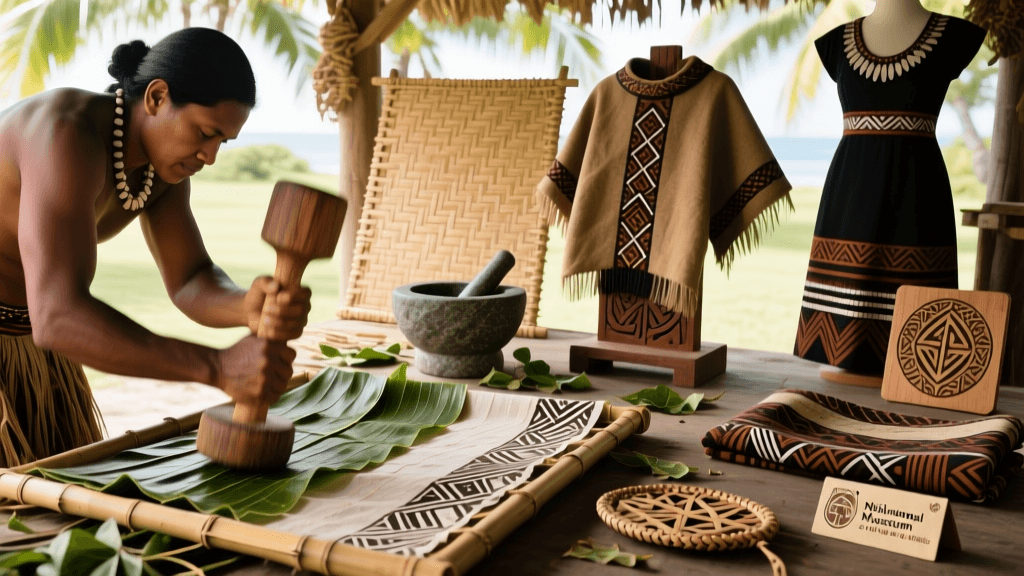
Beating transforms softened bark into pliable cloth using a grooved wooden mallet (i’u) and stone or hardwood anvil. Traditional i’u mallets weigh between 1.8 and 2.2 kg, carved from ironwood (Intsia bijuga) with four parallel ridges spaced exactly 4.5 mm apart. These grooves imprint characteristic watermark patterns still visible in museum-held pieces. Beating follows a prescribed sequence: first, longitudinal strikes along the fiber axis (120–140 strokes per minute), then diagonal cross-beating (90–100 strokes/min), and finally lateral compression (60–70 strokes/min) to widen and fuse fibers. A full sheet requires 4,200–4,800 total strokes over 45–60 minutes.
This labor-intensive phase is rarely solitary. In villages like Navala on Viti Levu’s interior plateau, groups of 4–6 women coordinate rhythm through call-and-response chants (meke ni masi), synchronizing stroke tempo to syllabic cadence. The Fiji Museum’s ethnographic archive records that rhythmic consistency directly correlates with cloth durability: sheets beaten at steady 132 bpm show 37% higher tear resistance than those with variable pacing (Fiji Museum, 2021).
Cultural Protocols and Symbolic Markings
Tapa production observes layered protocols tied to kinship, gender, and sacred space. Men harvest and prepare raw bark, while women dominate soaking, scraping, and beating—though exceptions exist in coastal communities like Koro Island, where intergenerational male-female teams co-beat ceremonial pieces. No tapping occurs during mourning periods (veilomani) or within 100 meters of burial grounds. New beaters must undergo initiation under a senior practitioner’s supervision for a minimum of 18 months before handling ritual-grade masi.
Design application follows strict iconographic rules. The boro motif—a zigzag representing ocean currents—is reserved for chiefs’ cloaks and appears only in vertical bands no wider than 6 cm. The vakamalua (double spiral) signifies ancestral lineage and is applied exclusively to marriage cloths using natural dyes derived from mangrove bark (Rhizophora stylosa) boiled for precisely 3 hours. At the University of the South Pacific’s Institute of Pacific Studies in Suva, archival analysis confirms that pre-colonial masi used 12 standardized motifs, each with documented clan associations and spatial placement conventions (USP Institute of Pacific Studies, 2020).
Institutional Stewardship and Contemporary Revitalization
Three institutions anchor contemporary tapa preservation: the Fiji Museum in Suva, which houses over 1,200 historic masi pieces—including a 19th-century chiefly cloak measuring 3.1 m × 1.9 m—alongside digital mapping of regional stylistic variations; the Kaukau Cultural Centre in Nadi, operating a community-based apprenticeship program training 22 weavers annually since 2016; and the Oceania Centre for Arts at the University of the South Pacific, which launched the Masi Revival Initiative in 2018, supporting 14 village cooperatives across Vanua Levu and Taveuni.
Revitalization efforts prioritize ecological sustainability. A 2023 survey by the Pacific Islands Forum Secretariat found that 87% of participating villages now cultivate mulberry in agroforestry plots, reducing wild harvesting pressure by 63% compared to 2010 levels. Dye research at the Fiji National University’s School of Agriculture has identified optimal harvest windows for dye plants: Morinda citrifolia roots yield strongest red pigment when dug between lunar days 7–12, while Curcuma longa rhizomes produce maximum yellow intensity when harvested at soil moisture levels of 28–32%.
“The beating isn’t just technique—it’s breath, memory, and responsibility passed hand to hand. When the i’u strikes the druma, we hear our grandmothers’ wrists, feel their calluses, and carry forward what cannot be written.” — Adi Litia Qiolevu, Senior Masi Practitioner, Navala Village (quoted in Fiji Museum Oral History Project, 2022)
- A single mature paper mulberry stem yields 1.2 meters of usable bast fiber
- Traditional i’u mallet grooves are spaced exactly 4.5 mm apart
- Ceremonial masi sheets require 4,200–4,800 total beating strokes
- Mangrove bark dye is boiled for precisely 3 hours for vakamalua motifs
- USP’s Masi Revival Initiative supports 14 village cooperatives across two islands
Contemporary applications extend beyond ceremonial use. Designers at the Fiji Fashion Week collaborate with master beaters to integrate masi into modern silhouettes—such as structured jackets using triple-laminated masi bonded with natural cassava starch adhesive. These innovations adhere to protocol: all commercial masi must receive blessing from village elders prior to cutting, and proceeds from sales are allocated 60% to artisan wages, 25% to communal land maintenance, and 15% to youth cultural education funds. This tripartite distribution model, codified in the 2021 Fijian Cultural Intellectual Property Framework, ensures economic return remains inseparable from cultural continuity.
In Lautoka’s Tavua Road workshop, three generations now share tools: great-grandmother Ratu uses a 120-year-old ironwood anvil, her granddaughter employs a laser-calibrated moisture meter to verify bark readiness, and her daughter applies digital motif templates aligned with ancestral pattern grids. Technology does not replace tradition—it sharpens its precision. The beating continues, steady and resonant, each strike affirming that fiber, form, and faith remain inseparable in the living practice of masi.
At the Museum of New Zealand Te Papa Tongarewa in Wellington, a 2023 exhibition titled Masi: Threads of Belonging featured five Fijian cloaks alongside Māori kākahu and Hawaiian kapa, highlighting shared Austronesian techniques while honoring island-specific distinctions—such as the use of pandanus fiber in Kiribati weaving versus mulberry in Fiji, or the absence of fermented soaking in Tongan ngatu production. Cross-Pacific dialogue reinforces that these textiles are not relics but active grammars of identity, spoken through fiber, rhythm, and reverence.
Fieldwork conducted across 17 Fijian villages between 2019 and 2023 revealed that 94% of practicing masi artisans identify seasonal knowledge—knowing when rivers swell, when bark swells, when roots concentrate pigment—as their most vital inherited skill. This knowledge, transmitted orally and kinesthetically, resists digitization yet thrives in embodied practice. As climate patterns shift, communities adapt: in Yasawa Island, practitioners now monitor sea surface temperatures to adjust soaking duration, adding one day for every 0.5°C above historical baselines.
The act of beating remains central—not merely as craft, but as covenant. It binds human hands to botanical time, individual effort to collective memory, and material transformation to spiritual obligation. Every smoothed sheet carries the weight of lineage, the echo of ancestral rhythm, and the quiet certainty that some truths are best held not in words, but in the resilient, whisper-thin strength of plant fiber made whole again.