Fijian Tapa Beating Techniques And Barkcloth Dyeing With Mangrove Bark
Origins and Botanical Foundations of Fijian Tapa
Fijian tapa, known locally as masi, is a hand-beaten barkcloth with origins stretching over 3,000 years across the Pacific. Its production begins not with fabric but with living trees—primarily the paper mulberry (Broussonetia papyrifera), though in coastal regions like the Yasawa Islands, the swamp-dwelling mangrove species Bruguiera gymnorhiza serves as a vital secondary source. Unlike inland plantations of cultivated mulberry, mangrove harvesting follows strict seasonal protocols: only mature trees aged 12–15 years are selected, and only during the dry season (May–October) when tannin concentration peaks. The inner bark—the phloem layer—is stripped in strips averaging 1.8 meters long and 12–15 centimeters wide, a dimension carefully calibrated to fit traditional wooden anvil widths.
Mangrove Bark Harvesting and Preparation Protocols
Harvesting mangrove bark is governed by vanua (land-based customary authority) and requires prior consultation with village elders and the turaga ni koro (village chief). In the Navatu region of Vanua Levu, permission must be granted at least seven days before collection, and a ceremonial offering of kava root is presented at the mangrove grove’s boundary marker—a carved stone known as vu ni vudi. Once harvested, bark is soaked in seawater for precisely 48 hours to soften fibers and initiate enzymatic breakdown. This step differs markedly from mulberry processing, which uses freshwater fermentation. After soaking, the outer bark is scraped off using shark-toothed tools called lau ni bula, revealing the pale, fibrous inner layer ready for beating.
Seasonal Timing and Ecological Stewardship
The timing of mangrove bark collection aligns with lunar cycles. In the Lomaiviti archipelago, harvesters consult the kalou vu (spirit calendar), observing the third quarter moon to ensure optimal fiber flexibility. Overharvesting is prohibited under the qoliqoli marine tenure system, which designates specific mangrove zones as no-take reserves. A 2021 survey by the Fiji Ministry of Fisheries documented that 63% of surveyed villages enforce rotational harvesting across three designated mangrove plots, each rested for minimum 18 months between extractions.
The Beating Process: Tools, Rhythm, and Social Structure
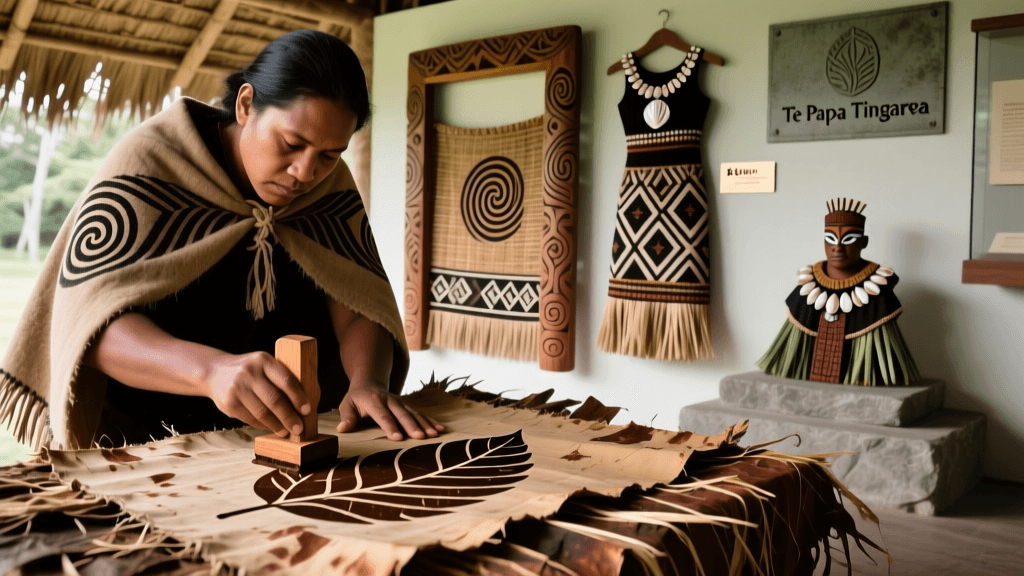
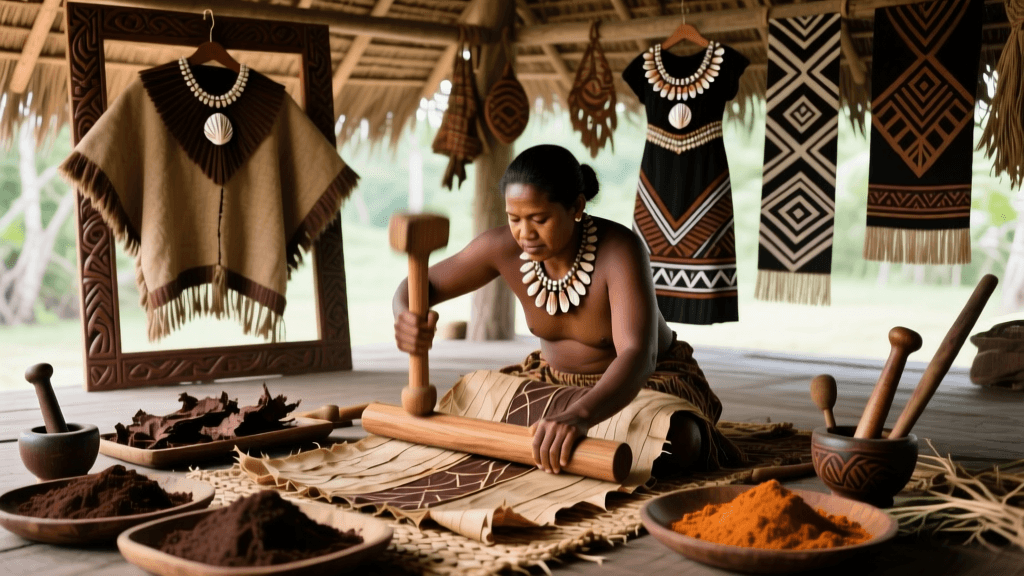
Tapa beating occurs on a hardwood anvil called a lali, traditionally made from Dysoxylum alliaceum (Pacific mahogany) and measuring 2.4 meters in length, 35 centimeters in width, and 22 centimeters in thickness. Beaters—druma—are carved from ironwood (Intsia bijuga) and feature four distinct grooved surfaces: coarse (for initial fiber separation), medium (for widening), fine (for thinning), and polished (for final smoothing). Each beat follows a rhythmic pattern passed orally: 7 strikes per section, repeated 12 times across the strip’s length, totaling 84 impacts per segment. This rhythm is synchronized with communal singing—often women-led chants recounting genealogies or navigational lore.
Gender Roles and Knowledge Transmission
While men traditionally fell and prepare trees, women dominate the soaking, scraping, and beating stages. Apprenticeship begins at age 9–11, with girls spending 1,200+ supervised hours mastering beat alignment and pressure modulation. At the University of the South Pacific’s Institute of Applied Sciences in Suva, ethnobotanical fieldwork recorded that master beaters apply 4.2 kilograms of consistent downward force per strike—measured via calibrated load cells—to avoid fiber breakage while achieving target thicknesses of 0.3–0.5 millimeters.
Natural Dyeing With Mangrove Bark Extract
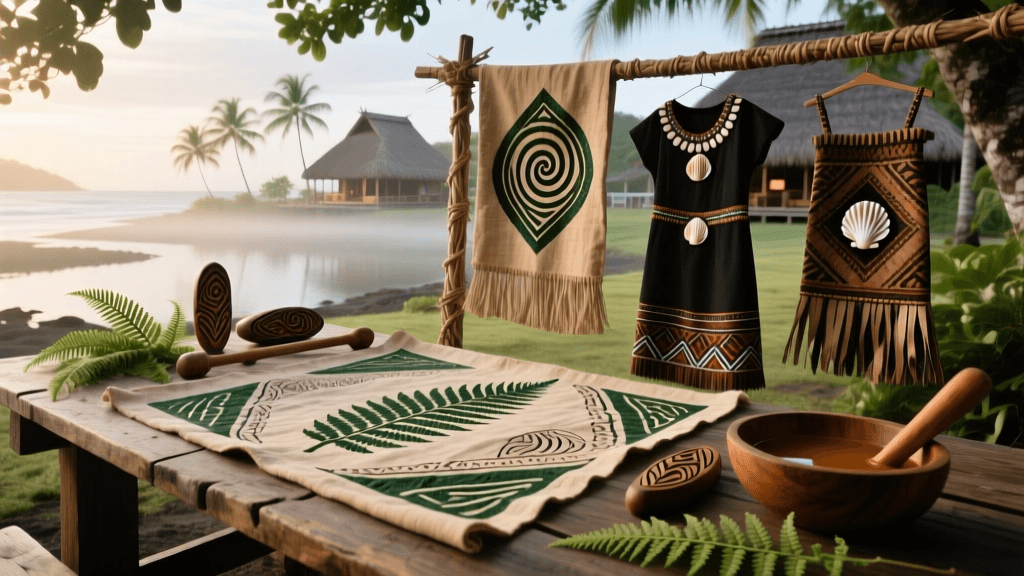
Mangrove bark yields rich brown to deep black dyes through controlled oxidation. Freshly scraped bark is pounded into pulp, then boiled for exactly 90 minutes in earthenware pots over low fire. The resulting decoction is strained and cooled to 32°C—the precise temperature required for tannin polymerization. Cloth is dipped for intervals calibrated to shade depth: 3 dips yield light tan (L* value 68 on CIELAB scale), 7 dips produce medium brown (L* 42), and 12 dips achieve near-black (L* 14). A 2019 pigment analysis conducted at the Fiji Museum confirmed that mangrove-dyed masi contains ellagitannins at concentrations up to 18.7 mg/g dry weight—significantly higher than mulberry-derived dyes.
- Standard beating time per 1-meter strip: 4.5–6 hours
- Minimum drying duration on bamboo racks: 48 hours in shaded, high-humidity conditions
- Maximum usable shelf life of untreated mangrove-dyed masi: 14 years (per Fiji Museum archival records)
- Average number of layers laminated for ceremonial cloaks: 5–7 plies
- Minimum width of ceremonial valenitoni cloaks: 1.2 meters
Ceremonial Use and Cultural Protocols
Tapa functions beyond adornment—it mediates social relationships. The valenitoni, a full-body cloak worn by chiefs during installation ceremonies in the Bureta district of Tailevu, requires 27 individual beaten sheets stitched edge-to-edge. Each sheet must be inspected by the bulou (female ritual elder) for fiber continuity; any visible tear disqualifies the entire piece. During the sevusevu kava ceremony, masi is presented folded in exact thirds—symbolizing land, sea, and sky—and placed on the ground with the dyed side facing upward to honor ancestral presence. At the Fiji Museum in Suva, conservation guidelines mandate storage at 55% relative humidity and 22°C to prevent tannin migration and fiber embrittlement.
Spiritual Safeguards and Taboos
Several prohibitions govern masi handling: pregnant women may not beat cloth during their first trimester; menstruating women refrain from dyeing activities; and no metal tools may contact freshly beaten sheets—only bone, shell, or wood implements are permitted. Violation triggers varovaro, a spiritual consequence requiring purification rites led by a bete (traditional priest). These protocols are codified in the 2017 Fiji National Cultural Heritage Policy, which recognizes tapa-making as intangible cultural heritage under Article 9.2.
Institutional Support and Contemporary Revival
The Fiji Museum, established in 1908, houses over 4,200 tapa artifacts—including a 19th-century mangrove-dyed veiqaravi (wedding shawl) measuring 3.1 meters by 1.4 meters. Its Conservation Lab collaborates with the Pacific Community (SPC)’s Culture Programme to standardize documentation protocols, including digital microscopy of fiber cross-sections and spectral reflectance mapping of dye gradients. Since 2015, the Ministry of iTaukei Affairs has funded 17 village-based masi revitalisation units, each equipped with GPS-mapped mangrove stands and calibrated beating anvils. Field data collected by SPC (2022) shows a 41% increase in youth participation in tapa-making across 23 provinces since programme inception.
“Masi is not cloth—it is memory made tactile. Every groove in the druma echoes a grandparent’s wrist motion; every mangrove stain carries the salt breath of the coast.” — Adi Litia Qiliho, Senior Curator, Fiji Museum, 2020
| Location | Primary Bark Source | Distinctive Pattern Motif | Key Institution Involved | Annual Production Estimate (sheets) |
|---|---|---|---|---|
| Vatukoula, Viti Levu | Mulberry + Mangrove blend | Dravu (wave motif) | Fiji Museum Conservation Lab | 1,850 |
| Navatu, Vanua Levu | Pure mangrove bark | Vakasama (interlocking triangles) | Ministry of iTaukei Affairs | 920 |
| Yasawa Islands | Mangrove only | Wiliwili (spiral) | University of the South Pacific | 640 |
Contemporary artists like Joeli O’Brien of the Ra Province integrate mangrove-dyed masi into wearable installations exhibited at the Pacific Arts Festival in Nouméa. Her 2023 work Rooted Currents used 320 meters of hand-beaten cloth, each meter representing one year of documented mangrove loss in Fiji’s western delta regions. Such practices affirm tapa not as relic but as responsive cultural grammar—where measurement, material, and meaning remain inseparable. The 2020 UNESCO report on Pacific Intangible Heritage noted that “Fijian masi-making demonstrates one of the most rigorously maintained ecological knowledge systems in Oceania, where botanical precision sustains both textile integrity and intergenerational continuity.”
At the Kava Bowl Centre in Nadi, weekly workshops teach youth to identify mangrove species by leaf venation patterns and bark texture—skills once transmitted solely through observation. Participants learn that the Bruguiera leaf’s 11–13 parallel veins, its 2.5-centimeter petiole length, and its distinctive aerial root morphology are diagnostic markers distinguishing it from ecologically similar Rhizophora species. These details anchor identity in botany, ensuring that every beat resonates with place-specific knowledge.
The resilience of masi lies in its embeddedness—not in museums alone, but in tidal rhythms, village councils, and the calibrated weight of a druma in a young woman’s hands. It is measured in millimeters of fiber, minutes of boiling, and decades of unbroken practice. As climate shifts reshape coastlines, the mangrove-dependent traditions of Navatu and Yasawa become ever more urgent testaments to adaptive cultural stewardship—where dye chemistry, kinship obligation, and ecological vigilance converge in every folded, stained, and revered sheet.
Conservation efforts now extend beyond artifact preservation. The Fiji Museum’s Masi Mapping Project, launched in 2021, documents 89 active production sites across 14 provinces, recording bark source locations, beating frequencies, and dye batch numbers. Each entry includes GPS coordinates, soil pH readings (averaging 5.2–5.8 in optimal mangrove zones), and rainfall data—linking cultural practice directly to environmental metrics. This integration reflects a broader regional shift: from viewing tapa as static heritage to recognizing it as a living metric of ecosystem health and cultural sovereignty.
In the village of Nalotu on Vanua Levu, elder weaver Rusiate Vakadewa demonstrates how a single mangrove strip—measuring precisely 1.8 × 0.14 meters—transforms over 11 hours into a luminous, supple sheet bearing the faint, silvery sheen unique to saltwater-processed bark. He notes, “The sea gives the bark its voice. Without that soak, the masi cannot speak to our ancestors.” That voice, sustained through precise measurement, sanctioned protocol, and unwavering care, continues to resonate across generations and oceans.