Decoding Sogdian Samite Silk: 2026 Astana Cemetery Finds
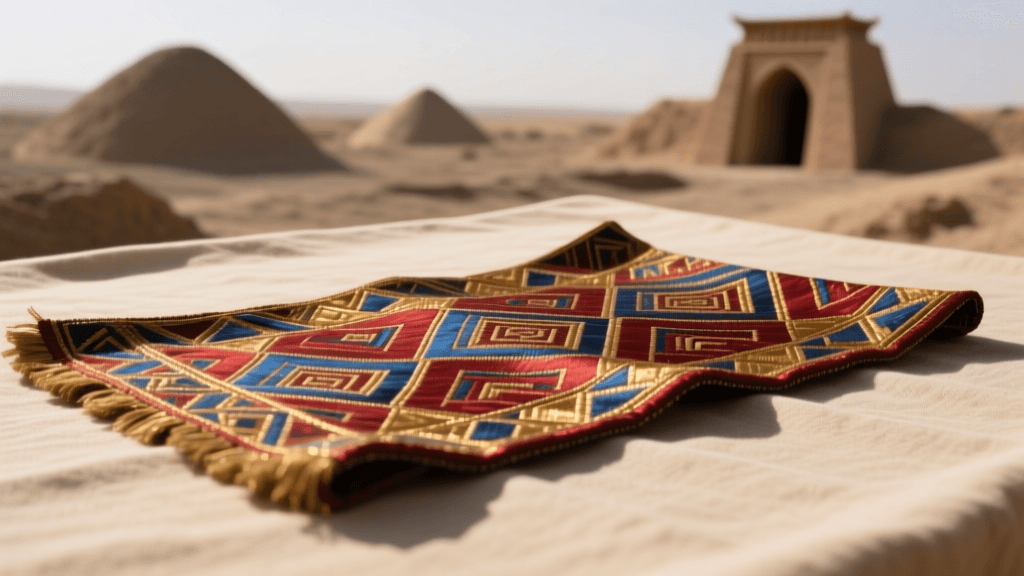
The Silk Road’s Most Luxurious Export: Sogdian Samite
The Silk Road was not merely a conduit for spices and precious metals; it was a vibrant highway of textile exchange that fundamentally altered the sartorial landscape of Asia. Among the most prized commodities traded between the Sasanian Empire, the Sogdian merchants of Central Asia, and Tang Dynasty China was samite—a heavy, weft-faced compound twill silk. As we navigate the archaeological landscape of 2026, recent excavations and digital preservation efforts at the Astana Cemetery in Turpan, Xinjiang, have provided unprecedented insights into how these complex weaves were produced, traded, and integrated into Chinese imperial fashion.
For centuries, Chinese silk production was dominated by warp-faced weaves, such as the traditional jin brocade. The introduction of Western weft-faced compound twills (samite) via Sogdian intermediaries represented a massive technological and aesthetic shift. According to the UNESCO Silk Roads Programme, the synthesis of these weaving traditions birthed entirely new textile categories that defined the cosmopolitan elite of Chang'an during the 7th and 8th centuries.
2026 Archaeological Milestones at the Astana Cemetery
The Astana Cemetery, often referred to as the "Underground Museum" of the Silk Road, has long been a treasure trove for textile archaeologists. However, the 2026 field season has yielded groundbreaking results. In early 2026, the Xinjiang Institute of Cultural Relics and Archaeology, in collaboration with international conservation teams, released a comprehensive multispectral imaging database of over 400 newly stabilized textile fragments recovered from the cemetery's peripheral tombs.
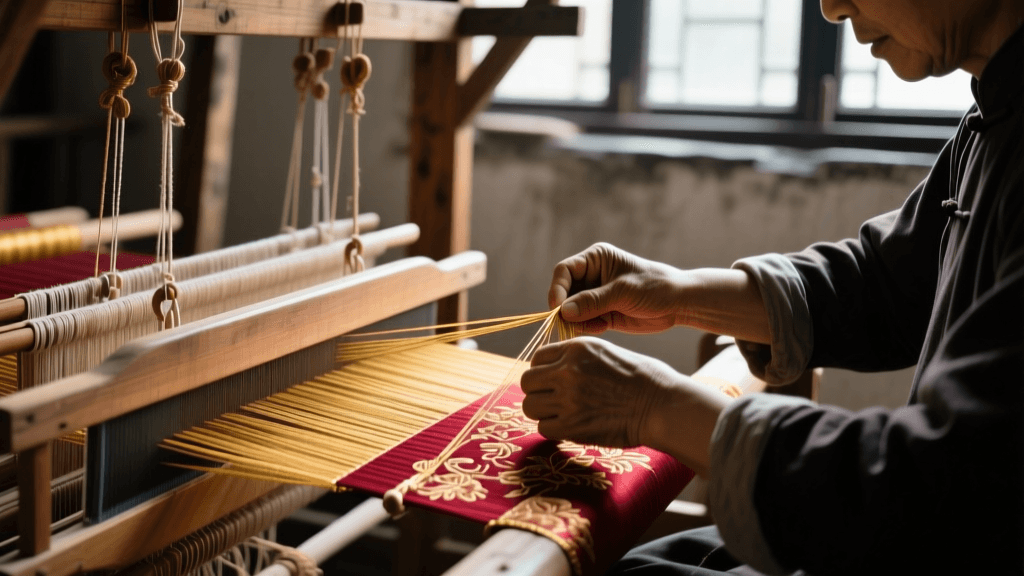
These 2026 findings are particularly notable for the discovery of hybrid loom setups depicted in tomb figurines, suggesting that local Turpan weavers had successfully adapted traditional Chinese draw-looms to accommodate the complex harness requirements of Sogdian samite by the mid-8th century. The preservation of these organic fibers in the hyper-arid Turpan Depression allows researchers to analyze the exact twist ratios of the silk threads, revealing a blend of Chinese cultivated Bombyx mori silk and wild Central Asian tussah silk in the weft threads.
Technical Analysis: Warp-Faced vs. Weft-Faced Compound Twill
Understanding the magnitude of the Silk Road textile exchange requires a deep dive into the mechanics of the loom. The transition from warp-faced to weft-faced structures allowed for larger, more complex, and more colorful surface patterns, which perfectly suited the bold, circular motifs favored by Sasanian and Sogdian designers.
| Feature | Traditional Chinese Jin (Warp-Faced) | Sogdian Samite (Weft-Faced) |
|---|---|---|
| Structural Basis | Compound tabby or twill, warp-dominant | Compound twill, weft-dominant |
| Pattern Creation | Pattern created by binding warp threads | Pattern created by floating weft threads |
| Color Palette | Limited by warp beam threading (usually 2-4 colors) | Highly polychrome; wefts can be swapped per pass |
| Loom Requirements | Standard draw-loom with pattern rods | Requires complex multi-harness or specialized draw-loom |
| Visual Texture | Ribbed, linear, and geometric emphasis | Smooth, dense, with sweeping curvilinear motifs |
The ability to swap out weft threads during the weaving process gave Sogdian samite its signature vibrant, painterly quality. When Tang Dynasty weavers finally mastered this technique, they merged it with indigenous Chinese auspicious symbols, creating a syncretic textile art form that dominated the 8th-century fashion scene.
Motif Migration: From Sasanian Persia to Chang'an
The 2026 digital archives from Astana highlight the prevalence of the "pearl roundel" motif. Originally a Sasanian royal symbol denoting divine glory (farr), the pearl-bordered medallion was adopted by Sogdian weavers and subsequently imported into China. Inside these roundels, Astana textiles frequently feature confronting animals—boars, lions, and ducks—holding necklaces or ribbons in their mouths.
By the late Tang Dynasty, as documented in the International Dunhuang Project archives, these foreign motifs began to soften. The rigid Sasanian boar was gradually replaced by the Chinese phoenix and dragon, and the pearl borders morphed into scrolling lotus vines. This visual evolution, perfectly captured in the stratigraphic layers of the Astana tombs, serves as a material timeline of cultural assimilation along the Silk Road.
Conservation Challenges and 2026 Imaging Technologies
Preserving protein-based fibers that are over 1,300 years old presents immense challenges. In 2026, the standard for non-invasive textile analysis has shifted away from physical sampling toward advanced photogrammetry and Reflectance Transformation Imaging (RTI). RTI allows conservators to manipulate virtual lighting across the surface of a fragile samite fragment, revealing the intricate twill diagonals and weft float structures without risking physical damage from microscopes or calipers.
Furthermore, the application of AI-assisted thread counting software in 2026 has revolutionized how archaeologists document weave density. By feeding high-resolution macro photographs into specialized neural networks, researchers can now map the exact ends-per-inch (EPI) and picks-per-inch (PPI) of degraded Astana samites in seconds, a task that previously took weeks of manual counting under magnification.
Practical Guide for Textile Historians and Weavers in 2026
For modern weavers, historians, and traditional garment enthusiasts looking to study or reproduce Silk Road textiles, the resources available in 2026 are unparalleled. Here is an actionable guide to engaging with Sogdian samite research today:
- Access Digital Archives: Utilize the open-access databases provided by the Textile Society of America and the Turpan Museum's 2026 digital portal. These platforms offer gigapixel images of Astana fragments where individual weft floats can be traced.
- Invest in Macro Photography: If you are conducting independent research on museum pieces, a 1:1 macro lens (such as the 90mm or 100mm focal lengths) paired with a cross-polarized lighting setup is essential. Cross-polarization eliminates the harsh glare of silk, allowing the underlying weave structure to become visible.
- Study the Harness Drafts: Modern weavers attempting to reproduce samite on multi-shaft looms should look into the 2026 published weaving drafts by the China Silk Museum. They have successfully reverse-engineered the 8th-century draw-loom tie-ups required for the classic "confronting lions in pearl roundels" pattern.
- Material Sourcing: To accurately replicate the drape and weight of historical samite, avoid standard charmeuse or habotai. Source heavily degummed, high-twist spun silk yarns for the warp, and loosely twisted, multi-ply filament silk for the weft to achieve the characteristic dense, matte-luster finish of Tang Dynasty compound twills.
The ongoing archaeological work at the Astana Cemetery continues to rewrite our understanding of ancient global trade. The 2026 findings not only preserve the physical remnants of the Silk Road but also provide a technical blueprint for keeping the ancient art of samite weaving alive in the modern era.