Silk Road Sogdian Samite Textiles: 2026 Archaeology Finds
noah tanaka·
The Silk Road was not merely a conduit for the exchange of physical goods; it was a vibrant, pulsing artery of cultural, artistic, and technological synthesis. Among the most profound material legacies of this ancient trans-Eurasian network is Sogdian samite, a luxurious weft-faced compound twill silk that captivated empires from Chang'an to Constantinople. In 2026, groundbreaking archaeological imaging and digital replication technologies are shedding unprecedented light on these ancient textile exchanges, allowing historians, conservators, and modern weavers to decode the secrets of the Sogdian loom.
The Enduring Legacy of Sogdian Samite
The Sogdians, an Eastern Iranian people centered in modern-day Uzbekistan and Tajikistan, were the premier merchants of the Silk Road between the 4th and 8th centuries. While they traded in spices, metals, and horses, their most coveted cultural export was their mastery of silk weaving. Samite (from the Greek hexamiton, meaning 'six threads') is a heavy, lustrous silk fabric woven with a weft-faced compound twill structure. This complex technique allowed weavers to create large, intricate, and polychrome patterns that were impossible on simpler drawlooms. Excavations at the Astana Cemetery in Turpan, Xinjiang, have yielded some of the most pristine examples of Sogdian samite. Preserved by the arid Taklamakan Desert climate, these fragments reveal a fascinating hybridization of motifs. The Sogdians acted as cultural intermediaries, absorbing Sasanian Persian aesthetics and adapting them for the tastes of the Tang Dynasty Chinese elite. Today, the UNESCO Silk Roads Programme continues to highlight these textile fragments as primary evidence of early globalization, demonstrating how fashion and technology flowed seamlessly across harsh geographical barriers.2026 Breakthroughs in Multispectral Textile Imaging
For decades, the vibrant colors of excavated Silk Road silks were lost to time, leaving behind only fragile, brownish-grey fragments. However, 2026 has marked a paradigm shift in archaeological textile analysis. The deployment of advanced macro-X-ray fluorescence (macro-XRF) and high-resolution multispectral imaging has allowed researchers to map organic dyes and metallic mordants without physically sampling the fragile silk. By analyzing the specific wavelengths of light absorbed and reflected by the fibers, conservation scientists can now identify the exact botanical and mineral origins of ancient colors. For instance, recent scans of Astana fragments have confirmed the use of madder root (Rubia tinctorum) for deep reds, weld (Reseda luteola) for brilliant yellows, and indigo for the iconic Sogdian blues. Furthermore, the detection of iron and alum mordants has revealed the sophisticated chemical knowledge possessed by 8th-century dyers. The International Dunhuang Project has been instrumental in digitizing and sharing these multispectral datasets, making the hidden colors of the Silk Road accessible to researchers globally.Decoding the Pearl Roundel Motif
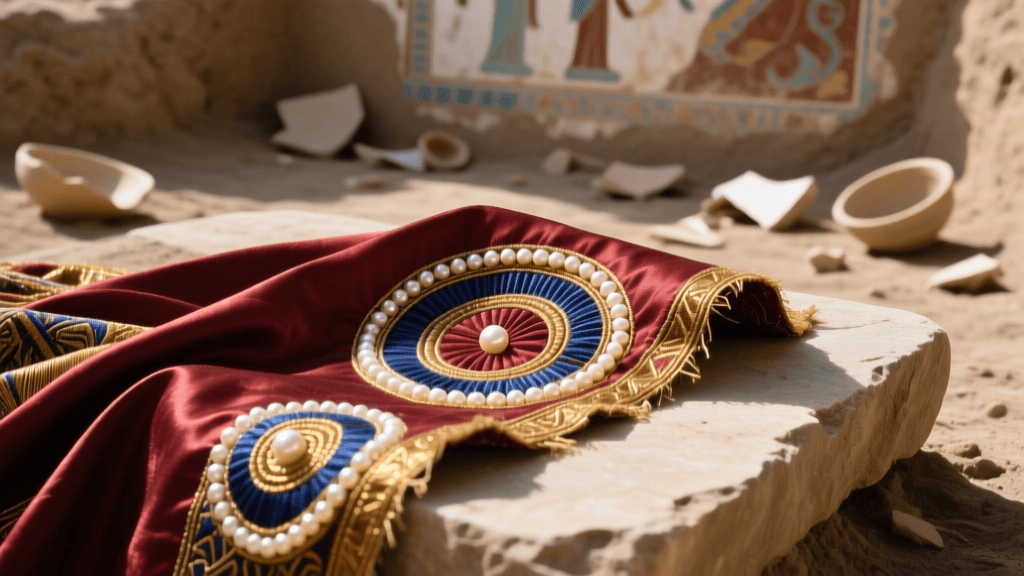
The defining visual signature of Sogdian samite is the 'pearl roundel'—a circular border of pearl-like dots enclosing pairs of confronting animals, such as boars, ducks, or mythical senmurvs. This motif originated in Sasanian Persia but was radically transformed by Sogdian weavers to suit the structural requirements of the drawloom and the aesthetic preferences of their international clientele.| Origin / Culture | Border Characteristics | Central Motif | Weaving Structure |
|---|---|---|---|
| Sasanian Persian | Thick, continuous pearl borders; heavy floral spandrels | Single regal animals (rams, lions) or royal busts | Weft-faced compound tabby (early samite) |
| Sogdian (Transoxiana) | Distinct, evenly spaced pearls; heart-shaped palmette separators | Confronting pairs of ducks, boars, or winged horses | Weft-faced compound twill (true samite) |
| Tang Chinese | Floral or scrolling vine borders replacing pearls | Native auspicious birds (cranes, pheasants) and dragons | Weft-faced compound twill & warp-faced satin |
Digital Looming and the 2026 Revival of Ancient Weaves
The archaeological revelations of 2026 are not confined to academia; they have sparked a renaissance in historical textile replication. Traditional hand-drawlooms capable of weaving true samite are exceedingly rare, requiring immense physical labor and specialized knowledge. Today, textile historians and master weavers are utilizing advanced digital jacquard looms to recreate the exact structural integrity of 8th-century Sogdian silks. Replicating samite requires precise software mapping. Using specialized textile CAD systems like Pointcarré or NedGraphics, weavers translate the multispectral scans of ancient fragments into digital weave matrices. The standard Sogdian samite requires a dense structure: typically 50 to 70 warp ends per centimeter and 40 to 50 weft picks per centimeter. To achieve the characteristic heavy drape and high luster, modern replicators source degummed mulberry silk in specific deniers, often employing a 2:1 or 3:1 warp-to-weft ratio to ensure the weft threads completely conceal the warp, creating the vibrant, unbroken color fields typical of the pearl roundels. For independent weavers and academic institutions looking to replicate these textiles in 2026, the process involves:- Thread Sourcing: Procuring 20/22 denier raw silk and applying a controlled, partial degumming process to retain the fiber's natural strength while allowing for tight packing.
- CAD Mapping: Assigning specific weave bindings (such as a 1/2 twill for the face and a 2/1 twill for the back) to create the compound structure in the digital loom software.
- Tension Calibration: Digital jacquard looms must be calibrated to high warp tension (often exceeding 50 grams per thread) to prevent the fine silk from tangling during the rapid shedding process.