2026 Silk Road Archaeology: Sogdian-Han Silk Textile Finds
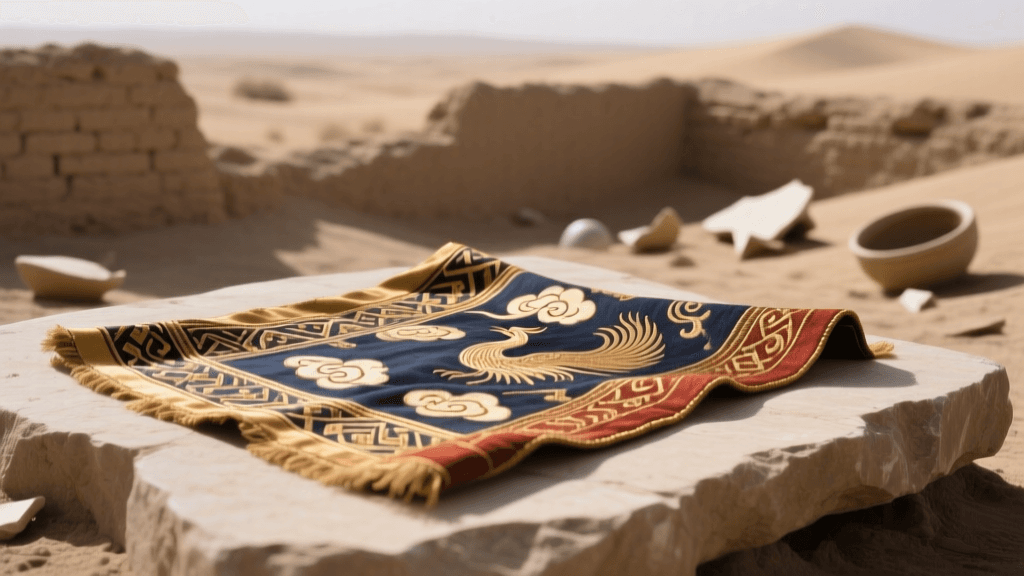
Unearthing the 2026 Tarim Basin Textile Cache
The Silk Road was never merely a conduit for the exchange of physical goods; it was a dynamic, living artery of technological, cultural, and aesthetic synthesis. Nowhere is this more evident than in the archaeological record of ancient textiles. In early 2026, the Xinjiang Institute of Cultural Relics and Archaeology unveiled a comprehensive analysis of newly excavated and recently conserved textile fragments from the Tarim Basin, specifically focusing on the Astana cemetery complex near Turpan and the ancient oasis town of Niya. These 2026 findings have fundamentally reshaped our understanding of how Sogdian merchants and Han Chinese weavers collaborated, resulting in hybrid silk textiles that merged Eastern weaving structures with Western aesthetic motifs.
For centuries, historians relied on the UNESCO Silk Roads Programme archives to understand the broad strokes of this trans-Eurasian network. However, the 2026 Tarim Basin excavations provide microscopic, thread-level evidence of cross-cultural adaptation. Unlike earlier assumptions that Sogdian silks were simply imported as finished goods, the latest archaeological data confirms that Han weavers in the Hexi Corridor and Turpan actively reconfigured their traditional looms to produce weft-faced compound twills—known in the West as samite—specifically tailored to the tastes of Central Asian and Persian markets.
The Mechanics of Exchange: Warp vs. Weft
To understand the magnitude of these 2026 archaeological finds, one must first understand the fundamental clash of ancient weaving philosophies. Traditional Han Chinese silk production was overwhelmingly warp-faced. In a warp-faced weave, the longitudinal threads (warp) are packed so densely that they completely hide the transverse threads (weft), resulting in a smooth, lustrous surface ideal for the flowing, draped garments of the Chinese elite. Conversely, Sogdian and Sasanian weavers favored weft-faced structures, where the horizontal threads dominate the surface, allowing for bold, geometric, and highly detailed pictorial motifs that were structurally more rigid and tailored.
The newly analyzed Astana fragments from the 2026 exhibition demonstrate a remarkable technological compromise. Han weavers adapted their drawlooms to create a hybrid structure: a warp-faced foundation that utilized a secondary, decorative weft system to mimic the visual density of Sogdian samite. This allowed Chinese workshops to maintain their efficient, high-tension warp beam setups while satisfying the Western demand for heavy, patterned silks.
| Textile Feature | Traditional Han Warp-Faced Silk (Jin) | Sogdian Weft-Faced Compound Twill (Samite) | Hybrid Silk Road Blend (2026 Astana Finds) |
|---|---|---|---|
| Structural Dominance | Warp threads hide the weft | Weft threads hide the warp | Warp foundation with prominent supplementary weft |
| Motif Execution | Fluid, linear, cloud-like patterns | Geometric, rigid, pictorial medallions | Curvilinear Han clouds framing Sogdian medallions |
| Loom Technology | Complex pattern harness drawloom | Simple harness with weft-insertion shuttles | Modified drawloom with dual-weft insertion systems |
| Drape and Weight | Lightweight, fluid, high drape | Heavy, stiff, structured | Medium weight, moderate drape, high durability |
| Primary Market | Domestic Chinese elite and bureaucracy | Central Asian nobility, Sasanian courts | Silk Road merchants, diplomatic gifts, Turpan elite |
Motif Migration: The Sogdian Pearl Roundel in Han Silk
Beyond structural mechanics, the 2026 Tarim Basin finds offer a masterclass in motif migration. The most striking examples recovered this year feature the iconic Sogdian 'pearl roundel'—a continuous border of small white circles enclosing confronting animals, such as boars, winged horses (Senmurv), or rams. According to the Metropolitan Museum of Art's Heilbrunn Timeline of Art History, the pearl roundel originated in Sasanian Persia and was carried eastward by Sogdian traders, becoming a symbol of cosmic order and royal authority.
What makes the 2026 Astana fragments revolutionary is the subtle Han reinterpretation of these motifs. In the newly conserved 'Boar Head Roundel' brocade, the traditional Sasanian boar is rendered with the fluid, calligraphic brushstroke aesthetic typical of Han dynasty lacquerware. Furthermore, the negative space inside the roundels, which Sogdian weavers typically left plain or filled with simple rosettes, has been populated by Han weavers with stylized 'lingzhi' (magic mushroom) clouds and 'chi' dragons. This proves that the weavers were not merely copying foreign templates; they were actively localizing them, creating a distinct 'Silk Road Creole' visual language that appealed to a cosmopolitan, multi-ethnic clientele.
2026 Conservation Technologies for Ancient Silks
The survival of these delicate protein-based fibers in the arid Taklamakan Desert is a miracle of geography, but their ongoing preservation requires cutting-edge science. As of 2026, the conservation of Silk Road textiles has moved beyond simple climate-controlled vitrines. The National Museum of China, in collaboration with the Dunhuang Academy, has pioneered the use of nanocellulose consolidants to stabilize friable, desiccated silk fibers without altering their optical properties or historical hand-feel.
Furthermore, multispectral imaging (MSI) has become the gold standard in 2026 for analyzing faded dyes. Many of the Astana silks appear uniformly brown or ochre to the naked eye due to centuries of UV exposure and oxidation. However, 2026 MSI scans have successfully mapped the original presence of madder root (red), indigo (blue), and weld (yellow), allowing digital reconstructions to reveal the startlingly vibrant, high-contrast color palettes originally intended by the Han-Sogdian weavers. These digital reconstructions are currently on display via augmented reality (AR) headsets at the Xinjiang Uygur Autonomous Region Museum, allowing visitors to see the textiles exactly as they appeared in the 7th century.
Actionable Guide for Modern Weavers and Researchers
For contemporary textile artists, historical reenactors, and fashion designers looking to replicate the 'Astana Hybrid' weaves documented in the 2026 findings, modern technology bridges the gap between ancient drawlooms and contemporary studios. Here is a practical guide to recreating these historic Silk Road textiles in 2026:
- Loom Selection: To achieve the complex dual-weft structures of the hybrid samite, a digital jacquard loom is highly recommended. The TC2 Digital Jacquard Loom (priced around $18,500 in 2026) offers the individual warp-thread control necessary to mimic the Han drawloom's harness system while managing the dense weft insertions.
- Yarn Specifications: Authenticity requires high-grade mulberry silk. Use a 20/22 denier thrown silk for the warp, set at a high density of 80 to 100 ends per centimeter. For the supplementary pattern weft, use a heavier 2/60Nm spun silk or a tightly twisted organzine to replicate the structural rigidity of Sogdian samite.
- Software Drafting: Utilize advanced weave-design software like Pointcarré or NedGraphics. When drafting the pearl roundel motifs, ensure you program a weft-faced compound twill bind (typically a 1/2 or 2/1 twill) for the motif areas, while maintaining a warp-faced satin or twill bind for the background. This contrast in binding structures is the secret to the tactile depth found in the 2026 Astana fragments.
- Tension and Timing: Hybrid weaves require precise tension management. Set your warp tension slightly higher than standard brocade weaving (approx. 45-50 grams per thread) to ensure the weft-faced motifs 'pop' to the surface without causing warp breakage. Expect the sampling phase to take approximately 40 hours per square meter as you calibrate the weft-beating force.
The 2026 Silk Road archaeological finds remind us that traditional Asian garments and textiles were never static. They were the result of relentless innovation, cross-border collaboration, and a willingness to adapt ancient technologies to new global markets. By studying and replicating these Sogdian-Han masterpieces, modern practitioners do more than preserve history; they keep the dynamic, evolving spirit of the Silk Road alive on the loom.