Slavic Vyshyvanka & Romanian IE: 2026 Sourcing Guide
The Enduring Legacy of Eastern European Embroidery
The landscape of Eastern European and Balkan folk dress has experienced a profound renaissance as we navigate 2026. At the heart of this revival are two of the most iconic and culturally significant garments in the region: the Slavic Vyshyvanka and the Romanian IE (traditional blouse). Far from being mere historical artifacts confined to museum vitrines, these meticulously embroidered pieces have reclaimed their status as living, breathing elements of cultural identity and high-end slow fashion. However, the surge in global demand has also triggered a flood of mass-produced, machine-embroidered imitations. For collectors, cultural enthusiasts, and ethical fashion advocates, understanding how to authenticate, source, and care for genuine hand-embroidered garments is more critical than ever. This comprehensive 2026 guide delves into the intricate techniques, regional variations, and ethical sourcing channels necessary to build an authentic Eastern European folk dress collection while directly supporting the artisan communities that keep these ancient traditions alive.
The Cultural and Symbolic Roots
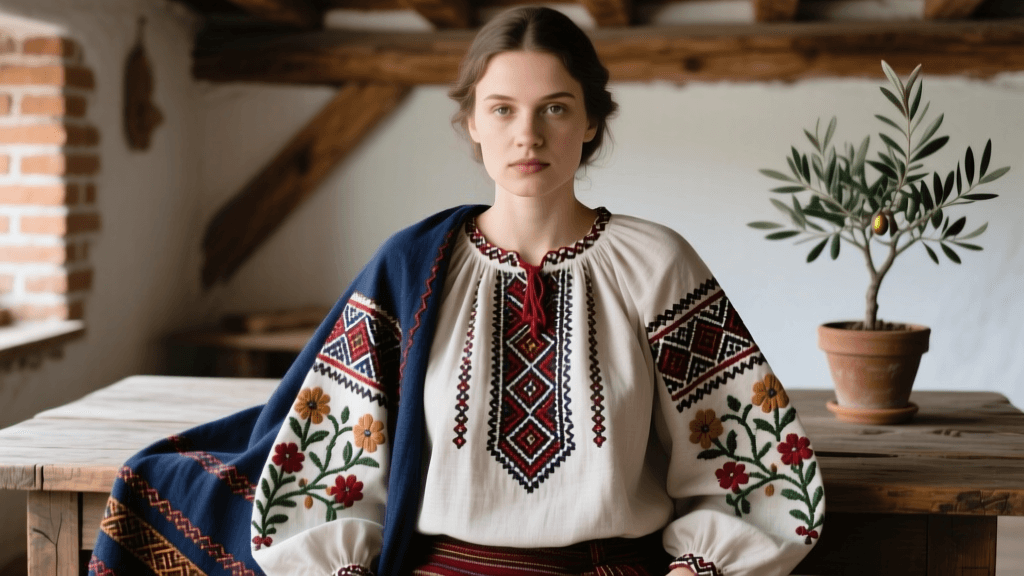
To truly appreciate the value of a genuine Vyshyvanka or IE, one must understand the language woven into their threads. In Slavic traditions, particularly across Ukraine and Belarus, the Vyshyvanka served as a protective talisman. The embroidery was strategically placed at the 'vulnerable' openings of the garment—the neckline, cuffs, and hem—to ward off malevolent spirits. According to the Encyclopedia of Ukraine, the geometric motifs found in Hutsul and Polissia regions are remnants of ancient pagan cosmology, where rhombuses symbolized fertile fields and sown seeds, while zigzag lines represented water and lightning.
Similarly, the Romanian IE is a masterpiece of semiotics. The most sacred part of the blouse is the altita, the densely embroidered shoulder piece that historically indicated the wearer's regional origin, social status, and marital availability. The vertical bands flowing down the sleeve, known as râuri (rivers), guide the eye and symbolize the flow of life and ancestral lineage. In 2026, cultural anthropologists and textile historians continue to emphasize that wearing these garments is an act of profound cultural continuity, connecting the modern wearer to centuries of matriarchal knowledge passed down through village networks.
Decoding the Embroidery Techniques
The distinction between a Slavic and a Balkan blouse often lies in the foundational stitching techniques, which vary wildly from village to village. In the Ukrainian tradition, the nyzynka technique is a hallmark of master artisans. This surface darning method is worked from the reverse side of the fabric, creating a geometric pattern on the front that resembles woven tapestry. Another revered technique is the zavolikannya, a running stitch that creates dense, horizontal bands of color, predominantly red and black, typical of the Polissia region. The famous Poltava 'white-on-white' (biloyu po bilomu) embroidery relies on shadow work, cutwork, and satin stitches to create a breathtaking, subtle texture that catches the light.
Conversely, the Romanian IE is defined by its complex smocking and gathering techniques. The incret is the intricately gathered collar, often embroidered with metallic threads or tiny glass beads that catch the sunlight during traditional circle dances. The stitching on the body and sleeves frequently employs the Romanian cross-stitch (which differs slightly in tension and angle from the standard European cross-stitch) and the chain stitch to create elaborate floral and vegetal motifs, especially in regions like Argeș and Vâlcea. Recognizing these specific structural elements is the first step in authenticating a piece in today's market.
2026 Market Realities and Pricing
As of 2026, the market for authentic Eastern European folk dress has bifurcated sharply. On one end, fast-fashion retailers and overseas factories utilize computerized multi-head embroidery machines to churn out synthetic replicas in minutes. On the other end, genuine hand-embroidered pieces are recognized as luxury textile art. The demographic reality of Eastern Europe means that the pool of master embroiderers capable of executing museum-quality nyzynka or altita work is shrinking, driving up the value of authentic pieces. Commissioning a bespoke Vyshyvanka from a master artisan in Bukovyna or a traditional IE from a cooperative in Olt now requires a significant financial and temporal investment. It is not uncommon for a single, fully hand-embroidered blouse to require between 120 and 300 hours of continuous labor, translating to prices that reflect true living wages for the artisans.
Comparison Chart: 2026 Market Data
| Feature | Ukrainian Vyshyvanka (Handmade) | Romanian IE (Handmade) | Machine-Made Replica (2026) |
|---|---|---|---|
| Base Material | Hand-woven linen or hemp | Hand-woven cotton or borangic (silk) | Synthetic blend or standard cotton |
| Embroidery Time | 80 - 250+ hours | 100 - 300+ hours | 2 - 4 hours |
| Average 2026 Price | $450 - $1,800+ | $500 - $2,200+ | $35 - $85 |
| Provenance Tracking | Artisan cooperative certificate | NGO / Guild verification | None |
Authenticating Hand-Embroidered Garments
In 2026, visual inspection alone is insufficient, as high-end digital embroidery machines can mimic complex surface patterns. The definitive test for authenticity remains the 'reverse-side inspection.' Hand-embroidered garments, particularly those utilizing nyzynka or traditional cross-stitch, will show a distinct, often messy reverse side with individual thread knots, starts, and stops. The tension will have microscopic variations that give the fabric a supple, organic drape. Machine embroidery, conversely, features a continuous bobbin thread on the reverse, uniform tension, and a stiff, synthetic backing that restricts the natural movement of the linen or hemp.
Furthermore, authentic pieces are increasingly accompanied by digital provenance certificates. Many established artisan cooperatives now utilize blockchain-based ledgers to track the lifecycle of a garment, from the harvesting of the flax to the final stitch. When sourcing online or at European textile fairs, always request the artisan's signature, the specific village of origin, and the cooperative's verification stamp. The UNESCO Intangible Cultural Heritage designation for the Romanian blouse has also spurred stricter export and authenticity regulations, making verified documentation a standard expectation for high-end buyers.
Ethical Sourcing and Cooperatives
Supporting the right channels ensures your investment preserves cultural heritage rather than exploiting it. In Romania, the NGO and community network Semne Cusute has been instrumental in reviving lost patterns and connecting global buyers directly with village artisans, bypassing predatory middlemen. They provide extensive databases of regional motifs and can facilitate custom commissions. In Ukraine, despite ongoing geopolitical challenges, resilient artisan collectives in the Carpathian Mountains and the Poltava region continue to operate, often supported by international cultural preservation grants. Buyers in 2026 should prioritize platforms that offer transparent pricing models, showing exactly what percentage of the sale goes directly to the embroiderer. Avoid generic marketplace listings that use vague terms like 'Boho peasant blouse' or 'Slavic style top,' as these are almost exclusively mass-produced appropriations.
Care, Maintenance, and Styling
Caring for a hand-embroidered linen or hemp garment requires a departure from modern laundry habits. Authentic pieces often utilize natural dyes derived from madder root, walnut husks, or onion skins, which are highly sensitive to alkaline environments. Hand-wash the garment in cold water using a pH-neutral, eco-friendly detergent. Never wring or twist the fabric; instead, roll it in a clean cotton towel to absorb excess moisture and lay it flat to dry away from direct sunlight, which can bleach natural fibers and threads. When ironing, always press on the reverse side over a damp cotton cloth to protect the three-dimensional texture of the embroidery.
Styling these heritage pieces in 2026 leans towards juxtaposition. Pair a delicate, white-on-white Poltava Vyshyvanka with sharply tailored, wide-leg wool trousers and minimalist leather footwear. A heavily embroidered Romanian IE with a dark altita can be layered under a modern, unstructured blazer, allowing the intricate collar and cuffs to serve as the focal point of a contemporary, sophisticated wardrobe. By investing in authentic garments and caring for them properly, you become a custodian of Eastern Europe's rich textile history, ensuring these ancient stitches survive for generations to come.