Slavic Sorochka Construction: Zero-Waste Geometric Patterns in 2026
The Renaissance of Zero-Waste Historical Patterning
In the contemporary landscape of 2026, the intersection of sustainable fashion and historical dressmaking has brought renewed attention to traditional European folk garments. Among the most ingenious of these is the Slavic sorochka (or sorochka), a traditional chemise worn across Ukraine, Belarus, and Russia. Unlike modern pattern drafting, which relies on curved armholes and princess seams that generate significant textile waste, the sorochka is a masterclass in zero-waste geometric patterning. By utilizing strict rectangles, squares, and triangles, historical makers ensured that every single thread of precious handwoven linen was incorporated into the final garment. For modern makers and historical costumers in 2026, understanding and executing these construction techniques offers both a profound connection to Eastern European heritage and a highly relevant blueprint for eco-conscious sewing.
The Philosophy of Loom-Width Construction
The foundational rule of the sorochka is dictated by the loom. Historically, rural weavers produced linen cloth in narrow widths, typically ranging from 36 to 40 centimeters (14 to 16 inches). Cutting curves into this fabric would result in unusable scraps, which was economically and culturally unacceptable. Therefore, the garment was engineered entirely from the geometric shapes that could be cut directly across or along the grain of the loom-width fabric. According to the textile conservation guidelines and historical archives at the Victoria and Albert Museum, the preservation and study of historical linen garments rely heavily on understanding these original zero-waste seam structures, as the straight-grain construction contributes significantly to the longevity and drape of the textile.
In 2026, while modern linen is frequently available in 54-inch or 72-inch widths, adhering to the narrow loom-width philosophy remains crucial for achieving the correct historical drape and maintaining the zero-waste ethos. Makers today often purchase wide fabric and artificially restrict their cutting layout to 16-inch panels, or they source authentic narrow-loom linen from specialized European flax cooperatives that have seen a massive resurgence in the mid-2020s.
Sourcing Materials for the 2026 Maker
To accurately construct a sorochka, the choice of fabric is paramount. You must use 100% linen; cotton or synthetic blends will not provide the necessary structural integrity for the heavy embroidery or the crisp gathers at the neckline. For a standard chemise, seek out a mid-weight linen ranging from 180 to 220 gsm (grams per square meter). The warp and weft threads should be clearly visible and relatively even, as this is essential if you plan to incorporate drawn-thread work (merezhka).
For thread, modern makers in 2026 have access to historically accurate, high-quality linen sewing threads. An 80/3 or 100/3 linen thread is ideal for the fine flat-felled seams, while heavier 30/2 or 40/2 linen threads are used for the structural gathering and embroidery. Beeswax remains an essential notion for conditioning the linen thread, reducing friction, and preventing tangling during the intensive hand-sewing process.
Step-by-Step Geometric Construction
The construction of the sorochka can be broken down into specific geometric modules. There are no curved armholes or shaped side seams. Instead, mobility and fit are achieved through strategic inserts and heavy gathering.
The Main Body Panels (Stan)
The core of the chemise consists of two to four long rectangular panels. In a two-panel construction, the front and back are cut as one continuous length of fabric, folded over the shoulder, with a slit cut for the neckline. In a four-panel construction, the front and back are separate rectangles joined at the shoulders. The width of these panels is exactly the width of the loom (e.g., 38 cm). The length is determined by the wearer's measurement from the shoulder to the desired hemline, plus 5 cm for a turned hem. Because the side edges are selvedges, they do not require finishing; they are simply joined together using a flat-felled seam.
The Sleeve (Rukav) and Underarm Gusset (Lastovitsa)
The sleeve is a simple rectangle. Its width is the loom width (38 cm), and its length is the measurement from the shoulder edge to the wrist, plus 10 cm to allow for deep, traditional gathering at the cuff. The true genius of the sorochka construction lies in the lastovitsa, or underarm gusset. This is a perfect square, typically measuring 12x12 cm or 15x15 cm. The gusset is inserted between the sleeve rectangle and the body panels, effectively creating a diamond-shaped underarm that provides immense mobility without the need for a curved armhole. Furthermore, the Metropolitan Museum of Art's Heilbrunn Timeline of Art History notes that Eastern European peasant dress remained remarkably consistent in its geometric construction, with the gusset being a defining hallmark of Slavic and broader European folk tunics for centuries.
The Shoulder Insert (Polik)
In many regional variations, particularly in Ukrainian traditions, a polik (shoulder insert) is used. This is a rectangular or trapezoidal piece of fabric that connects the top of the sleeve to the front and back body panels. The polik is heavily embroidered, as it sits prominently on the upper chest and shoulder, acting as a protective talisman in traditional folklore. It also serves a structural purpose, broadening the shoulder line and allowing the heavy sleeves to cascade elegantly down the arm.
Seam Finishes: The Run-and-Fell Technique
Because the sorochka was an undergarment worn directly against the skin, all internal seams had to be completely smooth and durable. The historical and most appropriate method for this is the run-and-fell seam (a variation of the flat-felled seam), executed entirely by hand.
- The Running Stitch: Place the two fabric panels right sides together, but offset one edge by 3 mm (1/8 inch). Sew a running stitch along the edge, aiming for 8 to 10 stitches per inch. Use a fine 80/3 linen thread.
- The Fold: Press the seam allowance open, then fold the longer 3 mm allowance over the shorter one, encasing the raw edge.
- The Fell: Fold the entire encased seam flat against the garment body. Using a fine whipstitch or slipstitch, secure the folded edge to the main fabric, catching only a few threads of the base fabric so the stitches are nearly invisible on the right side.
This technique ensures that no raw edges are exposed to friction, making the garment incredibly durable and comfortable.
Comparison Chart: Historical vs. 2026 Modern Adaptations
| Feature | 19th-Century Rural Construction | 2026 Modern Maker Adaptation |
|---|---|---|
| Fabric Width | 36-40 cm (Handwoven on narrow looms) | Artificial 40 cm cutting layout on 150 cm commercial linen |
| Seam Allowance | Selvedge-to-selvedge (Zero waste) | Selvedge preservation or 5mm trimmed for run-and-fell |
| Thread Material | Hand-spun flax, varying thickness | Commercially spun 80/3 and 30/2 wet-spun linen thread |
| Embellishment Timing | Embroidered before assembly, often over years | Embroidered before assembly, utilizing modern water-soluble stabilizers if needed |
| Neckline Finish | Drawstring channel or narrow standing collar | Standing collar with internal linen facing for structural support |
The Neckline and Cuff Gathering Techniques
The voluminous look of the sorochka is achieved through dense gathering at the neckline and cuffs. Historically, this was not done with modern elastic or simple drawstrings, but through a technique called smocking or cartridge pleating. To prepare the neckline, makers sew two to three parallel rows of running stitches, each 3 mm apart. The threads are pulled tightly, reducing a 120 cm circumference down to a 40 cm neck opening. This dense cluster of pleats is then secured to a narrow rectangular collar band. In 2026, makers often use a specialized linen cord for the drawstring channel, finished with traditional braided knots and tassels, avoiding synthetic cords that can degrade or cut into the delicate linen fibers over time.
Integration of Embellishment and Merezhka
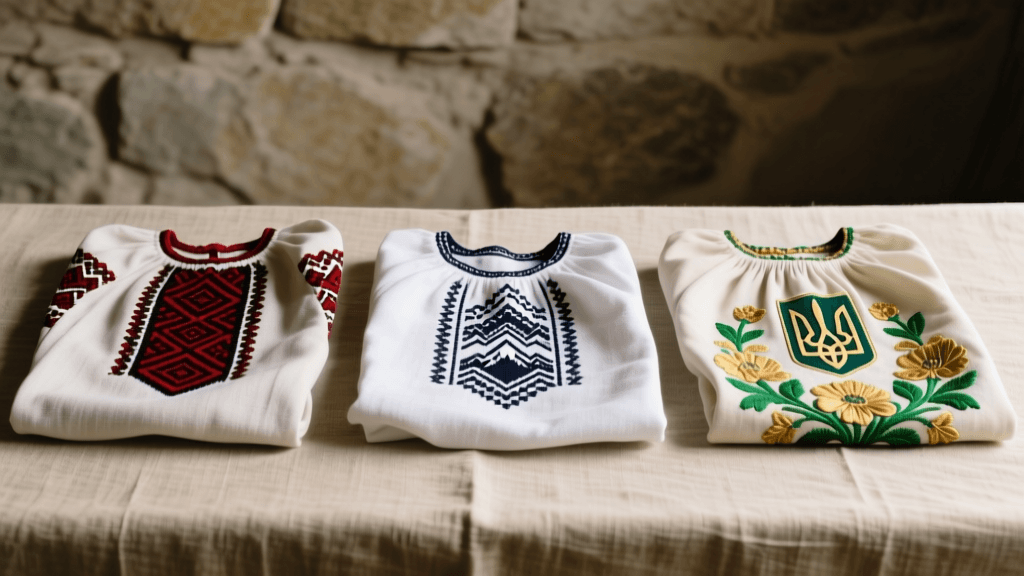
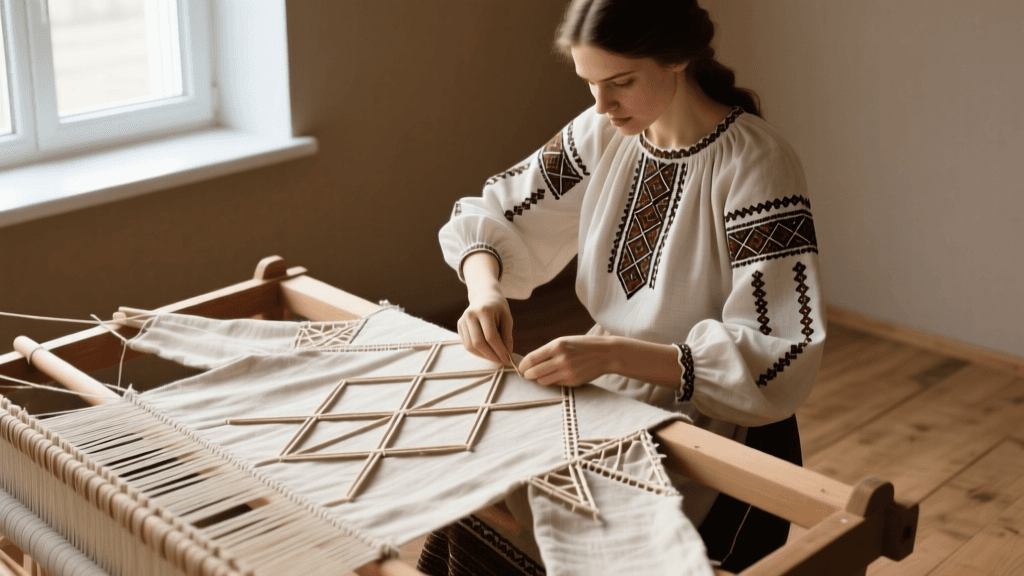
A defining characteristic of the Slavic sorochka is its intricate embroidery, particularly the use of merezhka (drawn-thread work) and zavolikannya (surface darning). In zero-waste construction, the embellishment is not an afterthought; it is integrated into the cutting plan. Drawn-thread work is often executed along the seam lines where panels will be joined. The maker will pull out specific weft threads, creating a transparent grid, and then wrap and weave the remaining warp threads to create lace-like geometric patterns.
Cross-stitch and satin stitch motifs are typically worked on the polik (shoulder insert), the cuffs, and the hem. It is critical to embroider these panels before the garment is assembled. Hooping a fully constructed chemise is nearly impossible, and working on flat panels ensures that the tension of the embroidery does not distort the final seams. Modern makers in 2026 benefit from LED magnification lamps and ergonomic embroidery frames, significantly reducing the eye strain that historically plagued rural seamstresses.
Finishing: Washing and Beetling
The final step in constructing a historically accurate sorochka is the finishing process. Raw linen is stiff and can be abrasive. Historically, the finished garment was boiled in wood ash lye, rinsed in a river, and laid out on the grass to bleach in the sun. Today, makers can achieve a similar effect by washing the completed garment in hot water with a pH-neutral detergent, followed by a process known as 'beetling.' Beetling involves pounding the damp linen with a smooth wooden mallet. This crushes the flax fibers, releasing their natural pectins and giving the fabric a beautiful, permanent luster and a soft, supple drape that mimics decades of wear.
Conclusion
The construction of the traditional Slavic sorochka is far more than a historical curiosity; it is a highly sophisticated system of geometric engineering. By embracing the constraints of the loom width, historical makers created garments that were durable, mobile, and entirely zero-waste. For the modern maker in 2026, mastering the lastovitsa gusset, the run-and-fell seam, and the precise gathering techniques of the sorochka provides a deeply rewarding sewing experience. It bridges the gap between ancestral craftsmanship and contemporary sustainable fashion, proving that the most eco-friendly patterns of the future are often found in the uncut rectangles of the past.