Slavic Folk Shirt Patterns: 2026 Zero-Waste Sewing
The Geometry of the Rubakha: Historical Context
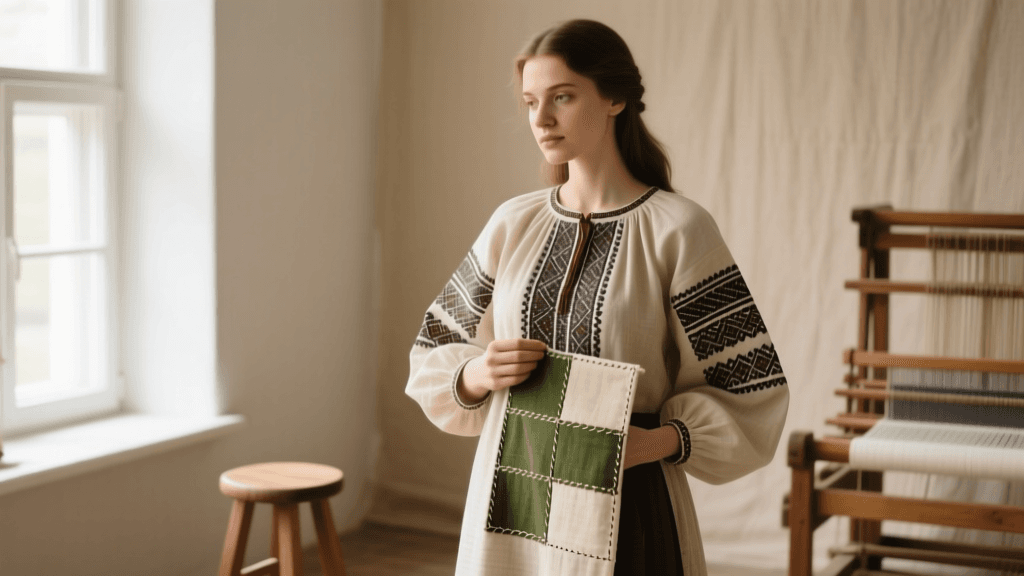
Long before the concept of sustainable fashion entered the modern lexicon, the traditional East Slavic rubakha and the South Slavic košulja represented some of the most ingenious examples of zero-waste garment construction in human history. Unlike modern tailored clothing, which relies on curved armholes, shaped darts, and complex grading that inevitably leaves behind 15% to 20% in fabric scraps, traditional European folk dress was born from the strict limitations of the loom. Historical linen looms produced narrow cloth, typically between 14 and 18 inches wide. Because every inch of hand-woven textile required immense labor to produce, wasting even a single scrap was unthinkable.
To solve this, village tailors and home sewers developed a purely geometric, rectangular patterning system. The entire shirt was constructed from straight-grain rectangles and squares, with triangular or diamond-shaped gussets and godets inserted to provide mobility and flare. The result was a garment that utilized 100% of the woven cloth, leaving absolutely zero waste on the cutting room floor. Today, as we navigate the environmental imperatives of 2026, these historical construction patterns offer a masterclass in sustainable design.
2026 Sustainable Revival: Why Rectangular Patterning Matters Now
As of 2026, the global push for circular fashion and the European Union's stringent regulations on textile waste have led design schools and independent makers across Europe to aggressively revisit historical construction methods. The rectangular patterning of Slavic folk dress is no longer just a historical curiosity; it is a highly relevant, actionable blueprint for modern zero-waste sewing. According to textile conservation experts at the Victoria and Albert Museum, studying historical folk garments reveals a deep, intrinsic understanding of fabric physics and grainline manipulation that modern pattern drafting often ignores.
By adapting the traditional rubakha for contemporary wardrobes, modern makers can create breathable, durable, and entirely zero-waste garments. The straight-grain construction means that the fabric's warp and weft threads are perfectly aligned with the body's vertical and horizontal planes, resulting in a garment that drapes beautifully, resists tearing, and is incredibly easy to mend or upcycle. Furthermore, institutions like The Metropolitan Museum of Art frequently highlight how the modular nature of these folk garments allowed them to be passed down, resized, and repurposed across generations—a core tenet of the 2026 circular economy.
Materials and Measurements for the Modern Maker
Fabric Selection in 2026
For an authentic yet modern adaptation, skip the synthetic blends and opt for 100% European-grown flax linen. In 2026, regenerative agriculture has made high-quality, traceable Baltic linen more accessible than ever. Look for a medium-weight linen, approximately 180 to 200 GSM (grams per square meter), which provides enough structure for the geometric folds while remaining breathable. Modern linen is typically woven on wide industrial looms, coming in 54-inch to 60-inch widths. To mimic the historical zero-waste layout, you will need to mentally divide your wide fabric into 15-inch to 18-inch longitudinal strips before cutting.
The Core Rectangular Blocks
The beauty of the rubakha lies in its modularity. Below is the standard cutting guide for a modern, medium-sized unisex shirt, adapted for 54-inch wide linen. By cutting along the straight grain and utilizing the remaining fabric for gussets and facings, you achieve a true zero-waste layout.
| Pattern Piece | Dimensions (Inches) | Grainline | Quantity |
|---|---|---|---|
| Main Body Panel (Front/Back) | 30 x 40 | Straight (Warp) | 2 |
| Sleeve Rectangle | 18 x 24 | Straight (Warp) | 2 |
| Underarm Gusset (Lastovitsa) | 6 x 6 (Diamond) | Bias (45-degree) | 2 |
| Side Godet (Klin) | 12 x 20 (Triangle) | Straight (Warp) | 2 |
| Neckline Facing Strip | 2 x 18 | Straight (Weft) | 1 |
Step-by-Step Construction Techniques
Constructing a traditional Slavic shirt requires a departure from modern sewing habits. You will not be clipping curves or easing sleeve caps. Instead, you will rely on precise straight-line sewing and the strategic insertion of geometric shapes to engineer mobility.
Step 1: Preparing and Cutting the Linen
Linen shrinks significantly during its first wash. Before measuring anything, pre-wash and dry your fabric using the exact method you plan to use for the finished garment. Once pressed, do not use standard measuring tapes and chalk lines to cut your rectangles. Instead, use the historical "pulled thread" technique. Snip the selvedge, pull a single warp thread, and let it gather the fabric. Cut along the channel left by the removed thread. This guarantees a mathematically perfect straight grain, which is absolutely critical for the structural integrity of a zero-waste rectangular garment.
Step 2: Assembling the Shoulders and Sleeves
Unlike modern shirts where the sleeve is set into a curved armhole, the rubakha sleeve is attached flat. Lay the main body panels flat, right sides together, and sew the shoulder seams. Next, align the top edge of the sleeve rectangle with the shoulder seam, right sides together, and stitch across. At this stage, the garment looks like a cross. The sleeve is entirely rectangular, meaning when the arms are lowered, the fabric will bunch at the shoulder—a deliberate historical feature that provides immense overhead mobility for agricultural labor.
Step 3: Inserting the Gussets (Lastovitsa)
The underarm gusset is the engineering marvel of European folk dress. Without it, a rectangular sleeve would tear the moment the wearer raised their arms. The gusset is a small diamond (cut on the bias for stretch) inserted at the intersection of the sleeve and the side seam. To insert it, sew three sides of the diamond to the sleeve and body panels, pivoting precisely at the corners. The bias cut of the gusset allows the underarm to expand and contract dynamically, completely eliminating the need for a curved armhole.
Step 4: Attaching the Godets (Klin) and Finishing Seams
To allow for walking and movement, triangular godets are inserted into the side seams of the main body panels, starting from the underarm gusset down to the hem. Sew the side seams and the godet inserts in one continuous line. Because historical garments were subjected to rigorous wear, all internal seams must be finished. In 2026, modern makers can use a serger, but for historical accuracy and superior durability, use a flat-felled seam or a run-and-fell stitch. These enclosed seams prevent the linen from fraying and add structural rigidity to the geometric blocks.
Embroidery and Apotropaic Protection
In Slavic folk tradition, the construction of the garment was only half the process; the embroidery was equally vital. Openings in the garment—the neckline, the cuffs, and the hem—were considered vulnerable points where evil spirits could enter the body. To protect the wearer, these structural seams were heavily fortified with apotropaic (protective) embroidery, traditionally executed in red linen thread. Red was associated with life, blood, and fire, serving as a spiritual barrier.
According to research archived by the Textile Research Centre, the geometric motifs used in these embroideries—such as rhombuses, crosses, and stylized solar symbols—were not merely decorative. They were deeply encoded cultural texts that indicated the wearer's region, marital status, and social standing. When recreating your rubakha in 2026, consider applying traditional counted-thread embroidery or modern surface embroidery along the neckline slit and the cuff edges. This not only honors the cultural heritage of the garment but also reinforces high-stress areas with dense, durable stitching.
Conclusion: The Future of Folk Construction
The traditional Slavic rubakha proves that zero-waste design is not a modern invention, but a forgotten ancestral wisdom. By embracing rectangular patterning, bias-cut gussets, and straight-grain construction, contemporary sewers can create garments that are historically resonant, structurally brilliant, and entirely sustainable. As the fashion industry continues to grapple with its environmental impact in 2026, looking backward to the geometric ingenuity of European folk dress provides a clear, actionable path forward for the mindful maker.