Traditional Rubakha Patterns: 2026 Zero-Waste Construction
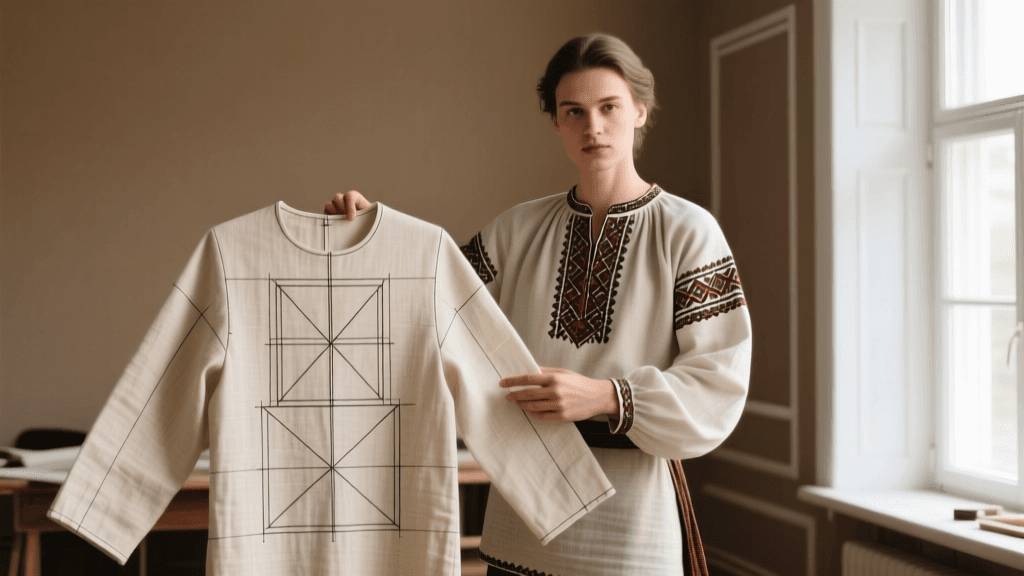
In 2026, the intersection of historical European folk dress and the modern zero-waste fashion movement has reached a pivotal moment. As contemporary sewists and sustainable designers seek alternatives to the wasteful, curved pattern cutting of the fast-fashion era, they are looking back centuries to the geometric brilliance of traditional peasant garments. Among the most masterful of these is the Slavic rubakha (and its Nordic cousin, the skjorte). These traditional folk shirts were born from a profound respect for woven textiles. In historical Eastern European and Scandinavian villages, handwoven linen was a precious commodity that took hundreds of hours to grow, process, spin, and weave. Cutting curves into the fabric and discarding the scraps was simply unthinkable.
The Philosophy of the Rectangular Cut
The foundational rule of the rubakha and skjorte is strict geometric construction. The garments are assembled entirely from rectangles, squares, and triangles. There are no curved armholes, no shaped princess seams, and no darts. Instead, the fabric is folded, gathered, and gusseted to conform to the human body. This rectangular cutting method ensures that 100% of the woven cloth is utilized in the final garment, making it the ultimate zero-waste pattern. According to researchers at the Textile Research Centre in Leiden, this economical approach to cutting not only preserved valuable resources but also created highly durable garments that could be easily mended, unpicked, and reconfigured as the wearer grew or as the fabric wore thin.
Sourcing 2026 Sustainable Linens
To authentically recreate a European folk shirt in 2026, the choice of fabric is paramount. The historical standard was unbleached or naturally dyed linen, and today's sustainable textile market offers incredible options that mirror these heritage weaves. When sourcing fabric for a rubakha, look for 2026 European Flax Alliance-certified mid-weight linens, typically ranging from 5.3 oz to 7.1 oz per square yard.
For the main body panels, a 5.3 oz (180 GSM) linen provides the perfect drape for gathering at the neck and cuffs without adding excessive bulk. For heavier, outerwear-style winter shirts, a 7.1 oz (240 GSM) slub linen offers excellent structure. In 2026, eco-conscious mills have also perfected natural botanical dyeing at scale. Consider sourcing linen dyed with traditional madder root for deep reds, or woad and indigo for historical blues, ensuring your garment remains historically grounded while supporting modern regenerative agriculture.
Drafting the Pattern: Measurements and Mathematics
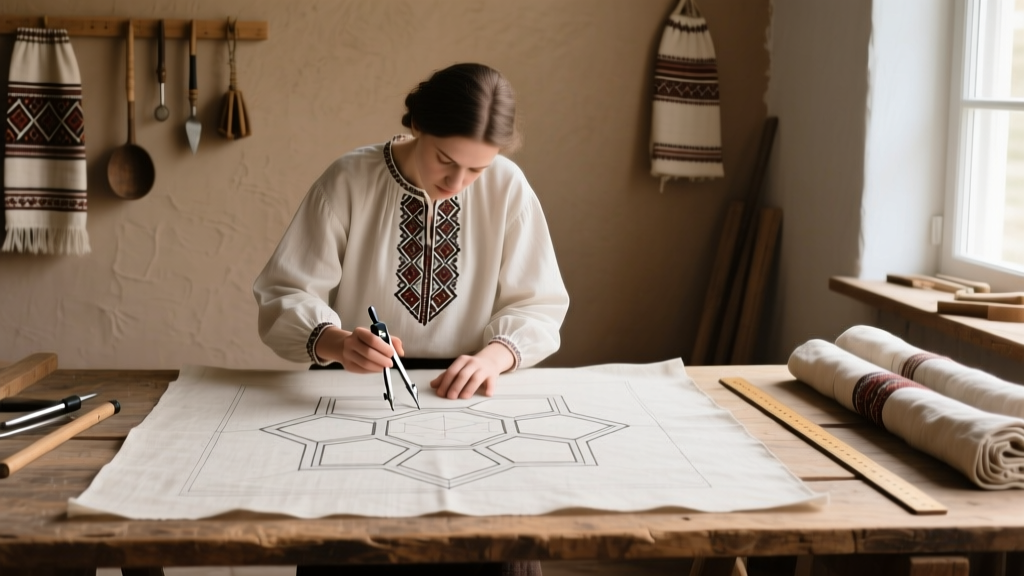
Drafting a zero-waste rubakha does not require complex curved rulers or commercial pattern paper. You only need a measuring tape, a fabric marker, and a basic understanding of your body's dimensions. The width of the historical fabric loom often dictated the width of the garment panels, but in 2026, with standard fabric bolts measuring 54 to 60 inches wide, we adapt the mathematics to fit the individual while maintaining the zero-waste ethos.
Essential Body Measurements
- Chest Circumference: Measure around the fullest part of the chest. Add 4 to 6 inches for historical ease and gathering.
- Bicep Circumference: Measure around the fullest part of the upper arm. Add 2 inches for ease.
- Wrist Circumference: Measure the wrist, adding 1 inch for ease, plus extra if you plan to use a tight buttoned cuff.
- Desired Length: Measure from the high shoulder point down to the desired hemline (historically, the rubakha fell to the mid-thigh or knee).
- Shoulder to Wrist: Measure from the base of the neck, over the shoulder, and down to the wrist bone.
2026 Zero-Waste Rubakha Cutting Guide
| Panel Name | Quantity | Width Formula | Length Formula | Purpose |
|---|---|---|---|---|
| Main Body | 1 (Folded) | Chest Circumference + Ease (Divided by 2) | Desired Length x 2 (Folded at shoulder) | Forms the front and back torso |
| Sleeves | 2 | Bicep Circumference + Ease | Shoulder to Wrist Measurement | Creates the straight, rectangular arms |
| Underarm Gussets | 2 | 4x4 inches to 6x6 inches (Based on bicep) | Square shape | Provides crucial underarm mobility |
| Side Godets | 2 or 4 | Base width 8-12 inches | From underarm to hemline | Adds flare and walking ease to the hem |
| Stand Collar | 1 | Neck Circumference + 1 inch | 1.5 to 2 inches wide | Finishes the neckline (Slavic style) |
The Magic of the Gusset (Lastovitsa)
If you were to simply sew a rectangular sleeve to a rectangular body, the resulting garment would bind tightly across the chest and restrict arm movement. The historical solution to this problem is the lastovitsa, or underarm gusset. This small square of fabric, typically measuring between 4 and 6 inches per side, is inserted at the intersection of the side seam and the sleeve seam. The gusset acts as a geometric pivot point, transforming the rigid cross-section of the shirt into a flexible joint. When drafting your 2026 pattern, the size of your gusset should scale with your bicep measurement; larger biceps require a slightly larger gusset to maintain the structural integrity of the flat-felled seams.
Side Godets and Hemline Flare
Because the main body of the rubakha is a straight rectangle, a shirt tailored to fit the chest comfortably will be quite narrow at the hem, restricting the wearer's stride. To solve this, triangular panels called godets are inserted into the side seams, usually starting just below the gusset and extending to the hem. By cutting these triangles from the negative space left over from the sleeve or body panel cutting layout, you maintain the zero-waste promise of the garment while achieving a beautiful, flared silhouette that allows for deep lunges, dancing, and agricultural labor.
Neckline Variations: Slavic vs. Nordic
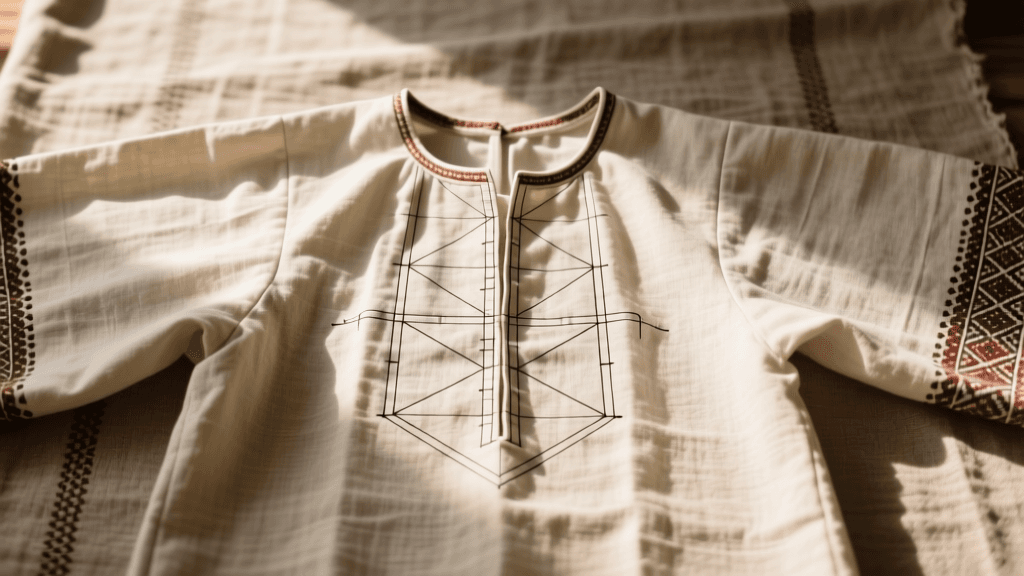
While the body and sleeves share the same rectangular DNA, the neckline is where regional variations shine. The traditional Slavic rubakha often features a short center-front slit (about 6 to 8 inches deep) finished with a narrow stand collar, sometimes fastened with a single wooden bead or woven tie. In contrast, the Nordic skjorte frequently utilizes a deeper, keyhole-style split neck without a stand collar, often gathered tightly with a linen drawstring. When cutting the neck hole, never cut a large circle. Start with a small slit and a shallow curve for the back of the neck, gathering the excess fabric of the main body panel into the collar or drawstring casing. This gathering technique creates the iconic, voluminous folds across the chest and shoulders that define European folk dress.
Seam Finishes for Longevity
Historical garments were built to last generations, and the seam finishes used in folk dress construction reflect this durability. Raw edges were never left exposed. In 2026, modern sewists can achieve historical accuracy using flat-felled seams or run-and-fell seams for all structural joins. A flat-felled seam encloses both raw edges within the seam itself, creating a clean finish on both the inside and outside of the garment while providing immense tensile strength. Utilizing modern 2026 ergonomic magnetic seam guides on your sewing machine can help you maintain the precise, consistent 1/4-inch and 1/2-inch seam allowances required for a flawless flat-felled finish on mid-weight linens.
Structural Embroidery as Reinforcement
In European folk traditions, embroidery was not merely decorative; it was deeply structural and symbolic. Dense cross-stitch and counted-thread embroidery were heavily concentrated at the structural stress points and "openings" of the garment: the neck slit, the cuffs, the armhole seams, and the hemline. Historically, it was believed that these openings were vulnerable points where evil spirits could enter the body, so dense red and black geometric embroidery (often using wool or silk threads) was applied as a protective talisman. From a construction standpoint, this dense stitching also reinforced the fabric at points prone to tearing and fraying. The Victoria and Albert Museum's textile archives highlight how these embroidered bands served a dual purpose, acting as both spiritual armor and physical reinforcement for hardworking peasant communities.
Conclusion: Heritage Meets Modern Sustainability
Constructing a Slavic rubakha or Nordic skjorte in 2026 is more than a historical reenactment; it is a profound statement on sustainable fashion. By embracing the zero-waste, rectangular cutting techniques of our ancestors, we eliminate textile waste, reduce our reliance on complex, disposable commercial patterns, and create garments that are inherently designed for longevity and repair. As noted by the Metropolitan Museum of Art's Costume Institute, the study of historical dress continually reveals the ingenuity of past generations. By integrating these time-tested geometric patterns into your modern sewing practice, you are not just making a shirt—you are preserving a vital, sustainable piece of European cultural heritage for the future.