Slavic Rubakha Tunic Pattern: Zero-Waste Construction for 2026
The Enduring Legacy of the Rubakha
The rubakha (in Russian traditions) and the sorochka (in Ukrainian traditions) represent the foundational base layer of Eastern European folk dress. For centuries, this simple, T-shaped tunic was worn by peasants and nobility alike, differentiated only by the quality of the linen and the complexity of the embroidery. In 2026, the global sustainable fashion movement has driven a massive resurgence in historical zero-waste pattern drafting, placing the Slavic rubakha at the forefront of eco-conscious garment construction. Modern makers and historical reenactors are increasingly turning to these ancient techniques to create durable, biodegradable, and entirely waste-free wardrobes.
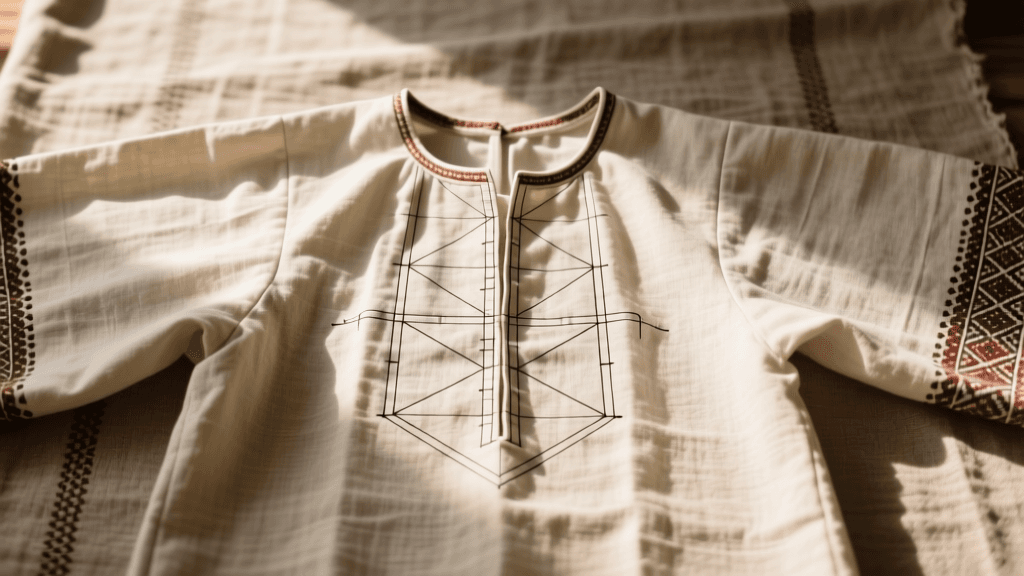
Unlike modern commercial patterns that rely on curved armholes, shaped side seams, and complex darts to contour the body, the traditional rubakha relies entirely on straight lines and rectangles. This geometric approach was born out of necessity: historical handlooms produced narrow strips of linen, and every single thread was precious. Cutting curves would result in unusable scraps. Today, understanding this historical constraint allows contemporary sewists to unlock a brilliant, mathematically perfect system of zero-waste garment creation.
The Mathematics of the Loom: Zero-Waste Geometry
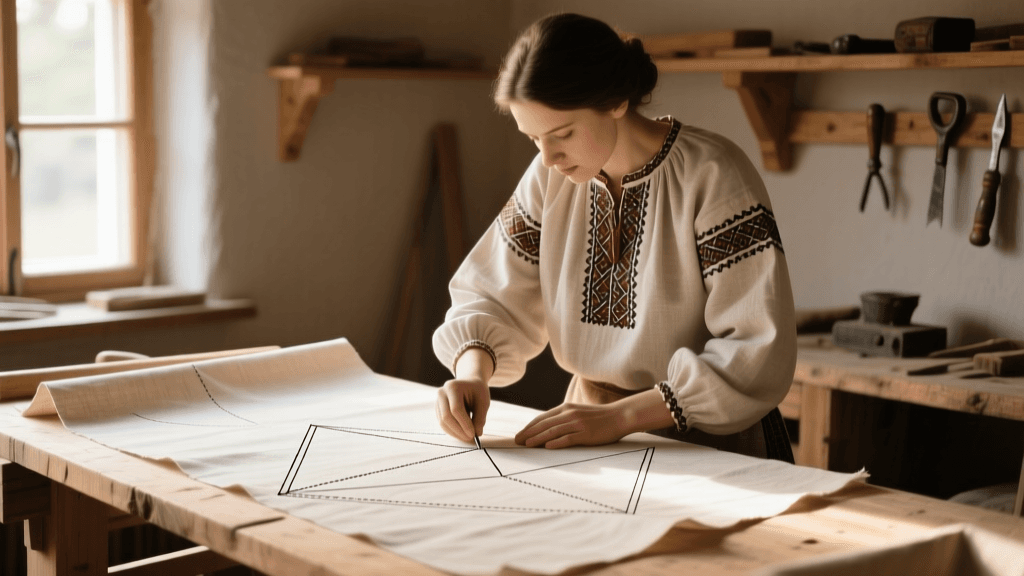
To truly master the rubakha pattern, one must think like a traditional weaver. Historical linen was typically woven on narrow looms, producing fabric widths of roughly 35 to 40 centimeters (14 to 16 inches). The pattern of the tunic was therefore dictated entirely by the loom's width. The main body panels were simply two long rectangles folded over the shoulders, while the sleeves were narrower rectangles attached at a perfect 90-degree angle.
In 2026, while most commercially available linen comes in standard widths of 140 to 150 centimeters, the zero-waste philosophy remains intact if we adapt the geometric logic. Instead of cutting narrow strips and sewing them together, modern makers can lay out the rectangular pattern pieces across the wider fabric like a jigsaw puzzle, ensuring that the negative space is utilized for smaller components like collars, cuffs, and gussets. Researchers exploring historical textile artifacts via Europeana's digital archives consistently note that the most well-preserved folk garments show an absolute minimum of fabric waste, a testament to the ingenuity of traditional village seamstresses.
Drafting the Pattern: Panels and Gussets
Drafting a rubakha requires only a few basic body measurements: the chest circumference, the desired tunic length (usually mid-thigh for men, calf-length for women), the sleeve length, and the bicep circumference. Because the garment is meant to be loose and flowing, ease is built directly into the rectangular geometry.
- Body Panels: Cut two large rectangles. The width of each rectangle is roughly half of your chest circumference plus 10-15 cm of ease. The length is the desired tunic length plus hem and shoulder fold allowances.
- Sleeves: Cut two rectangles. The width is the bicep circumference plus generous ease (at least 15 cm), and the length is the full arm measurement from the shoulder edge to the wrist.
- Neline Slit: The neckline is not a cutout curve. Instead, a simple horizontal slit is cut for the head to pass through, often finished with a small stand collar or a drawstring casing.
The Lastovitsa (Gusset) Technique
The most critical structural element of the Slavic tunic is the lastovitsa, or underarm gusset. Because the sleeves are attached at a strict 90-degree angle to the body panels, lifting the arms would pull the entire tunic upward and restrict movement if the garment were sewn flush. To solve this, a square or diamond-shaped piece of fabric (typically 10x10 cm to 15x15 cm) is inserted at the intersection of the sleeve seam and the side body seam.
This gusset acts as a pivot point, providing the necessary three-dimensional mobility without requiring curved armholes. In many regional traditions, the gusset was cut from red linen or heavily embroidered, serving both a structural purpose and a protective, talismanic function against evil spirits entering through the vulnerable underarm opening.
Fabric Allocation & Zero-Waste Breakdown
When working with standard 150 cm wide linen in 2026, strategic layout is essential to maintain the zero-waste ethos of the original garment. Below is a standard allocation chart for a medium-sized tunic, demonstrating how the negative space is entirely consumed by secondary pattern pieces.
| Pattern Component | Dimensions (Approx.) | Placement on 150cm Wide Fabric |
|---|---|---|
| Main Body Panels (x2) | 70 cm x 110 cm each | Placed side-by-side along the selvedge, utilizing 140 cm of the width. |
| Sleeves (x2) | 40 cm x 65 cm each | Cut from the remaining fabric length, placed adjacent to one another. |
| Collar & Cuffs | 15 cm x 50 cm strips | Cut from the narrow 10 cm offcut left over from the body panels. |
| Gussets (x2) | 15 cm x 15 cm squares | Cut from the spaces between the sleeve curves or selvedge edges. |
| Embroidery Floss / Belting | Variable | Any remaining microscopic strips are braided into traditional waist belts (pojas). |
Seam Construction and Embroidery Placement
Historical garments were subjected to rigorous daily labor, boiling washes, and harsh weather. To ensure longevity, all seams on a rubakha were finished using the run-and-fell (flat-felled) seam technique. This involves sewing the pieces together, trimming one seam allowance, folding the other over it, and topstitching it flat against the garment. This encloses all raw edges, preventing fraying without the need for modern sergers or synthetic overlocking threads.
Embroidery on the rubakha was never purely decorative; it was deeply symbolic and protective. According to traditional Slavic cosmology, evil forces could enter the body through the garment's openings. Therefore, counted-thread cross-stitch, satin stitch, and drawn-thread work (similar to Hardanger) were heavily concentrated at the neckline, the sleeve cuffs, and the bottom hem. The predominant color was red, derived from madder root, symbolizing life, blood, and solar energy. As recognized by cultural preservation efforts tracked on UNESCO's Intangible Cultural Heritage lists, the specific geometric motifs—such as the eight-pointed star (Aalatyr) and rhombus patterns representing sown fields—remain vital markers of regional identity across Eastern Europe.
Sourcing Authentic Linen in 2026
The success of a rubakha relies heavily on the textile. Modern synthetic blends or heavily processed cottons lack the structural integrity, breathability, and historical accuracy required for this garment. In 2026, the gold standard for traditional garment makers is certified European Flax linen. Organizations like European Flax ensure that the linen is grown without artificial irrigation, defoliation, or harmful chemicals, maintaining the ecological purity that aligns with the zero-waste philosophy of the pattern itself.
When selecting your fabric, look for a medium-to-heavy weight linen (between 180 and 220 GSM) with a slightly slubbed texture. Pre-washing the linen in hot water and drying it on high heat before cutting is mandatory. This pre-shrinks the fibers and softens the hand of the fabric, mimicking the well-worn feel of a garment that has been washed in a river and beaten against wooden blocks, as was the historical practice.
Conclusion
The Slavic rubakha is much more than a historical curiosity; it is a masterclass in sustainable, ergonomic, and deeply meaningful garment construction. By embracing the zero-waste geometry of the handloom era, modern sewists in 2026 can create clothing that respects both the environment and the rich cultural heritage of Eastern Europe. Whether you are crafting a meticulously embroidered festival shirt or a simple, durable daily tunic, the mathematical elegance of the rubakha pattern ensures a garment that is as functional as it is beautiful.