Slavic Rubakha Zero-Waste Gusset Construction Guide 2026
The Resurgence of Zero-Waste Historical Sewing in 2026
As the global fashion industry faces increasing scrutiny over textile waste, the year 2026 has seen a massive resurgence in historical, zero-waste sewing techniques. Among the most celebrated and structurally ingenious of these traditions is the construction of the Slavic rubakha (or sorochka). This traditional folk shirt, worn across Eastern Europe and the Balkans, is a masterclass in geometric pattern making. Unlike modern tailored garments that curve and cut away fabric, the rubakha relies entirely on rectangles, squares, and triangles, ensuring that not a single scrap of precious handwoven linen is wasted.
For modern makers and historical costumers, understanding the construction patterns of the rubakha—specifically the insertion of the lastovitsa (underarm gusset) and the klin (side gores)—offers a profound connection to European folk dress heritage. In this comprehensive guide, we will break down the exact measurements, drafting techniques, and sewing sequences required to construct an authentic, zero-waste Slavic shirt using 2026 sustainable textiles and modern drafting tools.
Sourcing Authentic Materials: 2026 Linen Standards
Historically, the rubakha was woven from hemp or flax on narrow looms, typically yielding fabric widths of 36 to 40 centimeters. The entire pattern was dictated by this loom width. Today, while most commercial linens are woven at 140cm or 150cm widths, sourcing authentic, heavy-weight European flax linen remains crucial for an accurate drape and silhouette.
In 2026, heritage mills in Belgium and Lithuania have introduced specialized 'loom-width' runs specifically for historical reproduction makers. When sourcing your fabric, look for medium-to-heavy weight linens ranging from 180gsm to 220gsm. Expect to pay between €25 and €35 per meter for certified organic, retted European flax. To maintain the zero-waste philosophy, calculate your yardage based on the traditional geometric layout rather than modern commercial pattern estimates.
Drafting the Geometric Base: Rectangles and Math
The foundation of the rubakha is a series of interlocking rectangles. Modern makers in 2026 frequently use open-source digital drafting software like Seamly2D to map out these geometric blocks, allowing for precise scaling based on individual body measurements while strictly adhering to straight-grain lines.
According to extensive archives of regional variations available through the Europeana traditional costumes collection, the basic anatomical blocks of the shirt remain remarkably consistent across Slavic regions:
- The Body Panel: A single, continuous rectangle folded over the shoulders, or two separate rectangles (front and back) joined at the shoulder seam.
- The Sleeves: Long, wide rectangles. The width of the sleeve at the bicep is usually exactly one fabric width (or a mathematically divided fraction of your modern 140cm fabric).
- The Collar and Cuffs: Narrow, straight-grain bands used to gather the excess fabric of the body and sleeves.
The Lastovitsa: Mastering the Underarm Gusset
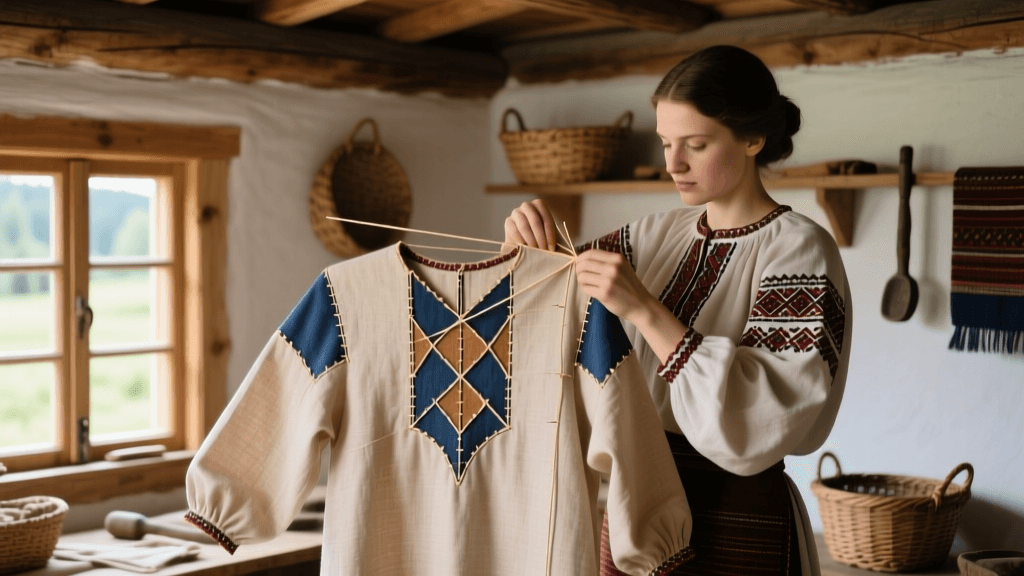
The true genius of the rubakha lies in the lastovitsa, the diamond-shaped gusset inserted at the underarm. Because the sleeve is a simple rectangle sewn directly to a rectangular body panel, the intersection creates immense tension and restricts arm movement. The gusset solves this geometric puzzle, providing a three-dimensional pivot point without requiring curved armholes.
Step-by-Step Gusset Insertion
- Cut the Square: Cut a perfect square of linen, typically measuring 12cm x 12cm to 15cm x 15cm depending on the wearer's proportions.
- Fold on the Bias: Fold the square diagonally to form a triangle, and press. When inserted, the straight grain of the gusset will sit on the bias (45-degree angle) relative to the body and sleeve, allowing the woven linen to stretch and move with the body.
- Mark the Intersections: On your sleeve and body panels, mark the exact point where the side seam and the underarm sleeve seam meet. Snip the fabric exactly to this point, finishing the raw edges with a fray check or a quick overlock to prevent unraveling during handling.
- Sew the Upper Half: Pin the gusset to the sleeve's underarm seam allowance, right sides together. Sew from the outer edge of the sleeve inward, stopping exactly at the pivot point with the needle down.
- Pivot and Attach the Body: Pivot the fabric and pin the adjacent side of the gusset to the body panel's side seam. Sew inward to the center point.
- Complete the Diamond: Repeat this process for the remaining two sides of the gusset, ensuring all four corners meet perfectly at the center pivot point without puckering.
Adding the Klin: Side Gores for Hem Volume
While the gusset provides upper-body mobility, the klin (side gores) provide lower-body volume. Traditional rubakhas were often worn over layers of skirts or trousers, requiring a wide hem for walking, bending, and agricultural labor.
The klin are simple right-angled or isosceles triangles inserted into the side seams from the hem upward. In 2026, zero-waste pattern cutters often use the triangular voids left over from cutting the neckline or the bias gussets to create these side gores, achieving a literal 100% fabric utilization rate. For a standard hem width, insert two to four gores per side, sewing them into vertical slits cut into the lower body panels or extending the side seams upward from the hem.
2026 Construction Comparison: Historical vs. Modern Adaptations
While the geometry remains untouched, the tools and finishing techniques have evolved. Below is a comparison of how historical methods translate to the modern maker's studio in 2026.
| Construction Feature | Historical Method (Pre-1900) | Modern 2026 Adaptation |
|---|---|---|
| Fabric Width | 36-40cm (Narrow handloom) | 140cm (Divided mathematically to mimic narrow loom proportions) |
| Seam Finishes | Hand-sewn flat-felled or whip-stitched | Machine flat-felled using specialized 2026 Bernina/Janome felling feet |
| Gusset Reinforcement | Hand-embroidered bar tacks at stress points | Hidden internal stay tape or dense machine zigzag at pivot points |
| Pattern Drafting | Measured directly on fabric using an arshin (traditional ruler) | Digital parametric drafting (e.g., Seamly2D) printed on zero-waste layout plotter |
Seam Finishing and Embroidery Integration
Because the rubakha was worn as an undergarment or a primary layer against the skin, all internal seams must be completely enclosed to prevent fraying and scratching. The traditional flat-felled seam is mandatory. In 2026, with the rise of advanced domestic sewing machines, achieving a perfect 3mm flat-felled seam on heavy linen is highly accessible, provided you use a heavy-duty needle (Size 100/16) and high-tensile linen thread.
Crucially, the construction sequence must be planned around the embroidery. Slavic folk dress is renowned for its intricate cross-stitch and drawn-threadwork, particularly around the collar, cuffs, and chest placket. Do not sew the side seams or attach the collar until all flat-panel embroidery is complete. Hooping or hand-stretching a fully assembled tubular garment will distort the geometric grain lines and ruin the tension of your counted-thread embroidery.
The Philosophy of Zero-Waste Folk Dress
Studying the rubakha is not merely an exercise in historical costuming; it is a vital lesson in sustainable design. As highlighted by contemporary sustainable fashion researchers and platforms like Zero Waste Design Online, the geometric constraints of historical folk dress offer brilliant solutions to modern textile waste. By forcing the designer to use the entirety of the rectangular cloth through gussets, gores, and strategic gathering, the Slavic rubakha proves that sustainability and striking, volumetric silhouettes are not mutually exclusive.
Whether you are hand-stitching every seam using historically accurate waxed linen thread or utilizing modern digital drafting to scale your pattern, the geometric heart of the rubakha remains a timeless testament to European ingenuity. By adopting these zero-waste construction patterns in 2026, makers are not just preserving a cultural legacy; they are actively participating in the future of sustainable garment creation.