Recreating the Ancient Greek Chiton: A 2026 Reenactor's Guide
The Resurgence of Classical Antiquity in 2026
As we navigate the 2026 historical reenactment and Hellenic festival season, the demand for rigorous historical accuracy in ancient Mediterranean garments has reached an all-time high. No longer are participants satisfied with cheap, synthetic costume-shop approximations of classical antiquity. Today's dedicated reenactors, museum educators, and cultural revivalists are turning to primary archaeological evidence and advanced textile sourcing to recreate the chiton—the foundational garment of ancient Greek and Roman daily life. Whether you are preparing for a major summer solstice Hellenic festival or curating a living history exhibit, mastering the drape, weight, and construction of the chiton is essential.
The chiton was not merely a piece of cloth; it was a complex, unstitched garment that relied entirely on the mathematical precision of its folds, the strategic placement of pins (fibulae), and the cinching of belts (zonai) to create its iconic silhouette. According to the World History Encyclopedia, the chiton evolved significantly from the Archaic period through the Hellenistic era, reflecting shifts in trade, textile technology, and cultural exchange across the Mediterranean. This comprehensive guide will walk you through the nuances of the Doric and Ionic variations, how to source historically accurate fabrics in 2026, and the precise draping techniques required to achieve an authentic classical silhouette.
Understanding the Chiton: Doric vs. Ionic Variations
To accurately recreate ancient Greek dress, one must first understand the fundamental differences between the two primary styles of the chiton: the Doric and the Ionic. While both are constructed from rectangular lengths of fabric, their materials, draping methods, and visual outcomes are distinctly different.
The Doric Chiton (Peplos)
Often referred to interchangeably with the peplos in its earliest forms, the Doric chiton is the older, heavier, and more austere of the two styles. Originating in the mainland Greek tradition, it was typically woven from wool. The Doric chiton features a deep overfold at the top, known as the apoptygma, which drapes over the chest and back. It is pinned at the shoulders, leaving the sides either entirely open or loosely tacked, and is belted at the waist. The heavier wool creates sharp, angular, and sculptural folds that are famously depicted in classical marble statuary.
The Ionic Chiton
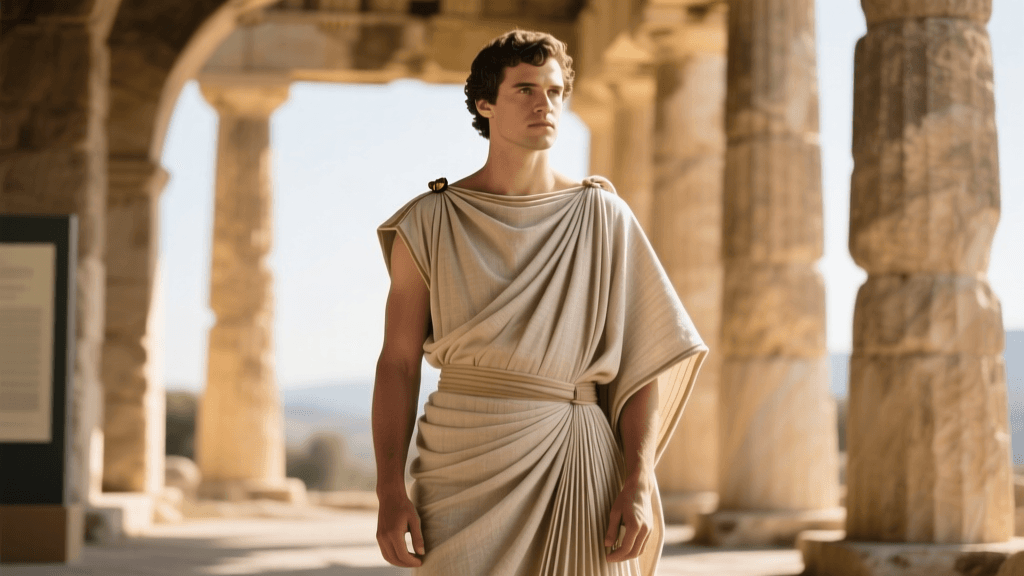
Introduced later and heavily influenced by Eastern Mediterranean and Anatolian textile traditions, the Ionic chiton is characterized by its lighter, more fluid drape. Woven from linen (and occasionally silk for the ultra-wealthy in later periods), the Ionic chiton lacks the deep apoptygma of the Doric style. Instead, it is gathered and pinned at multiple points along the arms, creating the illusion of short, flowing sleeves. As noted by The Metropolitan Museum of Art, the Ionic chiton's reliance on fine linen allowed for a multitude of delicate, rippling folds that clung to the body, representing a shift toward more sensual and dynamic representations of the human form in classical art.
Sourcing Authentic Textiles in 2026
The success of your chiton relies entirely on the weight, weave, and fiber content of your fabric. In 2026, the historical textile market has matured, with several European and North American mills producing historically accurate, hand-woven, and shuttle-loomed fabrics specifically for the reenactment community. Avoid modern synthetics, jersey knits, and heavily processed cottons, which lack the necessary structural memory to hold classical pleats.
| Fabric Type | Weight (GSM) | Drape Quality | Best Suited For |
|---|---|---|---|
| Medium-Weight Linen | 150-180 | Fluid, structured folds | Ionic Chiton |
| Lightweight Wool | 200-250 | Heavy, angular draping | Doric Chiton / Peplos |
| Silk-Linen Blend | 120-140 | Sheer, ethereal flow | High-status Ionic (Hellenistic) |
| Raw Hemp | 220-260 | Stiff, utilitarian | Working-class Doric variants |
When purchasing linen for an Ionic chiton, look for 'half-bleached' or unbleached linen with a visible slub in the yarn. This mimics the irregularities of ancient hand-spun threads. For the Doric wool, seek out lightweight tropical wools or finely woven merino that has been fulled slightly to prevent fraying at the raw edges, as ancient Greek garments were often woven to shape on the loom and left with unhemmed selvedges.
Precision Measurements and the Kolpos
Unlike modern tailored clothing, the chiton is entirely unstitched. Its fit is determined by the dimensions of the rectangular cloth. To calculate the correct amount of fabric for your 2026 project, you will need a flexible measuring tape and a basic understanding of your own proportions.
- Width: Measure your wingspan (fingertip to fingertip with arms outstretched). For a standard Doric chiton, add 12 to 18 inches to this measurement to allow for the side overlap and the bulk of the apoptygma. For an Ionic chiton, the width should be at least twice your wingspan to accommodate the multiple sleeve pins.
- Height: Measure from the nape of your neck (or the top of your shoulder) down to your ankle bone. To this measurement, you must add the kolpos allowance. The kolpos is the bloused overhang created when the garment is belted. Add at least 18 to 24 inches to your vertical measurement to ensure the kolpos falls elegantly over the belt without exposing your legs when you walk.
Step-by-Step Draping Technique
Draping a chiton is an art form that requires patience and a full-length mirror. Here is the step-by-step process for achieving a museum-quality Doric drape.
Step 1: Create the Apoptygma
Hold the fabric behind your back. Fold the top edge down to create the overfold (apoptygma). The depth of this fold should reach anywhere from your waist to your hips, depending on the desired style and the length of your fabric.
Step 2: Pin the Shoulders
Bring the front and back layers of the fabric over your shoulders. Pin them together at intervals using historical replica fibulae. For a basic Doric chiton, one pin per shoulder is sufficient. Ensure the pins are placed far enough apart to allow the neckline to rest comfortably across your collarbones without choking you.
Step 3: Belt the Garment (The Zone)
Tie a woven wool or linen belt (zone) tightly around your natural waist or slightly higher, just under the bust, depending on the historical period you are portraying. Pull the fabric up and over the belt to create the kolpos. Adjust the blousing evenly around your body so the hem falls at a uniform height just above the ankles.
Step 4: Adjust the Side Seams
The Doric chiton is traditionally open on the left side. However, for modern reenactment and public festivals, many participants choose to loosely tack the side closed with a few hidden stitches or small, discreet pins to maintain modesty while moving through crowds.
Sourcing Hardware: Fibulae and Zonai
The hardware used to secure your chiton is just as important as the textile. In 2026, the artisan community on platforms like Etsy and specialized historical outfitters offer exceptional, museum-grade replicas of ancient bronze and silver fibulae. Look for 'omega' or 'omega-arc' fibulae for early Archaic Doric styles, and 'bow' or 'annular' fibulae for later Classical and Hellenistic periods.
'The fibula was not merely a functional fastener; it was a highly visible marker of status, regional identity, and wealth. The metallurgical composition of the pin often dictated the drape and security of the heavy woolen peplos.' — Curatorial Notes on Mediterranean Bronze Age Fasteners.
For the belt, avoid modern leather corsetry belts. Instead, source tablet-woven wool belts featuring geometric meander (key) patterns, or simple, long cords of braided linen that can be wrapped multiple times around the waist and tied in a complex Heracles knot at the front.
Natural Dyeing for the Modern Reenactor
While the stereotype of ancient Greece is one of pristine white marble and undyed linen, the reality of the ancient world was incredibly colorful. If you wish to elevate your 2026 chiton, consider natural dyeing. Madder root (Rubia tinctorum) will yield authentic terracotta reds and deep pinks. Weld (Reseda luteola) provides the vibrant, colorfast yellows favored by brides and priestesses. Woad or indigo can be used to achieve the deep blues seen in fresco paintings from Pompeii and Herculaneum. When dyeing, always use an alum mordant to ensure the color remains vibrant through multiple festival weekends and washings.
Maintenance, Washing, and Storage
Caring for unstitched, naturally dyed historical garments requires specific protocols. Never machine wash a historically accurate wool Doric chiton. Instead, spot clean with cold water and a mild, lanolin-rich soap. For linen Ionic chitons, hand washing in cool water followed by line drying in the shade will preserve the fibers and prevent the dye from fading.
When storing your chiton between events, do not hang it on modern wire hangers, as this will stretch the fibers and distort the shoulder lines. Instead, fold the garment loosely along its natural drape lines, interleaving the folds with acid-free tissue paper, and store it in a breathable cotton canvas bag in a cool, dark environment. This ensures your meticulously sourced and draped garment will remain a staple of your historical wardrobe for years to come.
Conclusion
Recreating the ancient Greek chiton in 2026 is a deeply rewarding pursuit that bridges the gap between modern textile arts and ancient engineering. By respecting the historical distinctions between the Doric and Ionic styles, investing in high-quality natural fibers, and mastering the geometry of the drape, you do more than just wear a costume—you embody the living history of the classical world. Whether you are walking the grounds of a living history museum or participating in a contemporary Hellenic cultural revival, your chiton will stand as a testament to the enduring elegance of ancient European folk dress.