Drafting the Slavic Rubakha in 2026: Zero-Waste Pattern Guide
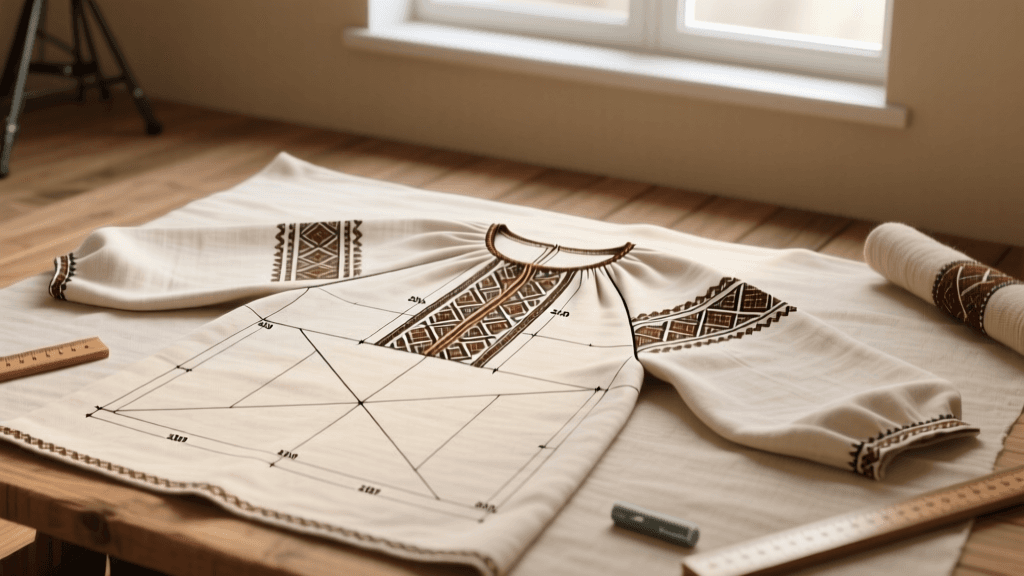
The Enduring Geometry of the Slavic Rubakha
The global shift towards sustainable, circular fashion in 2026 has brought historical, zero-waste pattern drafting back to the forefront of the sewing and historical costuming community. Among the most ingenious of these historical systems is the construction of the Slavic rubakha (also known as the sorochka in Ukraine or rubashka in Russia). This traditional Eastern European folk shirt is a masterclass in geometric efficiency, designed centuries ago to ensure that not a single thread of hand-woven linen was wasted. Today, as modern makers align with circular fashion principles, the rubakha offers a perfect blueprint for zero-waste garment creation.
Unlike contemporary commercial patterns that rely on curved seams and generate significant off-cuts, the rubakha is constructed entirely from rectangles, squares, and straight lines. This geometric approach respects the loom's natural output. In 2026, with digital weaving and standardized fabric widths, adapting these ancient techniques requires a bit of mathematical translation, but the core ethos remains identical: every piece of cut fabric must be integrated into the structural integrity of the garment.
Essential Materials and 2026 Linen Sourcing
When constructing a traditional sorochka or rubakha, the choice of fabric is paramount. Historically, these garments were woven from locally grown flax, resulting in narrow fabric widths (often 35 to 45 centimeters). Today, standard European flax linen is milled at widths of 140 to 150 centimeters. This abundance of width requires a strategic layout to maintain the zero-waste philosophy.
For an authentic yet wearable 2026 folk dress or shirt, mid-weight linen (180 to 220 GSM) is highly recommended. This weight provides the necessary opacity for a shirt while remaining breathable for summer festivals and historical reenactments. In the current 2026 textile market, premium European flax linen typically retails between €28 and €38 per meter. Because zero-waste drafting utilizes 100% of the purchased yardage, your material investment is entirely translated into wearable garment area, eliminating the hidden cost of fabric scraps.
Before cutting, it is critical to pre-wash and press your linen. Modern 2026 milling processes often leave residual starches that relax after the first wash. Machine wash your uncut linen at 40°C and tumble dry on medium to pre-shrink the fibers, ensuring your meticulously calculated geometric panels do not distort after assembly.
The Mathematics of Zero-Waste Drafting
The foundation of the rubakha is the main body panel. Rather than cutting a curved armhole, the garment hangs from the shoulders in a straight, T-shaped silhouette. The width of the body panels is determined by the wearer's chest circumference plus substantial ease for mobility and traditional gathering.
Core Measurement Formulas
- Main Body Width: (Full Chest Circumference ÷ 2) + 10 cm of ease per panel. For a 100 cm chest, each front and back panel will be 60 cm wide.
- Main Body Length: Shoulder to desired hemline + 4 cm for hem allowance. For a traditional knee-length shirt, this is typically 90 to 100 cm.
- Sleeve Width: Bicep circumference + 8 cm ease. Sleeves are cut as straight rectangles, typically 45 to 50 cm wide.
- Sleeve Length: Shoulder point to wrist + 5 cm for cuff gathering and hem.
By mapping out these rectangles on a 140 cm wide piece of linen, you will inevitably have leftover vertical strips. In a zero-waste system, these strips are not discarded; they are mathematically subdivided to create the collar, cuffs, neckline facings, and the most crucial structural element of the garment: the underarm gusset.
Fabric Allocation and Pattern Layout
To visualize how a 140 cm wide linen layout is entirely consumed without waste, refer to the allocation chart below. This layout assumes a standard medium build and utilizes every off-cut for structural reinforcements or traditional embellishment bands.
| Garment Component | Historical Loom Width Adaptation | 2026 Standard Width (140cm) Layout | Zero-Waste Scrap Integration |
|---|---|---|---|
| Main Body Panels (x2) | Straight loom width (40cm) | 60cm wide x 100cm long | Remaining 20cm side strips used for cuffs |
| Sleeves (x2) | Straight loom width (40cm) | 50cm wide x 65cm long | Tapering off-cuts at wrist form the gussets |
| Lastovitsa / Gusset (x2) | 10x10 cm Diamond | 12x12 cm Diamond (Better mobility) | Cut directly from sleeve taper off-cuts |
| Collar & Cuffs | Separate woven bands | Self-fabric straight grain strips | Selvedge edges utilized for internal ties |
The Lastovitsa: Mastering the Underarm Gusset
The defining feature of the rubakha's construction, and a hallmark of Eastern European textile heritage, is the lastovitsa (underarm gusset). Because the body and sleeves are cut as perpendicular rectangles, joining them directly creates a severe tension point at the underarm, restricting movement and inviting fabric tears. The lastovitsa is a diamond-shaped piece of fabric inserted at this junction, transforming a rigid T-shape into a dynamic, three-dimensional garment that allows the wearer to raise their arms fully without lifting the entire shirt.
Step-by-Step Gusset Insertion
- Prepare the Diamond: Cut a 12 cm x 12 cm square on the bias (45-degree angle to the selvedge). This bias cut allows the gusset to stretch and conform to the underarm hollow.
- Mark the Pivot Points: On the main body side seam, mark a 12 cm slit where the sleeve will join. On the sleeve seam, mark a corresponding 12 cm slit. Use a water-soluble pen to mark the exact pivot points where the seams intersect.
- Clip and Pin: Clip into the seam allowances precisely up to the marked pivot points. Pin the straight edges of the diamond gusset to the clipped edges of the body and sleeve, right sides together.
- The Pivot Stitch: Sew the first edge of the diamond, stopping exactly with the needle down at the pivot point. Lift the presser foot, rotate the fabric, and continue sewing the adjacent edge. This precision prevents puckering and ensures a clean interior finish.
Neckline Slit and Collar Construction
Traditional Slavic shirts rarely feature modern curved necklines. Instead, they utilize a shallow, gathered neckline with a deep center-front or center-back slit, known as a pazukha. This slit allows the garment to pass over the head and is secured with woven ties or a simple wooden button.
To draft this in a zero-waste manner, cut a straight slit down the center front of the body panel, measuring approximately 25 to 30 cm. The facing for this slit is created using a single, continuous straight-grain strip of linen harvested from your layout off-cuts. By folding the strip in half and attaching it to the slit using a flat-felled seam, you enclose all raw edges, providing immense durability without the need for modern sergers or synthetic bias tape.
Seam Finishes and Traditional Embellishment
To ensure the garment survives generations of wear and washing, all internal seams of the rubakha must be finished meticulously. The historical standard is the flat-felled seam. This technique involves sewing the panels wrong sides together, trimming one seam allowance by half, folding the longer allowance over the shorter, and topstitching it flat against the garment. While time-consuming, this creates a seam that is virtually indestructible and looks identical on both the interior and exterior of the shirt.
Embellishment in Eastern European folk dress is never purely decorative; it serves a talismanic purpose, protecting the wearer's vulnerable openings (neck, wrists, and hem) from malevolent spirits. In 2026, modern makers often use DMC or Anchor cotton embroidery floss to replicate traditional redwork cross-stitch or drawn-thread work (merezhka). When planning your embroidery, it is vital to execute it before assembling the garment. Hooping a flat sleeve panel or a flat body hem is significantly easier than attempting to embroider a fully constructed, tubular garment.
For those studying historical linen garment construction, the placement of these motifs is highly codified. Geometric stars and solar symbols are traditionally clustered at the shoulder line and cuffs, while the hemline features continuous bands of earth-motifs to symbolize fertility and grounding.
Conclusion
Drafting and constructing a Slavic rubakha in 2026 is more than a historical exercise; it is a profound engagement with sustainable design. By embracing the geometric constraints of the loom, mastering the structural brilliance of the lastovitsa gusset, and utilizing every centimeter of premium linen, modern makers can create folk dress that honors Eastern European heritage while championing the future of zero-waste fashion.