Ancient Greek Chiton Draping and Fabric Guide for 2026
The Resurgence of Classical Garments in 2026
The study and reconstruction of ancient European folk dress have reached new heights in 2026, driven by a global resurgence in historical reenactment, Hellenic cultural festivals, and academic textile analysis. At the forefront of this classical revival is the chiton, the foundational garment of ancient Greece that profoundly influenced the sartorial landscape of the Mediterranean. Unlike tailored modern clothing, the chiton was a masterclass in draping, relying on the geometric manipulation of rectangular textiles to create elegant, functional, and socially significant silhouettes.
Whether you are preparing for a summer performance at the Athens & Epidaurus Festival, participating in a university classics symposium, or simply exploring the roots of European textile traditions, understanding the mechanics of the chiton is essential. This comprehensive guide will walk you through the structural differences between the Doric and Ionic styles, how to source historically accurate fabrics in today's market, and the precise measurements required for authentic draping.
Doric vs. Ionic: A Structural Comparison
The ancient Greeks primarily wore two variations of the chiton, each reflecting different regional influences, climate needs, and aesthetic preferences. According to The Metropolitan Museum of Art's Heilbrunn Timeline of Art History, the evolution from the heavier Doric style to the lighter Ionic style represents a shift in trade, textile technology, and cultural exchange with the East.
| Feature | Doric Chiton (Peplos) | Ionic Chiton |
|---|---|---|
| Primary Material | Heavyweight wool or coarse linen | Fine, lightweight linen or silk blends |
| Construction | Single rectangular cloth, folded over (apoptygma) | Wider rectangle, often sewn at the sides |
| Fastening | Pinned at the shoulders with large fibulae | Pinned or sewn along the upper arms (sleeves) |
| Drape & Silhouette | Structured, columnar, heavy folds | Fluid, voluminous, intricate micro-pleats |
| Historical Era | Archaic Period (c. 800–480 BCE) | Classical & Hellenistic Periods (c. 480–31 BCE) |
Sourcing Authentic Textiles for Modern Reconstructions
The success of your chiton relies entirely on the drape and weight of your fabric. In 2026, the market for historically accurate, naturally dyed textiles has expanded significantly, making it easier than ever to avoid the synthetic sheen of modern polyester blends that ruin historical silhouettes.
Choosing the Right Weight
- For the Doric Chiton: Seek out medium-to-heavyweight wool flannel or a dense 7 oz to 9 oz linen. The fabric must have enough body to hold the deep, structured folds of the apoptygma (the overfold) without collapsing.
- For the Ionic Chiton: Opt for a lightweight, semi-sheer linen (around 3.5 oz to 5.3 oz). Handkerchief-weight linen is ideal for achieving the myriad of tiny, crinkled folds seen in classical Hellenistic sculpture.
Natural Dyes and Colorways
Contrary to the "white marble" myth of classical antiquity, ancient garments were vibrantly colored. Modern botanical dyers in 2026 are achieving stunning historical accuracy using madder root for deep reds, weld and saffron for brilliant yellows, and woad or indigo for blues. When sourcing your fabric, look for undyed, unbleached greige linen and partner with a natural dye studio, or purchase pre-dyed textiles from specialized heritage weavers who use alum mordants.
Step-by-Step Draping Guide: The Ionic Chiton
The Ionic chiton is highly versatile and flattering on all body types. As noted by the World History Encyclopedia's entry on the Chiton, this garment was essentially a wide tube of fabric that created sleeves through strategic pinning. Here is how to construct and drape it for a modern wearer.
1. Taking Measurements and Cutting
The Ionic chiton requires a single, wide rectangle of fabric.
- Width: Measure the wearer's wingspan (fingertip to fingertip) or simply use a width that is twice the wearer's hip measurement. For an average adult, a width of 110 to 130 inches is standard.
- Height: Measure from the highest point of the shoulder down to the floor, then add 8 to 12 inches to allow for the kolpos (the bloused overhang created by the belt).
2. The Draping Process
- The Side Seam: Fold the fabric in half widthwise. Sew the raw edges together from the bottom hem up to about 6 inches below the top edge, leaving the top open for the armholes.
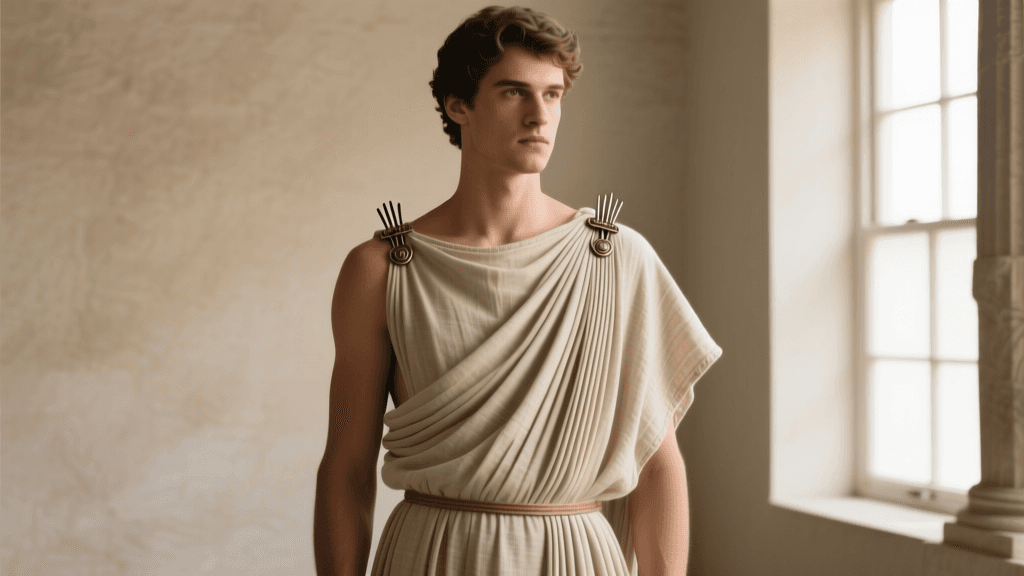
- Shoulder Pinning: Have the wearer step into the tube. Gather the top edge at the front and back over the left shoulder and pin them together using a historical fibula or a safety pin (if hidden). Repeat this process at intervals along the upper arm to create the iconic Ionic "sleeve." Leave a gap for the head.
- The Right Shoulder: Repeat the pinning process on the right shoulder and down the right arm.
- Belt and Kolpos: Tie a woven wool or linen cord (the zone) around the natural waist. Pull the fabric up and over the belt so that the hem falls gracefully just above the ankles. This creates the kolpos, a pouch of fabric that can be used to carry small items.
- Cross-Binding (Optional): For a more complex look, wrap a second cord around the torso, crossing it under the bust and over the shoulders to secure the back of the sleeves.
"The beauty of the Greek chiton lies not in the cutting of the cloth, but in the living architecture of its folds upon the human form." — Dr. Elena Rostova, Textile Historian, 2026 European Heritage Symposium.
Essential Accessories: Fibulae and Footwear
No chiton is complete without its functional hardware. The fibula (ancient brooch) was the linchpin of classical dress. For 2026 reenactments, avoid cheap, cast-zinc alloy replicas. Instead, invest in sand-cast bronze or brass fibulae crafted by specialized metalworkers. The penannular brooch or the classic bow fibula are excellent choices that provide the necessary tension to hold heavy linen without tearing the weave.
For footwear, the krepis (a leather sandal with a thick sole and ankle straps) is the most accurate pairing for a Greek chiton. Ensure the leather is vegetable-tanned rather than chrome-tanned to maintain historical integrity and avoid harsh chemical odors during summer festivals.
Roman Adaptations: The Tunica and Stola
As the epicenter of Mediterranean power shifted from Athens to Rome, the Greek chiton evolved into the Roman tunica. While the Greeks celebrated the fluid drape of the unstitched cloth, the Romans introduced more tailoring and social stratification through dress. According to the World History Encyclopedia's guide to Roman Clothing, the Roman tunica was often woven to shape on the loom or sewn from two pieces of fabric joined at the shoulders and sides, rather than draped from a single continuous rectangle.
For women, the tunica was layered beneath the stola, a sleeveless, floor-length overdress suspended by straps (institae) over the shoulders. The stola was the ultimate symbol of the Roman matron, representing modesty and civic virtue. If you are transitioning your wardrobe from Hellenic to Roman, you will need to incorporate the palla (a large rectangular mantle draped over the head and shoulders) and the stola, utilizing heavier, more opaque wools and incorporating the Roman love for Tyrian purple borders and woven clavi (vertical stripes).
Maintenance and Care for Heritage Garments
Preserving naturally dyed linens and wools requires a departure from modern laundry habits. Never use commercial enzymatic detergents or bleach, as these will strip botanical dyes and degrade protein fibers like wool.
- Washing: Hand wash in cool water using a pH-neutral soap specifically designed for delicate textiles or a mild olive-oil-based soap.
- Drying: Never wring out your chiton. Roll it in a clean, dry towel to press out excess moisture, then lay it flat on a mesh drying rack out of direct sunlight to prevent UV fading.
- Storage: Store your garments flat or rolled around acid-free tissue paper in a cedar chest. Hanging heavy wool peplos garments on modern wire hangers will distort the warp and weft threads over time.
Conclusion
The chiton remains a testament to the ingenuity of ancient European textile traditions. By prioritizing historically accurate materials, mastering the geometric art of draping, and respecting the maintenance needs of natural fibers, modern enthusiasts can bring the elegance of the ancient Mediterranean to life. Whether you are stepping onto a theatrical stage or attending a historical symposium in 2026, your reconstructed garments will serve as a living bridge to the classical past.