Slavic Rubakha Zero-Waste Pattern Drafting Guide 2026
The Renaissance of Zero-Waste: Why the Rubakha Matters in 2026
The global shift toward sustainable, zero-waste fashion in 2026 has sparked a massive revival in historical European garment construction. Among the most mathematically elegant and resource-efficient designs is the traditional Slavic rubakha (also known as the sorochka or vyshyvanka base). Worn across Ukraine, Belarus, Russia, and the Carpathian regions, this traditional chemise represents a masterclass in geometric pattern drafting. Unlike modern Western tailoring, which relies on complex curved armholes and significant fabric waste, the rubakha is constructed entirely from rectangles, squares, and triangles. This guide explores the precise construction patterns, loom-width constraints, and gusset engineering required to draft and sew an authentic, zero-waste Slavic rubakha using contemporary 2026 techniques and materials.
Understanding the Geometry of the Loom
To understand the pattern of the rubakha, one must first understand the technology of the traditional Slavic loom. Historically, handwoven linen was produced in narrow widths, typically ranging from 36 to 40 centimeters (14 to 16 inches). Because cutting curved shapes into this precious, labor-intensive fabric would result in unusable scraps, village tailors and seamstresses developed a strictly rectilinear pattern system. The Metropolitan Museum of Art's Costume Institute notes that historical European peasant dress frequently relied on these loom-width constraints to dictate the silhouette, resulting in garments that were entirely modular. In 2026, modern weavers and textile mills still produce specialty 'loom-width' linen specifically for historical reenactors and sustainable fashion designers, keeping this geometric tradition alive.
Drafting the Base Rectangles: A Step-by-Step Guide
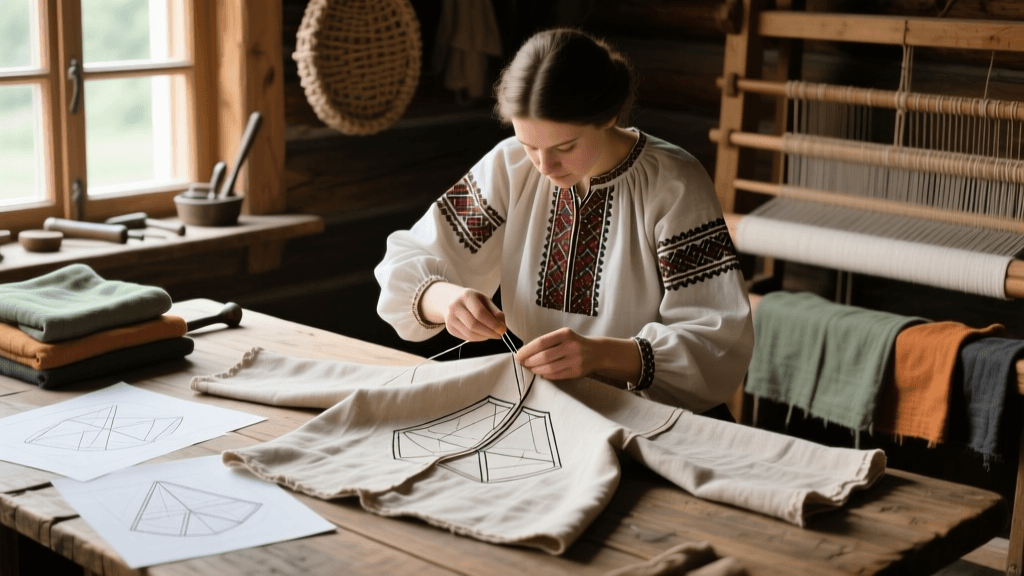
Drafting a rubakha requires abandoning standard modern slopers and embracing a grid-based approach. The garment is typically composed of a front panel, a back panel, sleeves, and structural gussets. Here is how to calculate your dimensions for a standard adult medium:
1. The Body Panels (Stan)
The front and back panels are identical rectangles. The width is exactly one loom width (e.g., 38 cm). The length is calculated by measuring from the highest point of the shoulder down to the desired hemline, plus 4 cm for hem and seam allowances. For a tunic-length shirt, this is usually around 85 cm.
2. The Sleeve Panels (Rukav)
The sleeves are also simple rectangles. The width is determined by the desired fullness at the bicep, often utilizing 1.5 to 2 times the base loom width (approx. 60-75 cm) for a gathered effect. The length is measured from the shoulder edge to the wrist, plus 6 cm for a traditional deep cuff.
3. The Yoke or Shoulder Insert (Polik)
Depending on the specific regional variation (such as the Carpathian or Poltava styles), the sleeve may attach directly to the body panel, or it may feature a rectangular or square shoulder insert known as a polik. This piece acts as a structural bridge, distributing the tension of the gathered fabric and preventing tearing at the shoulder seam.
Engineering Mobility: The Lastovitsa (Underarm Gusset)
The most critical engineering feat of the rubakha is the lastovitsa, or underarm gusset. Because the body panels and sleeves are strictly rectangular, sewing them together at a 90-degree angle creates a restrictive, immobile corner. The lastovitsa is a small square or diamond-shaped piece of fabric inserted at the intersection of the side seam and the underarm sleeve seam. According to extensive textile research documented by the Smithsonian Center for Folklife and Cultural Heritage, these gussets were essential for agrarian workers, providing the necessary range of motion for swinging scythes, lifting heavy loads, and reaching overhead without tearing the linen.
| Gusset Feature | Historical Village Specification | 2026 Modern Adaptation |
|---|---|---|
| Shape | Strict square or diamond | Square with slightly rounded corners for machine sewing |
| Dimensions | 10 cm x 10 cm to 15 cm x 15 cm | 12 cm x 12 cm (Standardized for modern ergonomic fits) |
| Grainline | Straight grain or true bias | True bias (45 degrees) to maximize stretch and recovery |
| Reinforcement | Hand-whipped edges | Fray-Check or serged edges before insertion |
Assembly: Mastering the Flat-Felled Seam
Because the rubakha was historically worn as both an undergarment and an outer shirt, the interior finishing had to be as pristine as the exterior. Raw edges were never left exposed. The traditional solution is the flat-felled seam, a technique that encloses all raw edges within the seam itself. In 2026, while historical purists still execute these seams by hand using a running stitch and whipstitch, modern makers can achieve identical structural integrity using specialized sewing machine attachments. Using a Bernina #70 or an equivalent narrow hemmer/flat-felled foot allows you to sew a perfect 6mm enclosed seam in medium-weight linen. When assembling the lastovitsa, precision is paramount. Sew the gusset to the sleeve underarm first, press the seams open or to one side, and then carefully pivot to attach the adjacent edges to the body side seams. The corners of the gusset must be clipped precisely to the stitch line to allow the fabric to lay flat without puckering.
Embroidery Placement and Structural Alignment
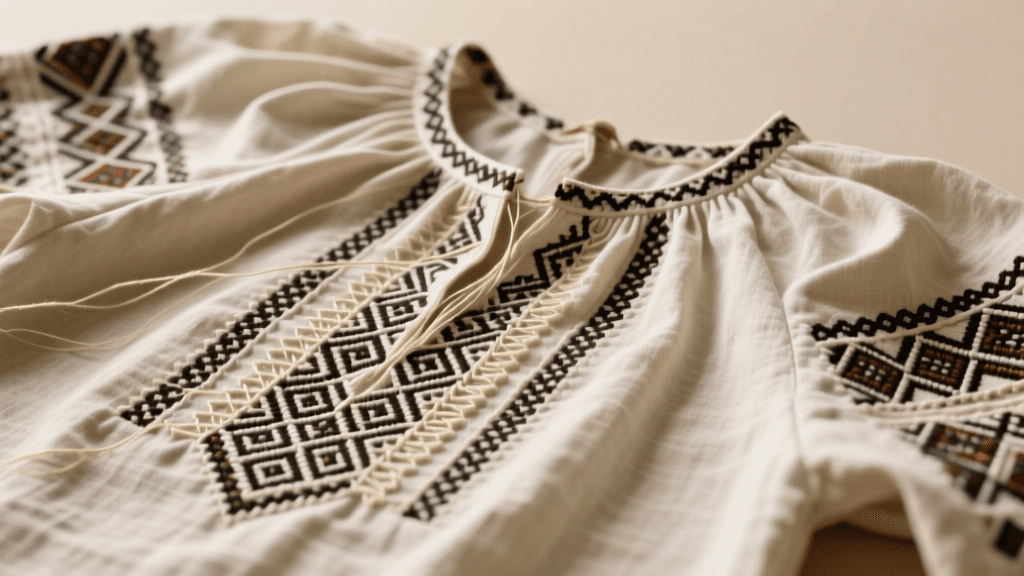
The construction of the rubakha is inextricably linked to its surface decoration. Traditional Slavic embroidery (such as the Ukrainian vyshyvka) was not merely decorative; it was deeply symbolic and structurally integrated. Embroidery was heavily concentrated along the structural seams—the cuffs, the hem, the collar, and the shoulder inserts. In a zero-waste pattern, these seams represent the points where the garment interacts most with the environment and the human body. By reinforcing these seams with dense cross-stitch, satin stitch, or cutwork, historical makers effectively stabilized the high-stress areas of the linen. When drafting your 2026 pattern, you must account for the take-up of the fabric during dense embroidery. A heavily embroidered cuff can shrink the linen width by up to 10%, so it is standard practice to cut the sleeve rectangles slightly wider and trim them to the exact loom-width only after the embroidery is completed and the fabric has been pressed.
Sourcing Authentic Loom-Width Linen Today
While modern commercial linen is typically woven in 140 cm to 150 cm widths, the authentic rubakha experience requires narrower fabric to truly honor the zero-waste geometry. Fortunately, the 2026 sustainable textile market has seen a resurgence in specialty weaving mills, particularly in Lithuania, Belarus, and Ukraine, that produce authentic 38 cm and 40 cm loom-width linen. When sourcing your fabric, look for 'handwoven' or 'narrow-loom' specifications. Medium-weight linen (between 180 and 220 GSM) is ideal for the main body panels, providing enough drape for comfort while maintaining the structural rigidity required for the gussets and gathered cuffs. For the embroidery, a higher thread-count, even-weave linen (approx. 28 to 32 count) is preferred to ensure precise stitch counting. As highlighted by the Victoria and Albert Museum's fashion archives, the intersection of textile production limitations and regional aesthetic expression is what makes European folk dress a perpetual source of inspiration for contemporary patternmakers.
Conclusion
Drafting a Slavic rubakha is a profound exercise in sustainable design and historical empathy. By embracing the strict geometric constraints of the loom, modern makers in 2026 can create garments that produce zero fabric waste, require minimal curved seaming, and offer exceptional mobility through the ingenious use of the lastovitsa gusset. Whether you are constructing a historically accurate reproduction or adapting these zero-waste principles for a modern sustainable wardrobe, the mathematics of the rubakha remain as relevant and brilliant today as they were centuries ago.