The Ultimate Chiton Draping Guide 2026: Doric & Ionic Styles
The 2026 Revival of Classical Antiquity Garments
The chiton remains the quintessential garment of ancient Greece, a masterpiece of draped textile engineering that has influenced Western fashion for millennia. As of 2026, the historical reenactment community and theatrical costume departments have seen a massive resurgence in demand for historically accurate classical garments. Moving away from the stiff, synthetic costumes of the past, modern classicists and reenactors now prioritize authentic drape, period-correct natural fibers, and precise draping techniques. Whether you are preparing for a major classical antiquity festival this summer or designing for a contemporary neoclassical stage production, mastering the chiton is essential.
According to The Metropolitan Museum of Art's Heilbrunn Timeline of Art History, the ancient Greeks did not cut and sew their garments to fit the body; rather, they draped rectangular pieces of fabric around the form, securing them with pins and belts. This fundamental philosophy of dress requires a completely different approach to garment construction than modern tailoring. In this comprehensive 2026 guide, we will break down the two primary variations of the chiton—the Doric and the Ionic—and provide actionable, step-by-step instructions for sourcing, measuring, and draping them flawlessly.
Doric vs. Ionic: Understanding the Core Differences
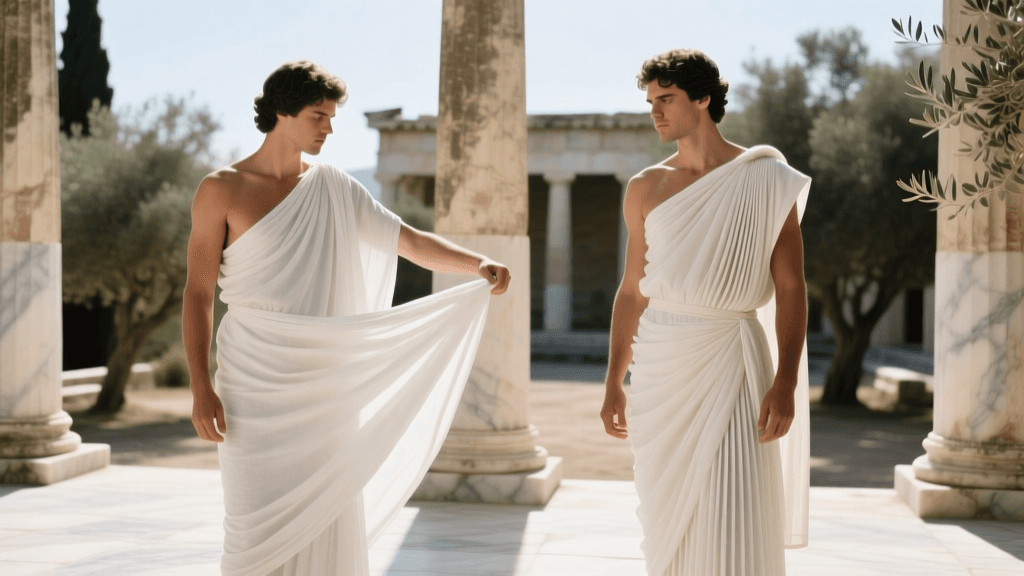
Before purchasing fabric, it is crucial to understand the structural and historical differences between the two main styles of the chiton. The Doric chiton (often referred to as a peplos when worn by women) and the Ionic chiton differ in fabric weight, construction, and draping methodology.
| Feature | Doric Chiton (Peplos) | Ionic Chiton |
|---|---|---|
| Era of Prominence | Archaic to Early Classical (c. 600–400 BCE) | Classical to Hellenistic (c. 500–100 BCE) |
| Primary Fabric | Heavyweight Wool | Lightweight Linen or Silk |
| Side Seams | Open on the left side | Sewn closed into a tube |
| Shoulder Fastening | One or two large fibulae (brooches) | Multiple small pins creating sleeve-like effects |
| Overfold (Apoptygma) | Prominent, deep fold over the chest | Rare or non-existent |
| Drape and Movement | Structured, heavy, columnar | Fluid, pleated, highly dynamic |
Furthermore, the British Museum's extensive antiquities archives reveal through marble statuary and terracotta figurines that the Ionic chiton was often worn with a complex system of girdling that created intricate, rippling folds, whereas the Doric peplos presented a more austere, monumental silhouette.
Sourcing Authentic Fabrics in 2026
The success of your chiton relies entirely on the drape of the fabric. In 2026, the textile market offers excellent options for historically accurate materials, but you must know what to look for to avoid modern, heavily processed fabrics that behave poorly when draped.
For the Doric Peplos: Wool
You need a lightweight to medium-weight wool with a high twist and a fluid drape. Avoid stiff coating wools or heavily fulled melton fabrics. Look for 'tropical weight' wool or fine merino wool challis. In 2026, specialty historical textile mills in the UK and Italy are producing authentic tabby-weave wools dyed with natural madder and weld. Expect to pay between $35 and $55 per meter for high-quality, historically accurate wool suitable for a Doric chiton.
For the Ionic Chiton: Linen
The Ionic chiton requires a lightweight, semi-sheer linen that can hold crisp pleats while flowing in the wind. Opt for a linen weighing between 120 and 150 GSM (grams per square meter). Handkerchief-weight linen is ideal. Avoid heavy, rustic linens meant for upholstery. Modern European mills are currently producing exceptional wet-spun linens that mimic the fine, almost translucent qualities described in ancient texts. Prices in 2026 for premium garment-grade linen range from $25 to $45 per meter.
Measurements and Cutting Guide
Unlike modern patterns, the chiton is cut using simple geometric rectangles based on the wearer's body measurements. You will need a flexible measuring tape and a large, flat surface for cutting.
Calculating Your Fabric Dimensions
- Width: Measure the wearer's arm span from elbow to elbow (with arms outstretched). Add 15 to 20 centimeters for ease and blousing. This is your fabric width.
- Height (Length): Measure from the highest point of the shoulder down to the desired hemline (usually the ankle or floor). For a Doric peplos, you must add an additional 45 to 60 centimeters to the top of this measurement to account for the apoptygma (the overfold).
Example Calculation for a 170 cm tall wearer making a Doric Peplos:
Width: 140 cm (elbow to elbow) + 20 cm ease = 160 cm total width.
Height: 140 cm (shoulder to floor) + 50 cm (overfold) = 190 cm total height.
You will need a single rectangle of wool measuring 160 cm by 190 cm.
Step-by-Step Draping: The Doric Peplos
The Doric peplos is an open garment, meaning the side is not sewn shut. It relies on gravity, the overfold, and the belt to stay in place.
- Create the Overfold: Lay your wool rectangle flat. Fold the top edge down by 45 to 60 cm. This folded section is the apoptygma. It should hang over the chest and back.
- Wrap the Body: Wrap the fabric around the wearer's body, leaving the left side open. The open edge should fall at the left hip or thigh, allowing for ease of movement.
- Pin the Shoulders: Gather the front and back layers (including the overfold) at the shoulders, roughly halfway between the neck and the edge of the shoulder. Secure these points with sturdy, historically accurate bronze or iron fibulae. Ensure the pins are sharp and have secure catch-plates to prevent the heavy wool from slipping.
- Belt the Waist: Tie a woven wool or leather belt around the natural waist, over the overfold. Pull the fabric up slightly over the belt to create a kolpos (a bloused effect) that hides the belt and adjusts the hemline to the perfect length.
Step-by-Step Draping: The Ionic Chiton
The Ionic chiton is a closed tube, offering more modesty and allowing for complex sleeve formations.
- Sew the Side Seam: Fold your lightweight linen rectangle in half widthwise. Sew the vertical edges together to create a large fabric tube. Finish the seams with a flat-felled stitch for historical accuracy and durability.
- Pin the Shoulders: Unlike the Doric style, the Ionic chiton uses multiple pins along the top edge to create faux sleeves. Starting at the front neckline, pinch the front and back layers together and pin them. Continue pinning at 5 to 7 cm intervals along the top edge, over the shoulder, and down the upper arm. Leave a gap for the head to pass through.
- Add the Armholes: The outermost pin on each side will serve as the boundary for the armhole. Ensure the gap between the last shoulder pin and the side seam is large enough for the arm to move freely.
- Girdle and Blouse: The Ionic chiton is typically belted high under the bust or at the natural waist. Because the linen is lightweight, you can create multiple kolpos blouses by adding a second belt at the hips and pulling the fabric down gracefully over both belts, creating a tiered, rippling effect.
Securing the Garment: Fibulae and Modern Safety
In 2026, safety and authenticity must go hand-in-hand, especially for theatrical performances or active reenactment. Ancient fibulae operated much like modern safety pins, but replica brooches purchased from specialty historical vendors often feature blunt or poorly tensioned pins.
Pro-Tip for 2026 Reenactors: Always test your fibulae on scrap fabric before wearing them. If the pin is too blunt to pierce tightly woven linen without tearing it, carefully sharpen the tip with a fine jeweler's file. For heavy wool Doric chitons, use 'penannular' or 'ring' brooches with long, sturdy pins that can pass through multiple layers of the apoptygma without bending. To protect the wearer's skin from sharp pin points, apply a small dab of clear nail polish or jeweler's wax to the very tip of the catch-plate to keep it securely closed during vigorous movement.
Final Touches: The Himation and Footwear
A chiton was rarely worn alone in public. To complete your classical ensemble, you must incorporate the himation—a large, heavy rectangular cloak draped over the left shoulder and wrapped around the body. The himation should be made of a heavier wool than the chiton, providing warmth and a striking visual contrast in color.
For footwear, avoid modern leather sandals with thick rubber soles. The 2026 standard for high-level historical accuracy dictates the use of krepides—leather sandals with open toes, secured by intricate lacing that wraps around the ankle and lower calf. Pair your draped chiton with minimalist leather krepides, and you will achieve a silhouette that is both historically impeccable and visually stunning.
Maintenance and Care for Natural Fibers
Caring for your hand-draped garments ensures their longevity. Wool Doric chitons should rarely be washed; instead, air them out in a breezy, shaded area and use a soft bristle brush to remove dust. If a spill occurs, spot-clean with cold water and a lanolin-based wool wash.
Linen Ionic chitons can be machine washed on a gentle, cold cycle, but they must be line-dried while still slightly damp. Ironing linen while damp on a high-heat setting will restore the crisp, structured pleats necessary for the Ionic drape. Store your garments flat or rolled rather than hung, as hanging heavy wool over long periods can distort the warp and weft of the fabric, ruining the carefully calculated drape.