Slavic Rubakha Pattern Cutting: Zero-Waste Gusset Techniques 2026
Introduction to the Slavic Rubakha and Zero-Waste Geometry
The Slavic rubakha (also known as the sorochka or kosovorotka depending on the specific regional collar style) is a masterclass in geometric efficiency and textile conservation. Long before the term 'zero-waste' entered the mainstream 2026 sustainable fashion lexicon, Eastern European peasants and artisans were engineering garments that left absolutely no fabric scraps on the cutting room floor. In 2026, as the historical costuming and slow fashion communities increasingly prioritize environmental sustainability, the rectangular construction pattern of the rubakha has seen a massive revival. Understanding this traditional European folk dress construction is not merely an exercise in historical reenactment; it is a profound lesson in spatial reasoning, textile respect, and sustainable garment engineering.
Unlike modern commercial patterns that rely on curved armholes, shaped princess seams, and complex darts that generate significant fabric waste, the traditional rubakha is constructed entirely from rectangles, squares, and triangles. This geometric approach ensures that every single thread of the woven cloth is utilized in the final garment. According to researchers at the Metropolitan Museum of Art's Costume Institute, the study of peasant dress reveals a deep, intrinsic connection between the limitations of the loom and the ultimate silhouette of the garment.
The Mathematics of Rectangular Pattern Cutting
To understand the rubakha, one must first understand the historical constraints of the loom. Historically, linen and hemp were woven on narrow shuttle looms, producing fabric that was typically only 36 to 45 centimeters (14 to 18 inches) wide. Because the fabric was so narrow, creating a garment with any volume or ease of movement required piecing together multiple straight strips. The weaver and the tailor were often the same person, or at least worked in tandem, meaning the cutting layout was planned before the yarn was even spun.
In 2026, most commercially available linen comes in widths of 140 to 150 centimeters (55 to 60 inches). While this modern width eliminates the need to piece the main body panels together, the zero-waste philosophy demands that we adapt the historical layout to modern dimensions without generating offcuts. When drafting a rubakha pattern on modern 140cm linen, the negative space left after cutting the main body panels and sleeves is precisely calculated to yield matching accessories, such as a headscarf (platok) or woven belt sashes, ensuring the zero-waste ethos is maintained.
Calculating the Base Measurements
The foundation of the rubakha is the main body panel. Unlike modern shirts that are cut on the fold with curved side seams, the rubakha body is often a single, massive rectangle that folds over the shoulders, or two identical rectangles joined at the shoulder seam. To calculate the width of the body panel, you take the full chest measurement, add a minimum of 15 centimeters (6 inches) for historical ease and gathering, and divide by two if using a front-and-back panel construction. The length is determined by the wearer's height, typically falling to the mid-calf for women or just below the knee for men, plus a 5-centimeter hem allowance.
The Crucial Role of Gussets (Lastovitsa)
The most defining technical feature of the Slavic rubakha is the underarm gusset, known in Russian as the lastovitsa. Because the sleeves are cut as simple, wide rectangles that attach directly to the rectangular body panel at a 90-degree angle, the garment would be incredibly restrictive and prone to tearing at the underarm stress point without a gusset. The lastovitsa is a square or diamond-shaped piece of fabric inserted at the intersection of the side seam and the sleeve seam. It provides the necessary three-dimensional volume for arm movement while maintaining the zero-waste rectangular cutting grid.
As recognized by UNESCO's Intangible Cultural Heritage lists, the preservation of these specific tailoring techniques is vital for maintaining the authenticity of regional folk dress, particularly in Eastern European traditions where the gusset was often highlighted with contrasting embroidery or colored fabric.
Step-by-Step Gusset Insertion Technique
Inserting a gusset is widely considered the most intimidating technique for beginners in historical European folk dress construction. However, with precise marking and careful pivoting, it becomes a straightforward process. In 2026, modern fabric markers and precision rulers have made this process more accurate than ever.
- Step 1: Mark the Pivot Point. On the wrong side of your sleeve and body panel, mark the exact seam allowance intersection (usually 1 cm or 5/8 inch from the raw edges). This dot is your pivot point.
- Step 2: Stitch the First Edge. With right sides together, pin one edge of the square gusset to the sleeve seam edge, stopping exactly at your marked pivot point. Stitch up to the pivot point, leaving the needle down in the fabric.
- Step 3: Clip the Seam Allowance. Carefully clip into the seam allowance of the main body panel at the intersection, stopping just one or two threads shy of your stitch line. This allows the fabric to open up and lie flat.
- Step 4: Pivot and Stitch the Second Edge. Rotate the fabric around the needle, aligning the clipped edge of the body panel with the adjacent edge of the gusset. Stitch to the next corner, and repeat the process until all four sides of the gusset are securely joined.
Once inserted, the seams are traditionally finished using a run-and-fell or flat-felled seam to prevent fraying and to add structural integrity to the high-stress underarm area.
2026 Fabric Recommendations for Historical Accuracy
Selecting the correct textile is paramount. The rubakha was traditionally made from hand-woven linen, which has a distinct slubby texture, high tensile strength, and a beautiful drape that softens with wear. In 2026, the global linen market has seen a resurgence in heritage flax farming, particularly in Western Europe, providing costuming professionals with exceptional, historically accurate options. Conservation experts at the Victoria and Albert Museum's textile archives frequently note that the longevity of historical linen garments is directly tied to the tightness of the weave and the quality of the flax retting process.
| Fabric Type | Weight | Best Use | 2026 Sourcing Tip |
|---|---|---|---|
| IL019 Medium Linen | 5.3 oz/yd² | Everyday Rubakha | Opt for undyed ecru to bleach naturally in the 2026 summer sun for an authentic patina. |
| 4C22 Rustic Linen | 7.1 oz/yd² | Outerwear / Winter Rubakha | Excellent for heavily embroidered pieces; the rustic slubs mimic historical hand-spun yarns. |
| Bockens 16/2 Linen | Sheer / Fine | Festive / Bridal Sorochka | Source from specialized Scandinavian weaving suppliers for museum-quality sheer collars. |
Modern Tools and Notions for the 2026 Maker
While the geometry remains ancient, the tools available to the 2026 maker have evolved to ensure precision and ease. When working with medium-to-heavy weight linens, using the correct needle is crucial to prevent thread breakage and fabric damage. We recommend using Schmetz Embroidery needles (size 90/14) when stitching through multiple layers of flat-felled seams. For thread, modern synthetic blends are entirely inappropriate for historical folk dress. Instead, utilize 100% linen threads, such as Bockens 35/2 linen sewing thread, which possesses the same shrinkage rate and tensile strength as the fabric itself, ensuring the seams do not pucker after the first wash.
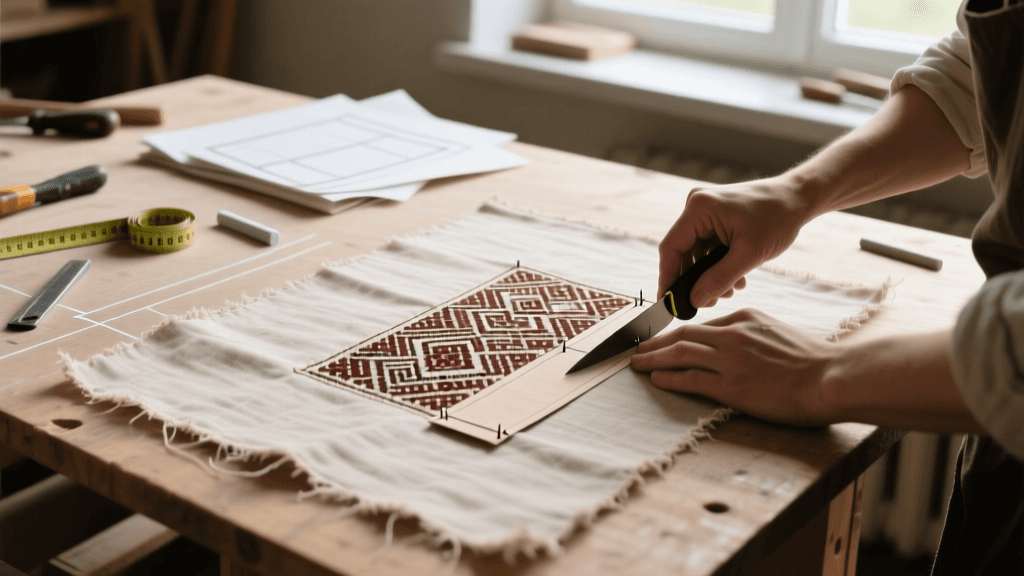
For cutting, a 60mm rotary cutter paired with a heavy-duty self-healing mat and a 15cm x 60cm clear acrylic quilting ruler will ensure your rectangular panels are cut with perfect 90-degree angles, which is the absolute foundation of a successful zero-waste layout.
Seam Finishing and Embroidery Placement
In Slavic folk tradition, the seams of the rubakha were not merely structural; they were spiritual vulnerabilities. It was believed that evil spirits could enter the body through the openings and seams of the garment. Consequently, apotropaic (protective) embroidery was heavily concentrated at the neck, the cuffs, the hem, and directly over the structural seams where the gusset met the body. When constructing your rubakha, you must plan your embroidery placement before you assemble the garment. It is significantly easier to execute complex cross-stitch or drawn-thread work on a flat, unsewn rectangular panel than to maneuver a fully assembled garment under an embroidery hoop.
For seam finishes, the traditional flat-felled seam is highly recommended. This technique encloses all raw edges within the seam itself, making the garment incredibly durable and comfortable against the skin. In 2026, many historical costumers use a specialized flat-felled seam foot for their sewing machines to achieve uniform, historically convincing topstitching on the interior of the garment.
Conclusion
The construction of the Slavic rubakha is a testament to the ingenuity of historical European textile workers. By embracing rectangular pattern cutting and mastering the insertion of the lastovitsa gusset, modern makers can create garments that are not only historically accurate and deeply meaningful but also aligned with the zero-waste imperatives of 2026. Whether you are crafting a festive sorochka for a cultural festival or a simple, everyday linen tunic for sustainable living, the geometric precision of the rubakha offers a timeless blueprint for respectful, waste-free garment creation.