Master Slavic Rubakha Zero-Waste Pattern Drafting in 2026
In 2026, the global fashion industry's pivot toward circularity and zero-waste design has sparked a massive revival in historical European garment construction. Among the most mathematically elegant and historically significant of these traditions is the Slavic rubakha (also known as the sorochka or shirts). Unlike modern pattern drafting, which relies on curved armholes, princess seams, and significant fabric waste, the traditional rubakha is a masterclass in geometric efficiency. Every single centimeter of the woven cloth is utilized, resulting in a garment that is not only deeply rooted in Eastern European cultural heritage but also perfectly aligned with contemporary sustainable sewing practices.
The Philosophy of Zero-Waste in Slavic Folk Dress
Historically, hand-woven linen was a precious commodity. The labor-intensive process of growing flax, retting, scutching, spinning, and weaving meant that wasting fabric was unthinkable. According to research on Eastern European textile traditions documented by the Metropolitan Museum of Art, the geometric construction of folk shirts across Slavic regions was directly dictated by the width of the weaver's loom. This constraint birthed a brilliant system of rectangular pattern drafting. By using only straight lines, right angles, and strategic folding, seamstresses created garments that allowed for maximum mobility without discarding a single scrap of cloth. In 2026, as modern sewists seek to minimize their environmental footprint, these centuries-old techniques offer a proven, stylish blueprint for zero-waste wardrobe building.
Essential Materials and Tools for 2026
To authentically recreate the rubakha while embracing modern comforts, selecting the right materials is paramount.
- Fabric: Opt for 100% European flax linen. In 2026, medium-weight linen (around 190-220 GSM) from certified sustainable mills in Lithuania or Belarus remains the gold standard. You will need approximately 3.5 to 4 meters of fabric, assuming a standard commercial width of 140 cm.
- Thread: Use a high-quality, long-staple cotton or linen thread (50/3 or 60/2 weight) for structural seams, and a thicker 2-ply wool or cotton floss for traditional embroidery.
- Measuring Tools: A flexible fiberglass measuring tape, a clear acrylic quilting ruler (at least 60 cm long), and a traditional tailor's square are essential for ensuring your right angles remain perfectly true.
- Marking Implements: Water-soluble fabric markers or traditional tailor's chalk. Avoid permanent inks, as the rubakha is designed to be boiled and heavily laundered over its lifetime.
Step-by-Step Rectangular Pattern Drafting
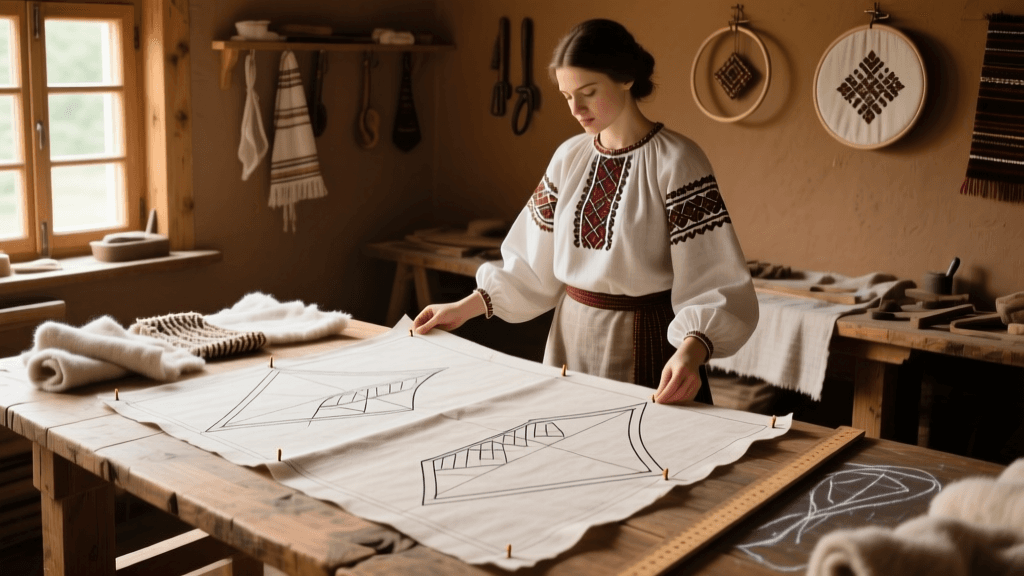
The beauty of the rubakha lies in its modularity. The pattern consists entirely of rectangles and squares. There are no curved armholes or shaped necklines. Instead, volume and shape are created through gathering and the insertion of geometric gussets.
Calculating the Core Rectangles
The main body of the shirt is typically constructed from two large rectangles (front and back) or one massive rectangle folded over the shoulders.
- Body Width: Measure your chest circumference. Add 15 to 20 cm for ease, then divide by two. This is the width of your front and back body panels.
- Body Length: Measure from the highest point of your shoulder down to your desired hemline (traditionally mid-calf for women, knee-length for men). Add 4 cm for hem and seam allowances.
- Sleeve Panels: The sleeves are simple rectangles. The width is determined by the bicep circumference plus generous ease (at least 15 cm), and the length is measured from the shoulder edge to the wrist, plus 5 cm for a deep cuff.
Drafting the Neckline Slit
Unlike modern garments with curved, scooped necklines, the traditional rubakha features a simple straight slit down the center front or shoulder. To draft this, measure your head circumference to ensure the opening will pass over your head when gathered. Typically, a 25 cm horizontal neck width combined with a 10 cm vertical center-front slit provides ample room. The edges are finished with a narrow, straight-grain binding strip.
Fabric Allocation and Measurement Chart
Adapting historical loom widths to modern 2026 commercial fabric widths requires mathematical adjustment. Historically, loom widths ranged from 35 to 45 cm. Today, commercial linen is typically 140 to 150 cm wide.
| Garment Component | Traditional Loom Width (cm) | Modern 2026 Linen Width (cm) | Zero-Waste Adaptation Technique |
|---|---|---|---|
| Main Body Panels | 35 - 45 | 140 - 150 | Cut front and back as one continuous tube or fold the wide fabric to utilize the selvedge as a finished hem. |
| Sleeve Rectangles | 35 - 45 | 140 - 150 | Cut two sleeves side-by-side from the remaining width after body panels are removed, ensuring zero offcuts. |
| Underarm Gussets (Lastovitsa) | 12 x 12 | 12 x 12 | Cut from the narrow negative spaces left between the sleeve and body panel cuts on the modern wide fabric. |
| Neckline Binding & Cuffs | 5 - 8 | 5 - 8 | Slice long, narrow strips from the extreme edges of the fabric layout to bind the gathered neckline and wrists. |
The Structural Secrets: Gussets and Gores
If you simply sew rectangular sleeves to a rectangular body, the garment will bind tightly under the arms and restrict movement. The genius of Slavic construction lies in the lastovitsa (underarm gusset) and the polik (shoulder gusset).
The Lastovitsa (Underarm Gusset)
The lastovitsa is a square or diamond-shaped piece of fabric inserted at the intersection of the side seam and the sleeve seam. Typically measuring 12x12 cm to 15x15 cm, this small square completely transforms the geometry of the shirt. It provides the necessary three-dimensional volume for the arm to lift and rotate. When drafting your layout, ensure you reserve enough fabric to cut these squares on the straight grain to prevent bias stretching and subsequent distortion during washing.
The Polik (Shoulder Insert)
In many regional variations, particularly in northern Russian and Belarusian traditions, a rectangular shoulder insert called a polik bridges the gap between the front and back body panels and the sleeve. The polik is often heavily embroidered, serving both a structural purpose—distributing the tension of the gathered neckline—and a decorative one. It acts as a yoke, anchoring the heavy gathers of the sleeve and body panels securely to the shoulder line.
Seam Finishes and Embroidery Placement
Because the rubakha was worn directly against the skin and subjected to rigorous laundering, all internal seams must be enclosed. The traditional flat-felled seam (or run-and-fell seam) is mandatory. This technique involves sewing the pieces together, trimming one seam allowance, folding the wider allowance over the trimmed edge, and topstitching it down. This creates a remarkably strong, fray-proof seam that lies flat against the skin, preventing chafing.
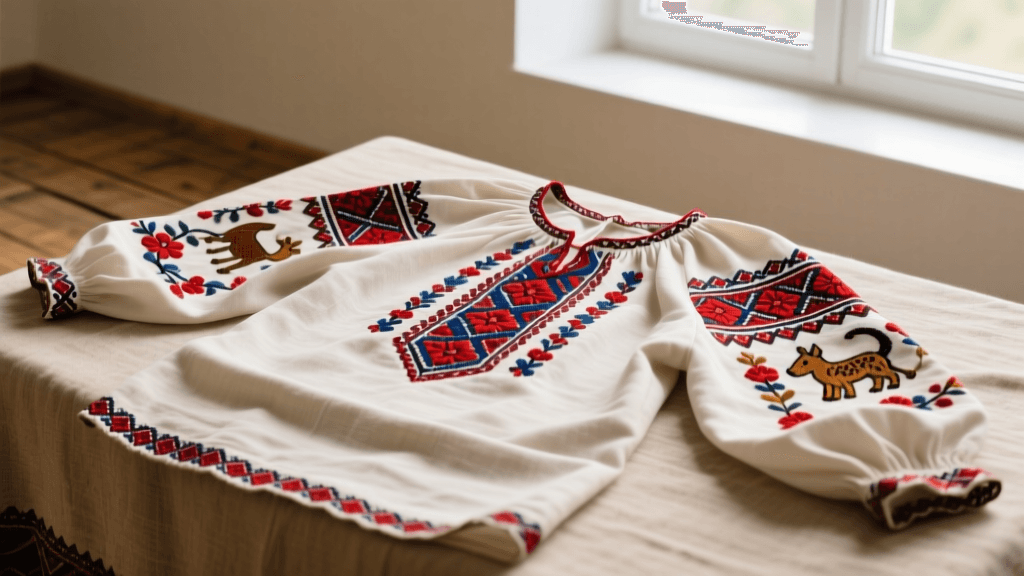
Embroidery on the rubakha is not merely decorative; it is deeply symbolic. According to the extensive textile archives at the Victoria and Albert Museum, traditional Slavic embroidery was strategically placed at the "openings" of the garment—the neckline, cuffs, and hem. These zones were considered vulnerable entry points for malevolent spirits. Dense, cross-stitch or satin-stitch motifs in red thread (symbolizing life, blood, and protection) were applied to these edges to act as a spiritual barrier. When planning your 2026 project, map out your embroidery zones before cutting your fabric, ensuring that the motifs will align perfectly once the seams are flat-felled and the fabric is gathered.
Modern Adaptations for Contemporary Wardrobes
While the traditional rubakha is voluminous, modern sewists in 2026 are adapting these zero-waste patterns for everyday wear. By reducing the ease allowance in the body panels from 20 cm to 10 cm, and shortening the hemline to the hip or thigh, the rubakha transforms into a chic, breathable tunic that pairs beautifully with modern tailored trousers or denim. Furthermore, substituting traditional red wool floss with tonal, monochromatic linen thread creates a minimalist, high-fashion aesthetic while preserving the historical construction techniques. Another popular 2026 adaptation is the use of contrasting linen offcuts from other projects to piece together the gussets, highlighting the garment's patchwork geometry and reinforcing the zero-waste ethos.
Conclusion
The Slavic rubakha is a testament to the ingenuity of historical seamstresses who viewed fabric constraints not as a limitation, but as a catalyst for geometric brilliance. By mastering rectangular zero-waste pattern drafting, you not only connect with a rich vein of European folk dress heritage but also actively participate in the vital 2026 movement toward sustainable, mindful garment creation. Gather your linen, square your ruler, and begin drafting a piece of history that wastes absolutely nothing.