Master Slavic Rubakha Pattern Drafting & Zero-Waste Sewing 2026
Introduction to the Slavic Rubakha and Zero-Waste Heritage
The Slavic rubakha (also known regionally as the sorochka, kosovorotka, or košulja) is a masterclass in sustainable, zero-waste garment construction. Long before the modern sustainability movement of 2026, Eastern European peasants and artisans crafted clothing that utilized every single inch of hand-woven linen. In an era where fast fashion dominates and textile waste is a critical global issue, the historical construction patterns of the rubakha offer profound lessons for modern makers, historical costumers, and sustainable fashion designers alike.
Unlike Western European tailoring, which evolved to use curved seams, darts, and complex armhole shaping to contour the body, traditional Slavic folk dress relied entirely on geometric, rectangular pattern drafting. This approach was born out of necessity: hand-loomed linen was incredibly labor-intensive to produce, and wasting fabric was simply not an option. Today, as we explore heritage techniques in 2026, understanding the mathematical precision and structural ingenuity of the rubakha allows us to recreate these garments with historical accuracy while embracing modern zero-waste design principles. For a broader look at historical European garments, researchers frequently consult the Europeana fashion and costume archives, which house thousands of digitized regional textiles.
The Geometry of Tradition: Rectangular Pattern Drafting
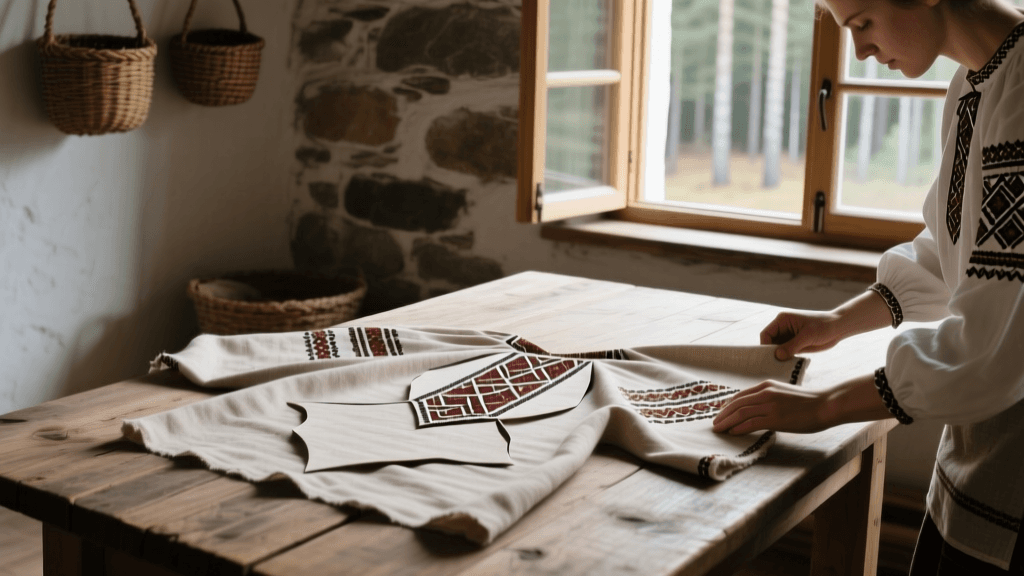
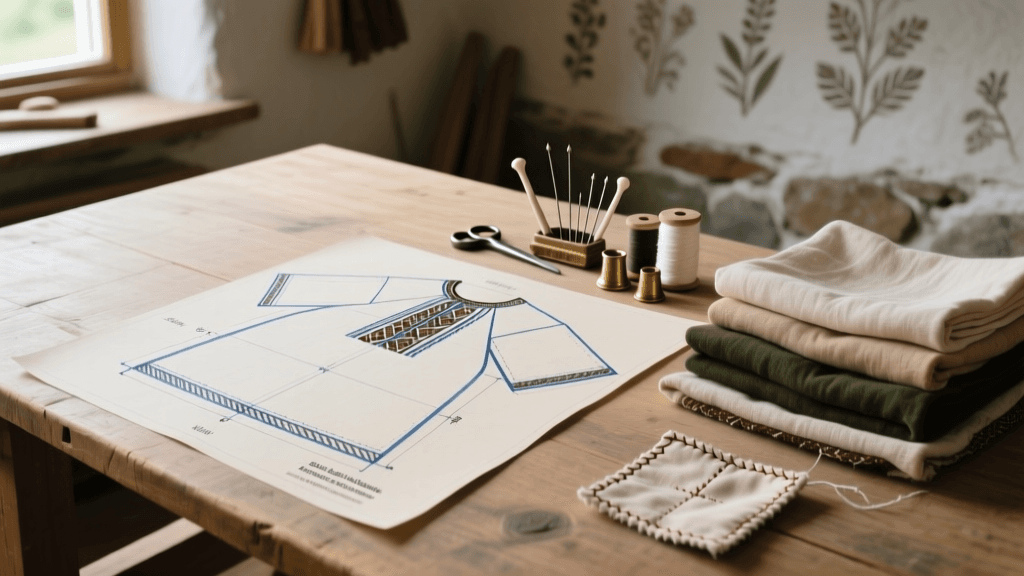
The fundamental rule of the rubakha is the absolute absence of curved seams. Armholes, as we know them in modern tailored shirts, do not exist in this traditional pattern. Instead, the garment is constructed from a series of rectangles and squares. The main body consists of a single long rectangle folded over the shoulders, or two identical rectangles joined at the shoulder seams. The sleeves are simple tubes, and the underarm mobility is achieved through the insertion of a diamond-shaped gusset, known as the lastovitsa.
This geometric approach means that the pattern is entirely dictated by the width of the fabric. Historically, hand-woven linen on a traditional floor loom yielded a narrow fabric width, typically between 14 and 16 inches (35 to 40 cm). Therefore, the body panels and sleeve panels were cut to match the loom width, with additional rectangular inserts added to the sides of the torso and the underside of the sleeves to achieve the necessary circumference. In 2026, modern linen fabrics are generally woven at 54 to 60 inches (140 to 150 cm) wide. To maintain historical accuracy and the zero-waste ethos, modern pattern drafters must artificially restrict their cutting layout to mimic these narrow historical panels, utilizing the leftover wide offcuts for complementary accessories like aprons, sashes, or headwraps.
Essential Measurements for the 2026 Modern Maker
Drafting a rubakha does not require complex slopers or muslin toiles. You only need a few key body measurements, combined with standard ease allowances:
- Chest/Bust Circumference: Determines the total width of the body panels plus side gussets.
- Neck Circumference: Crucial for calculating the gathered neckline opening.
- Wrist Circumference: Dictates the width of the sleeve cuff.
- Center Back to Wrist: Determines the total length of the sleeve plus body drop.
- Shoulder to Desired Hem: Dictates the length of the main body rectangles.
Because the garment is inherently oversized and relies on gathering and belting for shape, the fitting process is remarkably forgiving. The primary focus is on ensuring the neckline fits comfortably over the head and the sleeves allow full overhead mobility.
Step-by-Step Construction: Bodice, Gussets, and Sleeves
The construction sequence of a rubakha is highly specific. Attempting to sew it like a modern shirt will result in puckered seams and restricted movement. The historical method relies on flat-felled seams (known in Slavic traditions as zapolny shov) to enclose all raw edges, providing immense durability without the need for modern sergers or overlockers.
The Crucial Underarm Gusset (Lastovitsa)
The lastovitsa is the engineering marvel of the Slavic shirt. Because the sleeve is set in at a straight 90-degree angle to the body panel, raising the arm would pull the entire shirt upward without a gusset. The diamond-shaped gusset acts as a pivot point, distributing tension and allowing the arm to move freely. Inserting this gusset is where most beginners struggle. Here is the historically accurate sewing sequence for the underarm junction:
- Prepare the Slit: The side seam of the body panel and the underarm seam of the sleeve are left open at the junction point.
- Attach the Gusset to the Sleeve: Sew two adjacent edges of the diamond gusset to the underarm edges of the sleeve tube. Press the seams open or flat-fell them.
- Attach the Gusset to the Body: Sew the remaining two edges of the diamond gusset to the side seams of the body panel.
- Close the Seams: Sew the remainder of the sleeve seam down to the wrist, and the remainder of the body side seam down to the hem, ensuring the corners of the gusset are reinforced with a backstitch or a modern bar-tack.
Mastering this junction requires patience. In 2026, many revivalists use water-soluble basting thread and digital fabric clamps to hold the bias edges of the diamond gusset perfectly in place before committing to the final linen thread stitching.
Fabric Selection and Modern 2026 Textile Sourcing
Authentic rubakha construction demands natural fibers, specifically linen or hemp. Cotton, while widely available today, lacks the historical accuracy and the specific structural properties of bast fibers. Linen has a natural crispness that holds the geometric folds of the garment beautifully, and it softens immensely with wear and washing.
When sourcing linen in 2026, look for medium-weight fabrics (around 5.3 to 7.1 oz/yd² or 180 to 240 g/m²). Heavier linens will make the gathered neckline and cuffs too bulky, while lighter handkerchief linens may not withstand the tension of the gusset seams. Before cutting, it is absolutely mandatory to pre-wash and dry your linen on high heat to account for shrinkage, which can be up to 10% on the warp and weft. Modern heritage makers often utilize enzymatic washes to soften the modern mill finishes, replicating the feel of historically sun-bleached and river-washed flax.
Comparison Table: Traditional Hand-Sewing vs. Modern 2026 Methods
While purists may insist on entirely historical methods, the 2026 maker often blends historical accuracy with modern efficiency. Below is a comparison of how construction techniques have evolved for the modern revivalist.
| Construction Element | 19th-Century Traditional Method | 2026 Revivalist Technique |
|---|---|---|
| Pattern Drafting | Measured by eye using string and chalk directly on loom-width fabric. | CAD zero-waste layout software or laser-cut acrylic templates for precise geometric panels. |
| Seam Finishing | Hand-stitched flat-felled seams using waxed linen thread and bone needles. | Machine-stitched flat-felled seams using high-tensile polyester-wrapped cotton thread. |
| Gusset Reinforcement | Hand-embroidered crow's foot or bar tacks at stress points. | Machine bar-tacks or invisible fusible interfacing patches at the bias corners. |
| Neckline Gathering | Whip-stitched to a narrow woven tape or linen drawstring. | Machine-gathered using elasticized bobbin thread or shirred with modern silicone elastic. |
For those interested in the broader implications of these historical techniques on modern sustainability, the resources available at Zero Waste Design Online provide excellent academic context on how historical rectangular cutting informs contemporary sustainable fashion curricula.
Neckline Construction: The Drawstring vs. The Stand Collar
The earliest and most widespread form of the rubakha featured a simple slit neckline, often slightly off-center (creating the kosovorotka or "crooked collar" style in Russian traditions). The fabric around the neck opening was gathered onto a narrow linen tape, which also served as a drawstring to tie the shirt closed. This method is incredibly forgiving and requires no interfacing.
However, as Western European fashion influences permeated Eastern Europe in the 18th and 19th centuries, the stand collar (or mandarin collar) became popular, particularly in Ukrainian and Belarusian festive shirts. Constructing a historical stand collar on a rectangular garment requires gathering the neckline rectangle to the exact circumference of the collar band, securing it with a whipped edge, and then folding the band over to enclose the raw edges. In 2026, makers often use a lightweight linen-cotton interfacing inside the collar band to maintain a crisp, upright posture, a slight deviation from the purely soft historical collars but a necessary adaptation for modern formal wear contexts.
Embroidery Placement and Structural Reinforcement
In Slavic folk dress, embroidery was never merely decorative; it was deeply symbolic and structural. The intricate cross-stitch, satin stitch, and cutwork embroidery found on the rubakha were concentrated at the "openings" of the garment: the neckline, the cuffs, and the hem. In folk belief, these openings were vulnerable points where evil spirits could enter the body. Embroidery acted as an apotropaic (protective) barrier.
From a construction standpoint, these densely embroidered bands also served a vital structural purpose. The heavy linen floss and complex stitching reinforced the areas of the garment that experienced the most friction and wear. When planning your 2026 rubakha project, you must account for the embroidery before assembling the garment. It is nearly impossible to execute traditional counted-thread embroidery on a fully assembled sleeve. The modern workflow involves mapping the embroidery zones using digital counting software, stitching the motifs on the flat rectangular panels, and only then proceeding to the flat-felled seam assembly.
For further visual inspiration and structural analysis of regional embroidery variations, the Victoria and Albert Museum's fashion collections offer invaluable high-resolution archives of Eastern European peasant textiles, showcasing the incredible density and structural integration of traditional threadwork.
Conclusion
Drafting and constructing a traditional Slavic rubakha in 2026 is a deeply rewarding exercise in historical engineering. By embracing the constraints of rectangular pattern drafting, modern makers not only connect with the ingenuity of their ancestors but also actively participate in the zero-waste fashion movement. Whether you choose to hand-stitch every flat-felled seam or adapt the construction for modern machinery, the underlying geometry of the rubakha remains a timeless testament to the beauty of sustainable, purpose-driven design.