Zero-Waste Slavic Folk Shirt Patterns: 2026 Sewing Guide
The Renaissance of Zero-Waste European Folk Dress in 2026
As the global fashion industry faces mounting pressure to eliminate textile waste, modern designers and historical costumers are increasingly looking to the past for sustainable solutions. In 2026, the revival of traditional European folk dress construction has moved beyond mere aesthetic appreciation into a practical masterclass in zero-waste pattern cutting. Unlike contemporary fashion, which relies on curved armholes, shaped bodices, and complex grading that leaves up to 20% of fabric on the cutting room floor, historical Eastern European garments were born from necessity. Every single thread of hand-woven linen was precious, leading to the development of brilliant geometric construction techniques that utilize 100% of the textile.
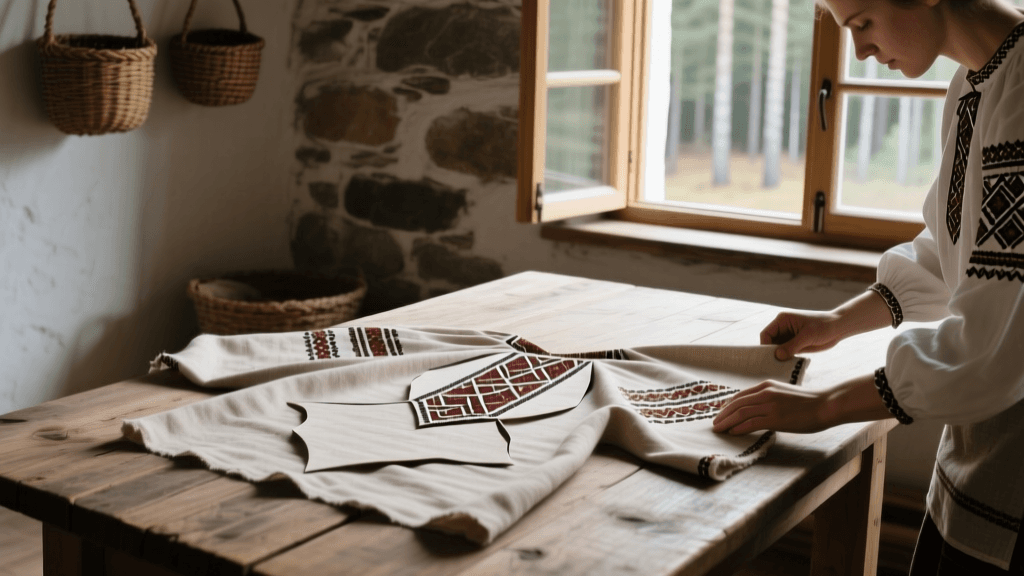
According to research highlighted by Zero Waste Design Online, historical pattern cutting methods offer a blueprint for modern sustainable fashion. By restricting pattern pieces to straight lines, rectangles, and triangles aligned with the warp and weft of the fabric, traditional artisans created flowing, durable garments without generating any scraps. In this comprehensive guide, we will explore the exact construction patterns, measurements, and assembly techniques of the Slavic rubakha and the Romanian ie, providing you with actionable steps to recreate these masterpieces in your own 2026 sewing studio.
Deconstructing the Slavic Rubakha: A Masterclass in Geometry
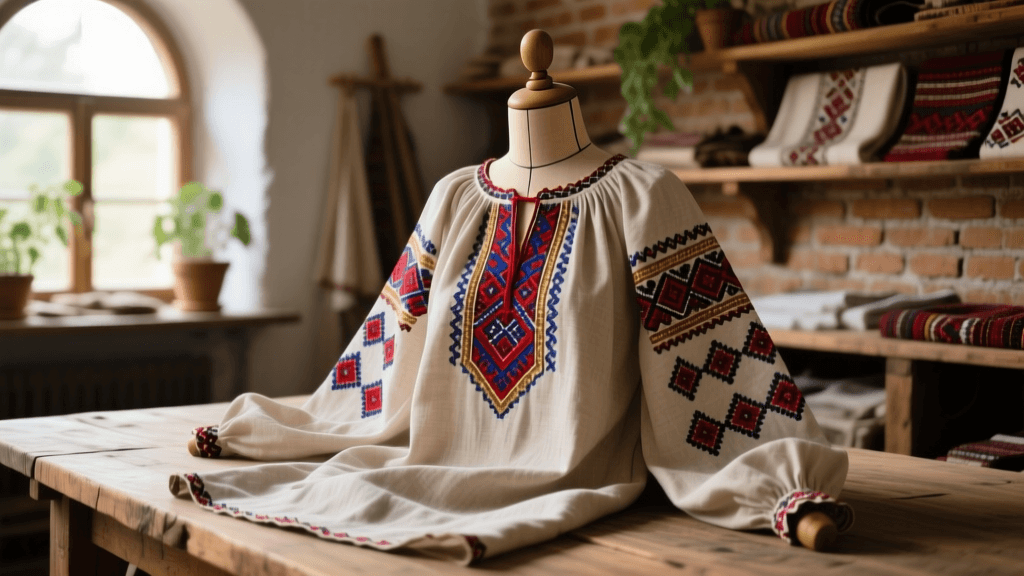
The rubakha (or sorochka) is the foundational undergarment and outer shirt of traditional Slavic folk dress, worn across Ukraine, Russia, Belarus, and Poland for centuries. Its construction is entirely based on the orthogonal geometry of the loom. Because traditional hand-woven linen was woven on narrow looms (typically 40cm to 60cm wide), the pattern pieces were designed as simple rectangles that could be cut directly along the grain line, ensuring the selvedge edges could often be incorporated into the seams to prevent fraying.
The defining feature of the rubakha is the lack of a curved armscye (armhole). Instead, the sleeve is attached directly to the body panel via a square gusset known as a lastovitsa. This gusset is the secret to the garment's mobility. When the wearer's arm is at rest, the gusset folds neatly into the underarm. When the arm is raised, the gusset expands, providing a full range of motion without pulling the main body of the shirt upward. This ingenious zero-waste solution eliminates the need for curved sleeve caps and the associated fabric waste.
Furthermore, to add volume to the lower half of the shirt for ease of walking and working, triangular gores called klin are inserted into the side seams. These triangles are cut by simply slicing a rectangle diagonally from corner to corner, yielding two perfect, symmetrical gores with zero offcuts.
Pattern Layout and Cutting Guide
Below is a standardized cutting layout for a modern adult Medium/Large rubakha, adapted for 2026 commercially available linen, which is typically woven on wider 140cm looms. While historical garments used narrow panels, we can scale the rectangles to maintain the exact same geometric proportions and zero-waste ethos.
| Pattern Piece | Quantity | Dimensions (cm) | Grainline & Notes |
|---|---|---|---|
| Main Body Panel | 2 | 70 x 110 | Lengthwise grain. Fold at shoulder or cut as one long 220cm panel with a neck slit. |
| Sleeve Rectangle | 2 | 65 x 55 | Crosswise or lengthwise grain. Gathered at the cuff. |
| Underarm Gusset (Lastovitsa) | 2 | 15 x 15 | True bias or straight grain. Provides underarm mobility. |
| Side Gores (Klin) | 4 | 30 (base) x 70 (height) | Cut two 30x70 rectangles in half diagonally. Adds hem flare. |
| Neckline Binding / Collar | 1 | 6 x 60 | Bias or straight strip for finishing the drawstring neckline. |
Constructing the Romanian Ie: Smocking and Gathers
While the Slavic rubakha relies on gussets and gores for shape, the traditional Romanian ie achieves its dramatic, voluminous silhouette through intricate gathering and smocking techniques. The ie is perhaps most famous for its altiță (the heavily embroidered shoulder band) and the crețuri (the dense, smocked gathers at the neckline and cuffs). In 2026, heritage crafters are reviving these techniques using modern, high-contrast mercerized cottons alongside traditional hand-spun threads.
The neckline of the ie is not cut into a curve. Instead, a large rectangular opening is cut, and the entire circumference of the neck is gathered using a technique called încrețire. This involves sewing parallel rows of running stitches and pulling them tight to create a dense, ruffled collar that sits elegantly on the shoulders. The structural integrity of this gather is maintained by a secondary technique: smocking. By weaving decorative threads over and under the gathered folds in a honeycomb or diamond pattern, the artisan locks the gathers in place, creating a stretchy, durable neckline that requires no elastic or modern hardware.
The sleeves of the ie feature râuri (rivers), which are vertical streams of embroidery that flow down the arm. These rivers are strategically placed along the seam lines and the center of the sleeve panels, effectively hiding the construction seams while turning them into focal points of the garment. According to the UNESCO Intangible Cultural Heritage registries, the integration of needlework and structural seaming is a hallmark of Balkan and Eastern European textile traditions, where the decoration is never merely applied, but is intrinsic to the garment's architecture.
2026 Sourcing and Material Recommendations
To achieve an authentic drape and durability for your folk dress construction, selecting the correct textile is paramount. In 2026, the market for heritage-grade, GOTS-certified European flax linen has expanded significantly. For the main body of a rubakha or ie, you should source a medium-weight linen in the range of 180 to 220 g/m² (approximately 5.3 to 6.5 oz). Fabrics designated as IL019 or similar medium-weight slub linens provide the necessary opacity and structural support for heavy embroidery without being overly stiff.
For the embroidery threads, modern crafters have moved beyond standard stranded cotton. The 2026 revival emphasizes the use of naturally dyed silk and wool threads. Madder root (for deep reds), woad (for indigo blues), and weld (for vibrant yellows) are now readily available from specialized heritage dyers. When working the altiță smocking on the Romanian ie, use a tightly twisted pearl cotton (size 5 or 8) to ensure the structural gathers hold their shape over decades of wear.
Seam Finishes and Historical Accuracy
Because historical garments were washed aggressively in rivers and beaten with wooden mallets, the internal seam finishes had to be indestructible. The standard seam for European folk dress is the flat-felled seam. To execute this, place your fabric wrong sides together and sew a standard 1.5cm seam. Trim one side of the seam allowance down to 0.5cm, fold the longer allowance over the trimmed edge, press flat, and topstitch it down to the garment body. This encloses all raw edges, preventing fraying and creating a clean, reversible interior.
For attaching the gussets (lastovitsa), precision is key. Mark the exact center of the gusset and the exact corner of the body panel slit. Use a hand-basting stitch to secure the gusset before machine or hand sewing. At the inner corner, pivot carefully, leaving the needle down in the fabric, to ensure the corner does not pucker or tear. Many traditionalists in 2026 still sew these specific stress points by hand using a backstitch, as it offers more flexibility and tensile strength than a modern lockstitch machine.
Modern Revival: Integrating Folk Techniques Today
The beauty of studying European folk dress construction lies in its direct applicability to modern sustainable wardrobes. By adopting the zero-waste geometry of the rubakha and the structural smocking of the ie, contemporary sewists can create bespoke, heirloom-quality garments that honor the past while protecting the future. Organizations like The Costume Society continue to champion the study of these historical techniques, proving that the most advanced sustainable fashion solutions were invented centuries ago on the village looms of Eastern Europe. Whether you are drafting your first rectangular tunic or mastering the honeycomb smocking of a traditional collar, these ancient patterns offer a timeless, waste-free path forward for the modern maker.