Slavic Rubakha Folk Shirt Construction Patterns & Techniques 2026
The Renaissance of Zero-Waste: Slavic Rubakha Construction in 2026
As the global fashion industry fully embraces the circular economy and zero-waste mandates of 2026, modern makers, tailors, and designers are increasingly looking to the past for sustainable solutions. The Slavic rubakha (also known as the sorochka or vyshyvanka depending on the specific region), a traditional folk shirt worn across Eastern Europe, represents one of the most brilliant historical examples of zero-waste pattern cutting. By utilizing strict rectangular geometry, traditional tailors ensured that not a single thread of precious, handwoven fabric was wasted on the cutting room floor. Today, this construction technique is not merely a historical curiosity; it is a highly relevant, actionable methodology for contemporary garment creation.
The Philosophy of Rectangular Construction
Historically, woven fabric was an incredibly labor-intensive and valuable commodity. The cultivation of flax, the retting process, spinning, and weaving on a traditional loom took hundreds of hours. Consequently, cutting curves into the fabric—which would leave unusable scraps—was economically and culturally unthinkable. The rubakha solves this by treating the human body as an architectural form that can be draped using only rectangles, squares, and right-angled triangles. The resulting garment is loose, highly mobile, and structurally sound, relying on strategic gathering and gussets rather than complex curved darts to accommodate human movement.
Essential Materials and Tools for the Modern Maker
Authentic rubakha construction relies heavily on the drape, breathability, and durability of linen. In 2026, the market for certified organic European flax linen has stabilized, with premium mid-weight fabrics (around 180 GSM) averaging $28 to $38 per yard from sustainable heritage mills. When selecting your textile, avoid modern synthetic blends; the rectangular cuts require a natural fabric that frays predictably, presses crisply, and molds to the body over time.
According to the Victoria and Albert Museum's textile conservation guidelines, natural linen fibers possess remarkable longevity when cared for correctly, softening beautifully over decades of wear and washing. For thread, opt for 100% linen or high-tensile cotton-wrapped polyester to withstand the stress of flat-felled seams. You will also need a modern sewing machine equipped with a dedicated flat-felling foot, alongside traditional hand-sewing needles for the embroidery and hemming.
The Geometry of the Rubakha: Pattern Drafting
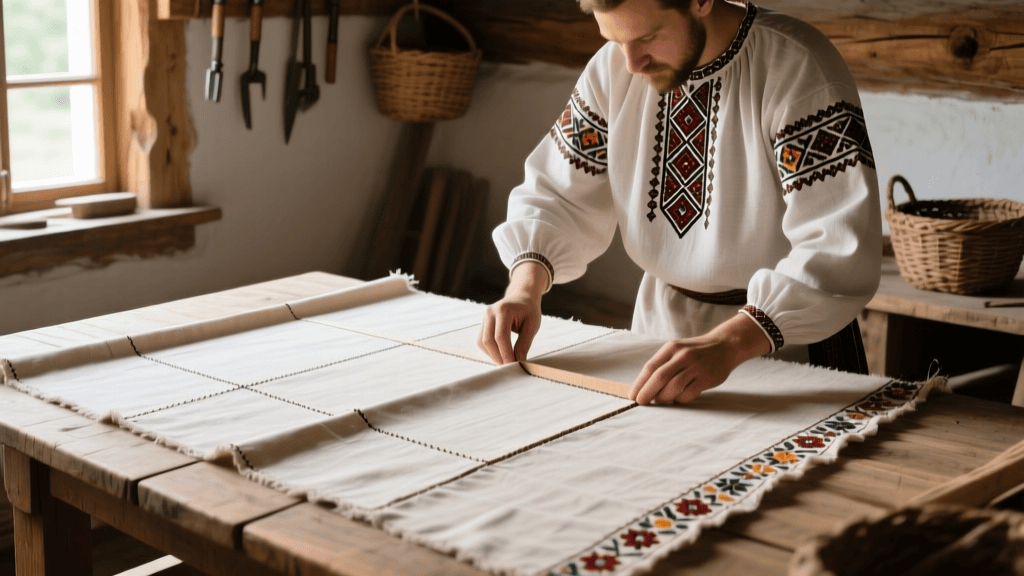
Unlike modern slopers that rely on curved armholes, princess seams, and shaped yokes, the rubakha is an exercise in pure geometry. The pattern consists entirely of straight lines. The body is formed from two large rectangles (front and back) or a single continuous piece folded over the shoulders. Sleeves are simple tubes, and the crucial underarm mobility is achieved through square gussets known as lastovitsa. Side gores are added to the lower half to provide walking ease and a graceful drape.
Standard Proportions and Measurements
Below is a structured guide for drafting a standard medium rubakha, optimized for the relaxed, oversized fit characteristic of 2026 folk-revival streetwear and contemporary layering.
| Pattern Piece | Shape | Standard Dimensions (Inches) | Function |
|---|---|---|---|
| Main Body Panel | Rectangle | 30" W x 60" L (folded) | Forms the torso and hemline |
| Sleeve Panels (x2) | Rectangle | 22" W x 24" L | Creates wide, gathered sleeves |
| Underarm Gussets (x2) | Square | 6" x 6" | Provides crucial arm mobility |
| Side Gores (x4) | Right Triangle | 12" W x 24" L | Adds hemline flare and movement |
| Collar Band | Rectangle | 17" W x 3" L | Finishes the gathered neckline |
Step-by-Step Construction Techniques
The hallmark of a high-quality rubakha is the seam finish. Because the garment is unlined, all internal seams must be fully enclosed to prevent fraying and ensure comfort against the skin. The traditional run-and-fell (flat-felled) seam is mandatory for historical accuracy and modern durability.
- The Run-and-Fell Seam: Place fabric pieces wrong sides together and sew a standard 3/8-inch seam. Trim one side of the seam allowance down to 1/8 inch. Fold the longer allowance over the trimmed edge, press flat, and topstitch. This yields a remarkably durable, zero-fray interior that looks identical on both sides.
- Gusset Insertion: Sewing a square gusset into a slit can be challenging for beginners. Pin the gusset to the sleeve slit first, sewing exactly to the corner points. Pivot carefully at the corners to attach the gusset to the body panel, ensuring no puckering occurs at the stress points. Reinforce the corners with a few hand-stitched backstitches.
- Neckline Slit and Gathering: The traditional rubakha features a deep center-front slit. Cut the slit, finish the edges with a narrow rolled hem or bias binding, and then run two rows of gathering stitches along the entire neckline. Draw the threads up to fit the collar band, distributing the fullness evenly across the shoulders and chest.
Hemming and Drawn-Thread Work (Merezhka)
The hem of a rubakha is rarely left plain. Historically, makers utilized a technique called merezhka (drawn-thread work) to create intricate, lace-like borders without adding separate fabrics. By carefully withdrawing horizontal warp threads from the linen and wrapping the remaining weft threads with a needle, makers created openwork geometric patterns. In 2026, this technique is experiencing a massive revival among slow-fashion artisans who value the meditative, screen-free process of hand-manipulation. If drawn-thread work feels too advanced for your current skill level, a traditional blind hem finished with a row of decorative chain stitch provides an excellent, historically grounded alternative.
Embroidery Placement and Cultural Symbolism
In Slavic folk traditions, embroidery was never purely decorative; it served as a talismanic boundary to protect the wearer from malevolent spirits and illness. The apertures of the garment—the neckline, cuffs, and hem—were heavily guarded with intricate geometric cross-stitch and satin stitch motifs, predominantly using madder-dyed red thread to symbolize life force and vitality.
The preservation of these protective motifs and the communal knowledge required to execute them is closely tied to what UNESCO's Intangible Cultural Heritage frameworks identify as vital traditional craftsmanship. In 2026, contemporary makers are adapting these ancient protective borders using eco-friendly, naturally dyed threads, merging historical symbolism with modern environmental consciousness. For deeper historical context on Eastern European weaving and embroidery motifs, the Textile Research Centre in Leiden offers extensive digital archives and academic resources that map the regional variations of these geometric patterns.
Adapting the Rubakha for 2026 Contemporary Wardrobes
While the construction remains strictly traditional, the styling of the rubakha has evolved. In 2026, the oversized, boxy silhouette of the rubakha pairs perfectly with modern tailoring. Artisans are experimenting with natural dyeing techniques, utilizing walnut hulls for deep browns, or Japanese indigo for striking blue variations, moving beyond the traditional undyed white. Styling the rubakha over a fine-gauge merino turtleneck in the winter, or belting it with a hand-tooled leather sash over wide-leg linen trousers in the summer, bridges the gap between ancient heritage and contemporary avant-garde fashion.
Conclusion: Bridging Heritage and Modern Sustainability
Constructing a Slavic rubakha in 2026 is a profound exercise in mindful creation. By adhering to the strict rectangular geometry of our ancestors, we eliminate textile waste, honor the labor-intensive history of European flax cultivation, and produce a garment of true heirloom quality. Whether you are a historical reenactor, a sustainable fashion student, or a hobbyist seeking a deeper connection to your materials, mastering the rubakha's zero-waste construction techniques offers timeless rewards that transcend fleeting seasonal trends.