Zero-Waste Folk Dress Patterns: Rubakha & Kirtel 2026 Guide
The 2026 Revival of Zero-Waste Historical Sewing
As the global fashion industry faces intense scrutiny over textile waste in 2026, modern makers, historical reenactors, and sustainable designers are looking backward for ecological solutions. European folk dress construction—specifically the geometric, zero-waste cutting techniques of the Slavic rubakha and the Nordic kirtel (or kjortel)—has emerged as a masterclass in sustainable pattern drafting. Unlike modern slopers that curve around the body and leave behind crescent-shaped scraps of fabric, traditional European peasant garments were engineered to utilize every single inch of the woven cloth.
In this comprehensive 2026 guide, we will explore the mathematical precision of rectangular construction, how to draft these historical patterns using modern digital tools, and the intricate sewing techniques required to assemble a historically accurate, highly functional folk shirt.
The Philosophy of Rectangular Construction
Before the industrialization of textile production, weaving linen and wool by hand was an incredibly labor-intensive process. According to research documented in the Metropolitan Museum of Art's Heilbrunn Timeline of Art History, pre-industrial European textiles were so valuable that cutting them into curved shapes was considered wasteful and economically unviable. Consequently, folk dress patterns were based entirely on straight lines, rectangles, squares, and right-angled triangles.
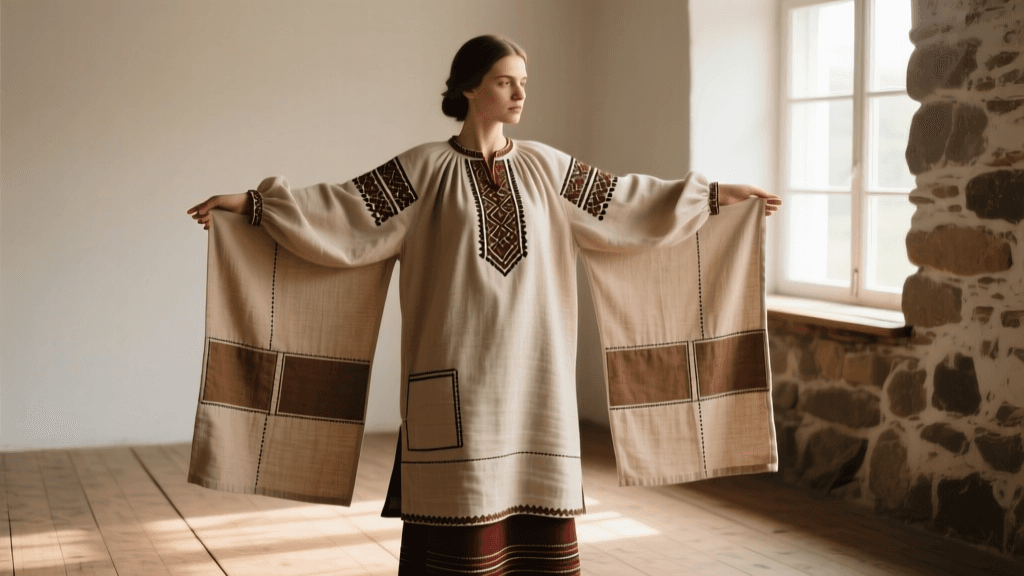
The base of both the Slavic rubakha and the Nordic kirtel is a series of long rectangles. The body is formed by folding a single long panel over the shoulders, or by seaming two wide rectangles together at the shoulders. Sleeves are simple tubes, and any additional volume required for movement or hem flare is achieved by inserting square gussets or triangular gores. This modular geometry means that when the garment is laid flat on the cutting table, the negative space between the pattern pieces is virtually zero.
Anatomy of the Folk Shirt
The Main Body Panels
The core of the garment consists of the front and back panels. In a traditional rubakha, this is often a single piece of fabric folded at the shoulder line with a slit cut for the neck. For the Nordic kirtel, the front and back are usually separate rectangles seamed at the shoulders, allowing for more complex smocking or gathering at the neckline.
The Sleeves and the Lastovitsa (Gusset)
Because the armhole is not curved, the sleeve is simply a rectangular tube. However, a straight tube attached to a straight body panel restricts arm movement. To solve this, historical seamstresses inserted a square or diamond-shaped piece of fabric under the arm, known in Slavic traditions as the lastovitsa (gusset). This gusset acts as a pivot point, granting the wearer a full range of motion without tearing the seams.
Side Gores (Klini)
To allow for walking and working, triangular panels called gores are inserted into the side seams from the hem upward. These gores transform the narrow, tubular torso into a flared, comfortable tunic or dress.
Drafting Patterns with 2026 Digital Tools
While historical seamstresses relied on chalk, string, and body measurements, makers in 2026 have access to powerful parametric software. Open-source platforms like Seamly2D have revolutionized historical pattern drafting. By inputting your personal measurements (bust, waist, hip, shoulder-to-hem, and arm length), Seamly2D can automatically calculate the exact dimensions of your rectangles, gussets, and gores, generating a custom, zero-waste layout that can be printed on a home plotter or standard A4 tiles.
When setting up your digital workspace, remember to add a standard 1.5 cm (5/8 inch) seam allowance to all rectangular edges. For the gusset, it is highly recommended to add a slightly wider 2 cm allowance to accommodate the tricky pivot stitching required later.
Fabric Widths: Historical Looms vs. Modern Bolts
One of the biggest challenges in recreating European folk dress today is that modern fabric widths differ vastly from historical hand-loomed widths. Historical linen was typically woven on narrow looms, resulting in fabric widths of roughly 36 to 40 inches (90-100 cm). Modern linen bolts available in 2026 are usually 54 to 60 inches (137-152 cm) wide. To maintain the zero-waste ethos, you must adapt your cutting layout to the width of your modern fabric.
| Garment Component | Historical Layout (36' Width) | Modern 2026 Layout (60' Width) | Yardage Required |
|---|---|---|---|
| Main Body | Two separate panels | Cut as one continuous folded tube | 1.5 yards |
| Sleeves | Cut lengthwise | Cut side-by-side on crossgrain | 0.75 yards |
| Gussets & Gores | Pieced from scraps | Nested in sleeve cutting waste | 0 yards (Zero Waste) |
| Total | 3.5+ yards | 2.25 yards | 2.25 yards |
Step-by-Step Sewing: Mastering the Underarm Gusset
The most intimidating aspect of rectangular construction for modern sewists is inserting the lastovitsa. If sewn incorrectly, the underarm will pucker and tear. Follow this 2026-tested method for a flawless finish:
- Staystitch the Pivot Point: On the main body panel, mark the exact corner where the side seam meets the shoulder seam. Stitch a single line of reinforcement exactly on your seam allowance line, pivoting precisely at the corner dot.
- Clip the Corner: Using sharp embroidery scissors, snip directly into the corner dot. Do not clip past the staystitching. This allows the fabric to open up and lie flat against the gusset.
- Pin Three Sides First: Align the gusset square with the sleeve and the body panel. Pin and sew three of the four sides of the diamond. Leave the final side (the one connecting to the clipped corner) for last.
- The Pivot Stitch: With the needle down in the fabric, pivot at the corner, carefully easing the clipped body fabric around the point of the gusset. Sew slowly, adjusting the fabric every few stitches to prevent tucks or puckers.
Cultural Context: Embroidery as Protection
When constructing a Slavic rubakha, the sewing is only half the process. Historically, the structural seams, neckline, and cuffs were considered vulnerable entry points for evil spirits. To protect the wearer, these areas were heavily fortified with apotropaic embroidery. In 2026, there is a massive resurgence in traditional drawn-thread work and red-and-black cross-stitch motifs. Modern makers are digitizing these regional patterns from museum archives, utilizing computerized embroidery machines to replicate the dense, protective borders of the Carpathian and Balkan regions, while purists continue to stitch by hand using naturally dyed linen threads.
Sourcing Authentic Materials in 2026
To achieve the correct drape and historical accuracy, the choice of textile is paramount. The Victoria and Albert Museum's Textile Collection highlights the importance of slubby, uneven yarns in historical peasant linens. Avoid modern, highly processed, and bleached apparel linens. Instead, seek out 'rustic' or 'homespun' style mid-weight linens (approx. 190-220 GSM). For the Nordic kirtel, lightweight wool tabbies or woad-dyed linen blends provide the authentic structure and temperature regulation required for traditional Scandinavian layering.
Conclusion
The construction techniques behind the Slavic rubakha and the Nordic kirtel are not merely historical curiosities; they are blueprints for a sustainable future in fashion. By embracing rectangular geometry, utilizing underarm gussets for mobility, and leveraging modern 2026 parametric drafting tools, today's makers can create beautiful, durable, and entirely zero-waste garments that honor the ingenuity of European folk traditions.