Slavic and Nordic Rectangular Shirts: 2026 Zero-Waste Patterns
As the sustainable fashion and historical costuming movements converge in 2026, modern makers are increasingly turning to the zero-waste construction techniques of traditional European folk dress. Long before the advent of modern, curved pattern drafting and the resulting fabric waste, rural communities across Slavic and Nordic regions crafted highly functional, durable garments using strictly rectangular and square geometries. The traditional linen shirt—known as the rubakha or sorochka in Eastern Europe and the särk or sraka in Scandinavia—remains a masterclass in efficient fabric utilization. By understanding these historical construction patterns, contemporary sewists can create beautiful, historically grounded garments that produce absolutely zero textile waste.
The Philosophy of Rectangular Cutting
Historically, hand-woven linen and wool were incredibly labor-intensive and precious commodities. Every thread was valuable, and cutting curved armholes or princess seams would result in unusable scraps. Consequently, European folk dress relied on the natural width of the loom. Garments were engineered using rectangles, squares, and triangles that fit together like a jigsaw puzzle. In many Slavic traditions, the uncut cloth was even considered sacred, and piercing it with unnecessary cuts was thought to invite bad luck. Today, as the zero-waste sewing movement dominates sustainable fashion discussions in 2026, these historical constraints are celebrated as brilliant engineering solutions that modern pattern drafters are eager to replicate.
Anatomy of the Folk Shirt
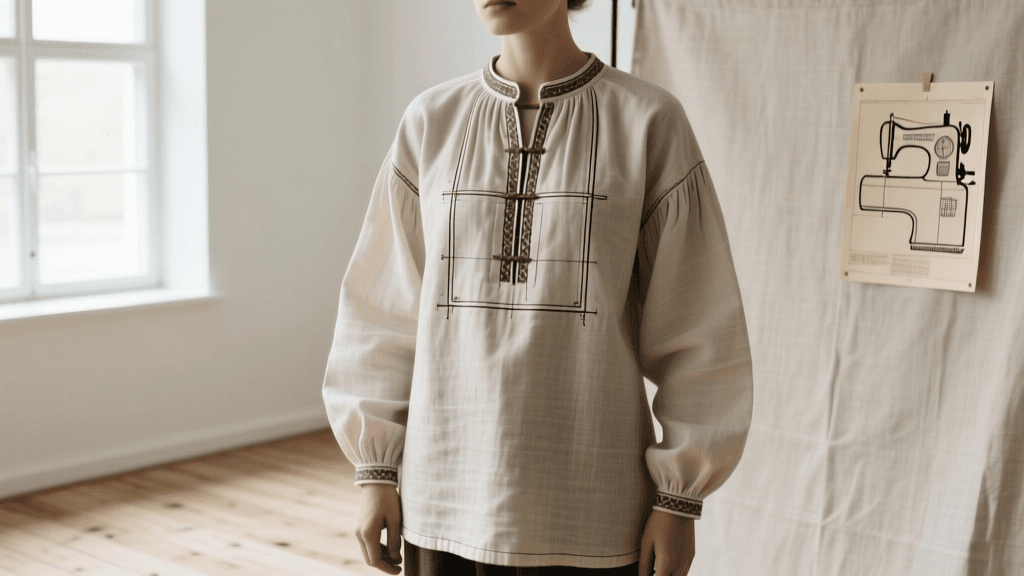
To successfully draft a traditional rectangular shirt, you must abandon modern slopers and embrace modular geometry. The garment is composed of several distinct, straight-grain components:
- The Main Body (Stan): A single, massive rectangle of fabric folded over the shoulders, or two rectangles (front and back) joined at the shoulders. The neckline is created via a simple slit or a small rectangular cutout, never a curved scoop.
- The Sleeves (Rukav): Long rectangles gathered into a cuff or left wide and flared. They are attached directly to the body panel without a curved armhole cap.
- The Gusset (Lastavica / Kil): A small square of fabric (typically 4x4 to 6x6 inches) inserted at the underarm junction where the sleeve meets the body. This is the mechanical secret of the folk shirt, providing the mobility that a curved armhole provides in modern tailoring.
- The Godets (Klin): Triangular inserts added to the side seams of the main body to provide flare and walking room at the hem without wasting fabric from the main torso block.
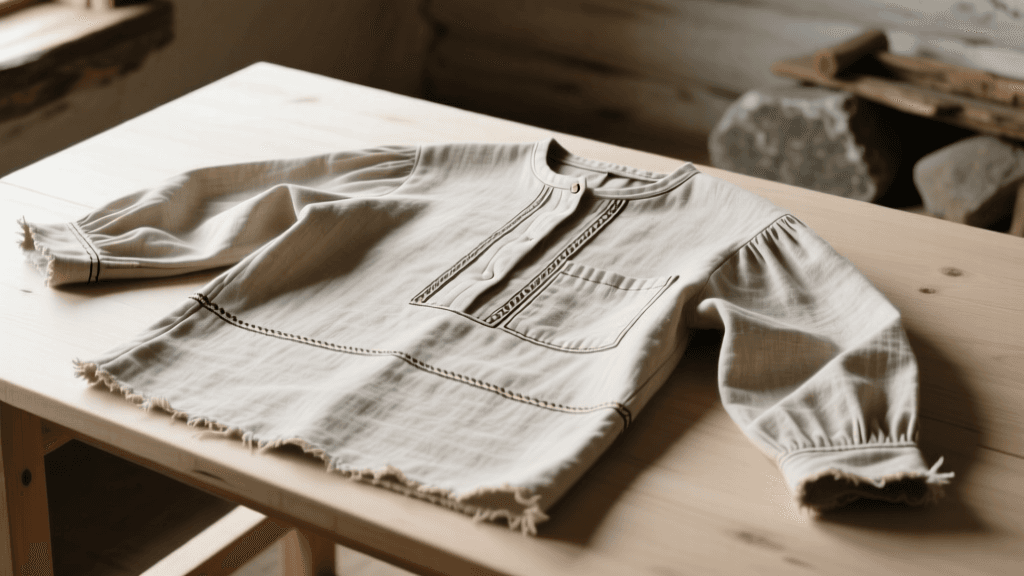
- Collars and Cuffs: Narrow, straight-grain bands used to bind the raw edges of the neckline slit and sleeve ends, often heavily embroidered.
2026 Fabric Sourcing and Preparation
The foundation of any authentic European folk shirt is high-quality, natural linen. In 2026, the resurgence of heritage flax farming in Europe—particularly the dew-retted flax from Normandy, France, and the Baltic states—has made premium, sustainable linen more accessible than ever. When sourcing fabric, look for European Flax certified linens in the 5.5 oz to 7.5 oz weight range. A 5.5 oz linen provides the beautiful drape required for gathered sleeves and smocked collars, while a 7.5 oz linen offers the structural integrity needed for heavy cross-stitch embroidery and winter wear. According to the Victoria and Albert Museum's textile archives, linen has been the cornerstone of European peasant dress for centuries due to its unparalleled durability, washability, and ability to soften beautifully with age.
Crucial Preparation Step: Linen shrinks significantly. Before cutting your zero-waste layout, you must pre-wash and dry your fabric using the exact method you plan to use for the finished garment. For most folk shirts, a hot wash (60°C) and a high-heat tumble dry will pre-shrink the fibers and give the linen a soft, historical 'homespun' texture.
Measurement and Pattern Layout Guide
The following table provides a baseline zero-waste layout for a standard medium-sized shirt, adapted for modern 54-inch wide linen. Historically, loom widths were much narrower (14 to 18 inches), requiring more seams. Modern makers can utilize the wider fabric to reduce side seams while maintaining the rectangular geometry.
| Component | Dimensions (54-inch Fabric) | Quantity | Grainline |
|---|---|---|---|
| Main Body Panel | 30" wide x 50" long | 1 (Cut on fold) | Lengthwise |
| Sleeves | 22" wide x 24" long | 2 | Lengthwise |
| Underarm Gussets | 6" x 6" square | 2 | Straight grain |
| Side Godets | 12" long triangle (8" base) | 2 to 4 | Straight or bias |
| Collar Band | 18" long x 4" wide | 1 | Lengthwise |
Essential Sewing Techniques for Folk Shirts
Constructing a rectangular shirt requires specific historical seam finishes that ensure durability without the use of modern sergers or synthetic threads. For visual references on historical Scandinavian cutting layouts and original garment construction, the DigitaltMuseum portal provides extensive high-resolution archives of original 19th-century särk garments, showcasing these exact seam treatments.
1. The Run-and-Fell Seam
The run-and-fell (or flat-felled) seam is the gold standard for folk dress construction. It encases all raw edges, preventing fraying and creating a remarkably strong joint capable of withstanding years of physical labor and harsh washing. Furthermore, the Textile Research Centre's Needles encyclopedia details the evolution of the run-and-fell seam as a vital technique for heavy linen and wool textiles across Europe.
Execution: Place your fabric pieces wrong sides together. Sew a standard seam at 3/8 inch. Trim one seam allowance down to 1/8 inch. Fold the longer 3/8 inch allowance over the shorter one, encasing the raw edge completely. Press flat, then topstitch 1/4 inch from the fold on the right side of the garment. This results in two parallel rows of visible stitching on the exterior and a clean, finished edge on the interior.
2. Setting the Square Gusset
Inserting the underarm gusset is widely considered the most challenging step in folk shirt construction, but it is essential for mobility. Without a gusset, a rectangular sleeve will bind tightly and tear when the wearer lifts their arms.
Execution: Leave a 6-inch slit unsewn at the top of the sleeve seam and the corresponding side body seam. With right sides together, pin one edge of the square gusset to the sleeve slit, and the adjacent edge to the body slit. Stitch up to the exact corner of the gusset. Leave the needle down in the fabric, raise the presser foot, pivot the fabric 90 degrees, lower the foot, and continue stitching. Reinforce this pivot point with a backstitch. Repeat for all four sides of the gusset. This precise pivoting prevents blown-out corners and maintains the structural integrity of the underarm.
3. The Neckline Slit and Bindings
Instead of a curved facing, traditional shirts use a straight center-front slit, finished with a narrow straight-grain binding or a folded placket. Cut a slit down the center front of the main body panel (usually 8 to 10 inches). Bind the raw edges with a 1-inch wide strip of linen, folding it to the inside and slip-stitching it down by hand. This creates a clean, historically accurate opening that lies flat against the chest.
Embellishment and Smocking
Once the structural construction is complete, the garment serves as a canvas for regional embellishment. In 2026, traditional hand-embroidery techniques are experiencing a massive revival among slow-fashion enthusiasts. Slavic rubakhas are famous for their dense redwork cross-stitch, often featuring geometric solar symbols and protective motifs along the collar, cuffs, and hem. Nordic särks frequently utilize intricate white-work, drawn-thread techniques, and honeycomb smocking at the neckline. Smocking not only provides beautiful decorative texture but also acts as a functional gathering mechanism, allowing a massive rectangle of linen to be cinched comfortably around the neck and wrists while retaining the elasticity needed for movement.
Conclusion
The construction patterns of traditional Slavic and Nordic folk shirts offer a profound lesson in sustainable design. By embracing rectangular cutting, utilizing gussets for mobility, and finishing seams with historical run-and-fell techniques, modern makers can create garments that are deeply rooted in European heritage while perfectly aligned with the zero-waste imperatives of 2026. Whether you are crafting an authentic historical reproduction or a modern, linen everyday tunic, these time-tested techniques ensure your garment will be as durable, functional, and beautiful as those crafted centuries ago.