Authentic Slavic & Balkan Embroidered Shirts: 2026
The Renaissance of Eastern European Folk Dress in 2026
As we navigate the sustainable fashion landscape of 2026, the global appreciation for traditional European folk dress has evolved from niche historical reenactment into a cornerstone of the slow-fashion movement. Nowhere is this more evident than in the surging demand for authentic Slavic and Balkan embroidered shirts. Garments such as the Ukrainian vyshyvanka, the Romanian ie, and the broader Balkan rubakha are no longer relegated to museum archives or annual heritage festivals. Today, they are celebrated as masterpieces of textile engineering, mathematical geometry, and ancestral storytelling.
For collectors, cultural enthusiasts, and conscious consumers, navigating the 2026 market requires a discerning eye. The proliferation of mass-produced, factory-made replicas has made it increasingly difficult to distinguish between genuine heritage craftsmanship and commercialized costumes. This comprehensive guide will walk you through the anatomy, symbolism, and modern sourcing strategies for authentic Eastern European embroidered shirts, ensuring your investments honor the artisans who keep these traditions alive.
The Core Garments: Vyshyvanka, Ie, and Rubakha
The traditional embroidered shirt of Eastern Europe and the Balkans shares a common ancestral root in the ancient Slavic and Thracian tunic, yet it diverges into highly distinct regional variations. Understanding these differences is the first step in authenticating a piece.
The Ukrainian and Belarusian Vyshyvanka
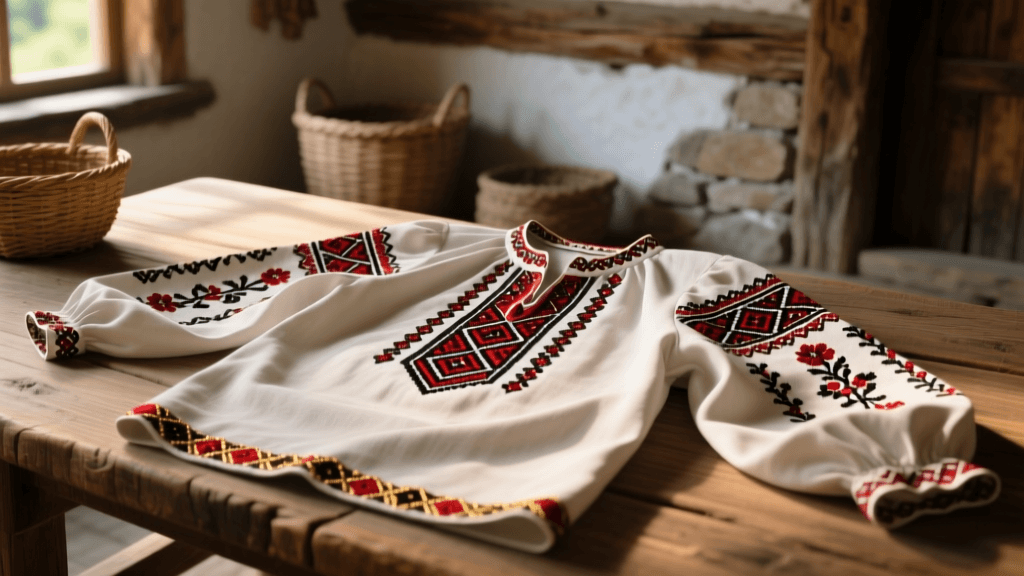
The vyshyvanka is perhaps the most globally recognized Eastern European folk garment. In 2026, the most sought-after pieces originate from the Poltava and Hutsul regions. Poltava embroidery is famous for its bila po bilomu (white-on-white) technique, utilizing intricate cutwork and shadow stitching that creates a subtle, textural masterpiece. Conversely, Hutsul shirts from the Carpathian Mountains are vibrant, featuring dense geometric patterns in black, red, and yellow, often incorporating metallic threads and seed beads. Authentic 2026 pieces from master artisans in these regions frequently integrate NFC-thread technology, allowing buyers to scan the hem and verify the weaver’s identity and the hours logged on the piece.
The Romanian and Moldovan Ie
The ie (pronounced 'yeh') is a masterpiece of Balkan and Eastern European textile art, famously recognized by the altiță—a dense, rectangular band of embroidery covering the shoulder. According to UNESCO's Intangible Cultural Heritage frameworks, the traditional techniques of making the blouse with embroidery on the shoulder represent a vital element of cultural identity in Romania and the Republic of Moldova. The ie also features the încreț (a decorative gathering at the neck) and râuri (diagonal or vertical 'rivers' of embroidery flowing down the sleeves). True artisan pieces use hand-spun wool, silk, and historically accurate metallic threads.
The Balkan and Slavic Rubakha
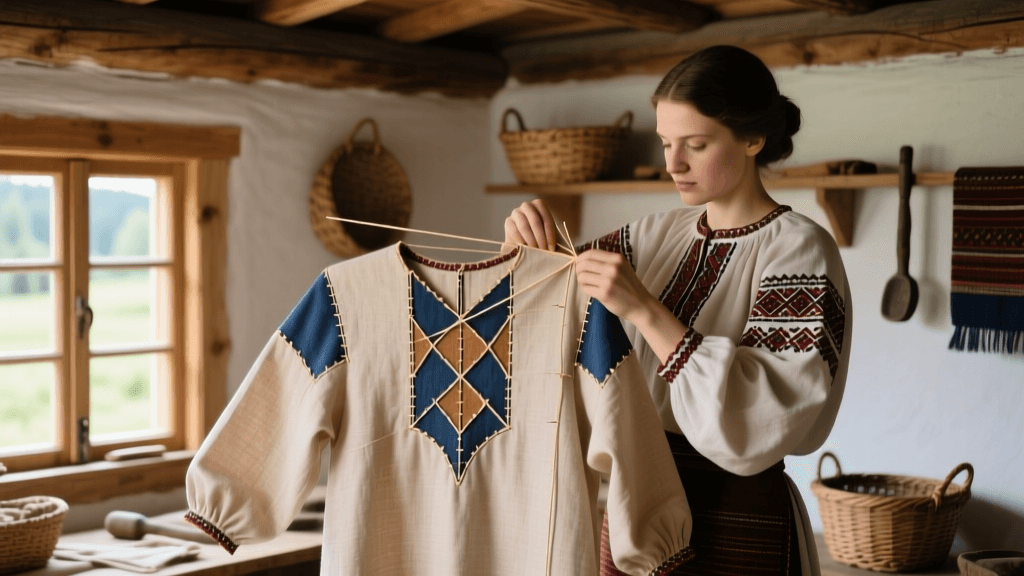
The rubakha serves as the foundational tunic across many Slavic and Balkan cultures, from Serbia to Russia. Unlike the highly tailored modern blouse, the traditional rubakha is constructed from straight loom-widths of fabric, utilizing square gussets (lastka) under the arms and shoulder inserts (polik) to provide mobility without wasting a single inch of handwoven cloth. Embroidery is typically concentrated at the 'vulnerable' openings: the neckline, cuffs, and hem, serving as a talismanic boundary to protect the wearer from negative energy.
Decoding the Geometry: Symbolism in Stitchery
Traditional Eastern European embroidery is not merely decorative; it is a coded language. Before the widespread adoption of literacy in rural villages, women encoded their hopes, prayers, and protections into the very fabric of their family's clothing. When sourcing a vintage or newly commissioned piece in 2026, look for these foundational motifs:
- The Rhombus (Diamond): The most ubiquitous symbol in Slavic and Balkan stitchery, representing a sown field, fertility, and agricultural abundance. A rhombus divided into four smaller squares with dots inside specifically symbolizes planted seeds.
- The Rosette (Sun Star): Often found on the chest or shoulders, this eight-pointed star represents the sun, life-giving energy, and the eternal cycle of seasons. It is a powerful protective talisman.
- The Zigzag (Water/Snake): Continuous wavy lines or sharp zigzags represent water, the sky, and the celestial realm. In some Balkan traditions, the zigzag also represents the snake, a revered household guardian spirit.
- The Tree of Life: Usually rendered as a stylized, geometric plant rising from a central pot or base, symbolizing ancestral lineage, the connection between the underworld, the earthly plane, and the heavens.
2026 Sourcing Guide: Artisan vs. Mass-Market
The market in 2026 is sharply divided between heritage cooperatives and fast-fashion manufacturers. While mass-market replicas offer accessibility, they lack the structural integrity, historical accuracy, and cultural soul of an authentic piece. Below is a comparative breakdown to help you evaluate potential purchases.
| Feature | Authentic Artisan Piece (2026) | Mass-Market Commercial Replica |
|---|---|---|
| Base Material | Hand-loomed flax linen, raw hemp, or handwoven cotton. Irregularities in the weave are present and prized. | Factory-milled cotton-polyester blends or chemically treated rayon. Uniform, synthetic sheen. |
| Embroidery Technique | Hand-stitched using traditional counted-thread methods (e.g., cross-stitch, nyzynka, cutwork). The reverse side is nearly as neat as the front. | Machine-embroidered. The reverse side is messy with jump stitches and synthetic stabilizer backing. |
| Construction | Straight-cut loom widths, hand-finished seams, traditional gussets (lastka) for mobility. | Modern curved armholes, serged seams, darts, and standardized commercial sizing. |
| Production Time | 80 to 300+ hours of dedicated hand-stitching. | Less than 2 hours of machine programming and stitching. |
| 2026 Market Price | $350 – $1,200+ USD (depending on complexity and region). | $40 – $90 USD. |
Material Authenticity: The 2026 Flax and Hemp Revival
A critical marker of an authentic Eastern European folk shirt is the base fabric. Historically, these garments were woven from locally grown flax (linen) and hemp. In 2026, there has been a massive resurgence in heritage agriculture, with cooperatives in Ukraine, Romania, and Bulgaria returning to traditional retting and scutching methods to produce small-batch, handwoven textiles.
When examining a potential purchase, hold the fabric up to the light. Authentic handwoven linen will exhibit 'slubs'—natural, slight thickenings in the yarn that give the fabric a beautiful, organic texture. Furthermore, true hemp-linen blends possess a distinct, earthy scent when lightly dampened and a natural temperature-regulating quality that synthetic blends simply cannot replicate. Be wary of sellers claiming '100% traditional linen' if the fabric is perfectly uniform, blindingly white (traditional linen is naturally ecru or grey-beige unless heavily bleached with wood ash), and lacks the characteristic drape of handwoven cloth.
Preservation and Care for Heritage Textiles
Investing in an authentic, hand-embroidered Slavic or Balkan shirt requires a commitment to proper textile conservation. The dyes used in traditional pieces—often derived from madder root (red), woad (blue), and onion skins (yellow)—can be sensitive to modern alkaline detergents. Furthermore, the metallic threads used in Romanian altiță work can tarnish or snap if subjected to aggressive washing.
According to the Victoria and Albert Museum's textile conservation guidelines, historic and artisanal embroidered garments should be washed as infrequently as possible. When cleaning is necessary, use a pH-neutral, conservation-grade detergent in cool water. Never wring or twist the linen; instead, roll the garment in a clean, dry towel to press out excess moisture, and lay it flat to dry away from direct sunlight. Ironing should only be done on the reverse side, using a medium-heat setting with a protective cotton pressing cloth to prevent crushing the three-dimensional texture of the embroidery stitches.
Conclusion: Wearing History in the Modern Era
The year 2026 marks a pivotal moment for Eastern European and Balkan folk dress. As consumers increasingly reject the homogenization of global fast fashion, the vyshyvanka, ie, and rubakha stand as testaments to the beauty of slow, intentional creation. By understanding the regional nuances, decoding the ancient geometric symbols, and insisting on authentic materials and construction, you do more than acquire a beautiful garment. You become a custodian of a living heritage, supporting the rural artisans who continue to weave their history into every thread.