Silk Road Sartorial Legacy: Persian Influences on Tang Hanfu
The Crossroads of Couture: Tang Dynasty and the Silk Road
The Tang Dynasty (618–907 CE) represents a cosmopolitan zenith in Chinese history, largely due to the bustling trade networks of the Silk Road. The capital city of Chang'an (modern-day Xi'an) was the eastern terminus of this vast trans-Eurasian network, hosting over a million residents, including thousands of foreign merchants, diplomats, and artisans. According to the UNESCO Silk Roads Programme on Textiles, the exchange of goods was not merely economic; it was a profound cultural transmission that permanently altered the trajectory of Asian material culture, particularly in the realm of traditional garments.
While the foundational elements of Hanfu (the traditional clothing of the Han Chinese) were established centuries earlier during the Han and Zhou dynasties, the Tang era introduced a radical sartorial openness. The integration of Central Asian, Persian, and Sogdian aesthetics resulted in a vibrant fusion that redefined Chinese fashion. As noted by the Metropolitan Museum of Art's Heilbrunn Timeline of Art History, Tang textiles and garments reflect a society deeply enamored with the exotic, incorporating foreign silhouettes, weaving techniques, and motifs into everyday aristocratic and common wear.
Key Cross-Cultural Garments: The Yuanlingpao and Hufu
The Round-Collar Robe (Yuanlingpao)
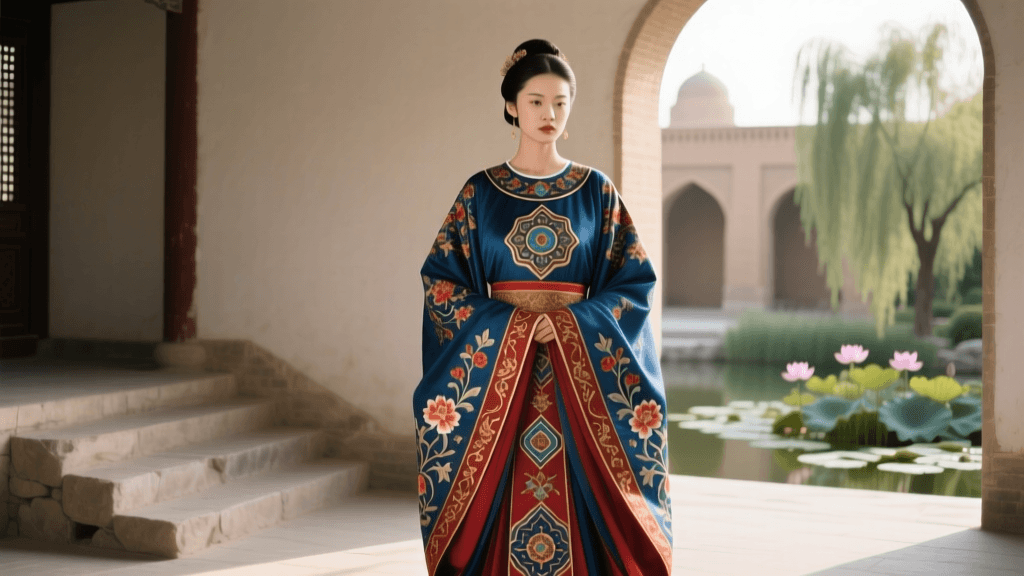
Perhaps the most enduring legacy of Silk Road cross-cultural exchange is the Yuanlingpao, or round-collar robe. Prior to the Tang Dynasty, traditional Han Chinese clothing predominantly featured cross-collars (jiaoling) that wrapped to the right. The round collar, however, was heavily influenced by the nomadic and semi-nomadic peoples of the steppes, as well as Persian and Sogdian traders. Originally adopted as practical riding wear, the Yuanlingpao was elevated to official court attire and everyday wear for men and, remarkably, for women who adopted male dress as a symbol of liberation and cosmopolitan flair.
Hufu: The Allure of Foreign Dress
The term Hufu translates literally to foreign clothing. During the early to mid-Tang period, wearing Hufu became a massive trend among the elite. This style was characterized by narrow sleeves, fitted bodices, and trousers tucked into knee-high leather boots—a stark contrast to the wide, flowing sleeves and draped skirts of traditional Han garments. The Encyclopedia Britannica's entry on the Silk Road highlights how the movement of Sogdian merchants along these routes facilitated the spread of these practical, equestrian-inspired garments into the heart of the Chinese empire.
Sogdian Pearl Roundels and Textile Innovations
The visual language of Tang Dynasty Hanfu was heavily dictated by imported textile patterns. The most iconic of these is the pearl roundel (lian zhu wen), a motif consisting of a circle of pearls enclosing an animal or floral design. This motif originated in Sasanian Persia and was brought to China via Sogdian weavers. Inside these roundels, Tang weavers placed auspicious Chinese symbols or Central Asian motifs like boar heads, peacocks, and winged horses.
Furthermore, the Silk Road introduced samite, a luxurious weft-faced compound twill silk. This weaving technique allowed for highly complex, polychrome patterns that were previously impossible with traditional Chinese warp-faced weaves. The introduction of new dyes, such as vibrant indigo and safflower reds from Central Asia, also expanded the Tang color palette, leading to the famously vivid and heavily patterned silks of the era.
The markets of the West in Chang'an were a dizzying array of foreign faces, spices, and silks. To wear the dress of the Western Regions was to wear the wealth of the world.
— Historical consensus on Tang Dynasty cosmopolitanism, derived from Edward Schafer's The Golden Peaches of Samarkand.
Actionable Guide: Sourcing and Wearing Tang-Inspired Hanfu Today
For modern enthusiasts, historians, and cultural practitioners looking to accurately recreate or wear Tang-style Hanfu with Silk Road influences, attention to specific measurements, fabrics, and historical accuracy is paramount. Below is a practical guide to sourcing authentic Tang-fusion garments.
1. Product Specifications and Measurements
- Product Name to Search: Tang Dynasty Yuanlingpao with Sogdian Pearl Roundel Brocade or Tang Style Banbi and Qixiong Shanqun Set.
- Hem Circumference: A historically accurate Tang Yuanlingpao should have a massive hem circumference of at least 350cm to 400cm to allow for the characteristic sweeping drape and riding ease.
- Sleeve Width: While early Tang Hufu featured narrow sleeves, the formalized Tang Yuanlingpao evolved to feature wide sleeves measuring 45cm to 55cm in width at the cuff.
- Collar Height: The round collar should sit flush against the neck with a height of 3cm to 4cm, often fastened with a fabric knot button at the right shoulder.
2. Fabric Selection and Costs
- Authentic Silk Brocade (Zhijin): For museum-quality reproduction, seek out jacquard-woven silk brocade featuring weft-faced patterns. Cost: $150 to $300+ USD for a full robe.
- High-Grade Polyester Jacquard: For everyday wear, cosplay, or cultural festivals, modern polyester blends offer excellent durability and drape while mimicking the sheen of samite. Cost: $45 to $80 USD.
- Lining: Tang robes were often lined. Use raw silk or breathable cotton for the inner lining to maintain structural integrity.
3. Timing and Sourcing
Ready-to-ship garments from specialized Hanfu vendors (such as those based in Chengdu or Hangzhou) typically arrive within 15–20 days via international e-commerce platforms. However, if you require custom-woven brocade with specific historical pearl roundel motifs, expect a production and shipping timeline of 45 to 60 days. Always verify the vendor's historical accuracy by checking their pattern references against museum artifacts from the Astana Tombs in Turpan.
4. Styling and Accessories
To complete the Silk Road aesthetic, pair the Yuanlingpao with a die-xie belt (a leather belt with hanging straps used to carry tools and pouches, derived from nomadic horsemen). Footwear should consist of black leather boots with upturned toes, a direct import from Central Asian equestrian culture.
Comparative Analysis: Pre-Tang vs. Tang Silk Road Fusion Hanfu
Understanding the shift in Chinese fashion requires comparing the indigenous styles of earlier dynasties with the cosmopolitan fusion of the Tang era.
| Garment Feature | Pre-Tang (Han/Wei) Traditional Hanfu | Tang (Silk Road Fusion) Hanfu |
|---|---|---|
| Collar Style | Cross-collar (Jiaoling), wrapping right over left. | Round-collar (Yuanling) and lapel-collar (Fanling). |
| Sleeve Silhouette | Consistently wide, flowing, and draped. | Varied: Narrow for Hufu/riding, wide for formal court. |
| Primary Motifs | Cloud scrolls, dragons, geometric lattice, jade motifs. | Sasanian pearl roundels, boar heads, grapevines, lions. |
| Weaving Technique | Warp-faced compound tabby and basic twills. | Weft-faced compound twill (Samite), complex brocades. |
| Footwear | Woven straw sandals, flat silk slippers. | Knee-high leather riding boots with upturned toes. |
Preserving a Cosmopolitan Legacy
The Silk Road did not merely move silk from East to West; it moved ideas, aesthetics, and tailoring techniques from West to East, permanently enriching the tapestry of Asian traditions. The Tang Dynasty's embrace of Persian and Sogdian influences demonstrates that traditional Chinese clothing was never static. Instead, Hanfu was a living, breathing canvas of global exchange. By understanding the precise measurements, textiles, and motifs of this era, modern wearers and designers can authentically celebrate a time when the crossroads of the world met in the folds of a single, magnificent robe.