Silk Road Threads: Persian Influences on Tang Dynasty Hanfu
The Crossroads of Chang'an: A Textile Melting Pot
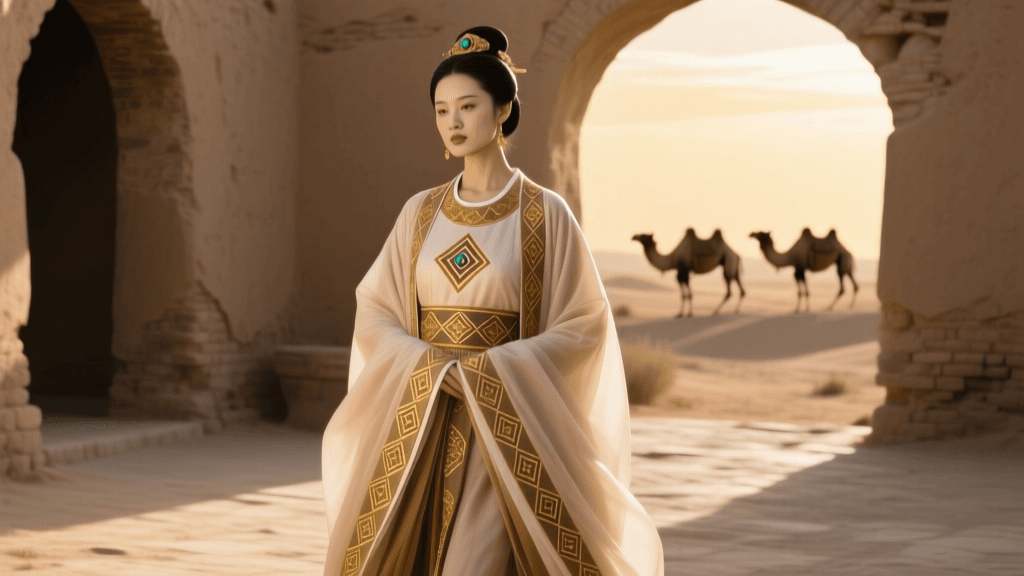
The Tang Dynasty (618–907 CE) represents a golden age of Chinese cosmopolitanism, a period when the capital city of Chang'an served as the eastern terminus of the vast Silk Road network. With a population exceeding one million, Chang'an was a bustling metropolis where merchants, diplomats, and artisans from Persia, Sogdia, India, and the Turkic steppes converged. This unprecedented cross-cultural exchange profoundly transformed traditional Chinese clothing, introducing new weaving techniques, exotic motifs, and entirely new garment silhouettes that were eagerly adopted by the Han Chinese elite. To understand Tang Dynasty Hanfu is to understand a sartorial language heavily influenced by historical trade routes and the diverse ethnic groups that traversed them.
Sasanian Persian Motifs and Sogdian Weavers
One of the most visible impacts of the Silk Road on Tang textiles was the introduction of Sasanian Persian motifs, most notably the pearl roundel (lian zhu wen). This design featured a circular border of pearls enclosing confronting animals such as boars, lions, or ducks. Sogdian merchants, who acted as the primary middlemen of the Silk Road, brought these motifs into China. According to the Metropolitan Museum of Art's Heilbrunn Timeline of Art History, the transmission of these textile patterns was so profound that Chinese weavers in the Sichuan and Jiangnan regions began replicating Sasanian roundels using traditional Chinese drawlooms, blending Persian iconography with native silk-weaving techniques.
Furthermore, the introduction of samite—a heavy, weft-faced compound twill silk—revolutionized Chinese textile production. Originally a Persian and Byzantine specialty, samite allowed for more complex, polychrome patterns that were highly prized by the Tang court. This cross-pollination of technology meant that Hanfu garments of the era were heavier, more structured, and more vibrantly patterned than the flowing, lightweight gauzes of the preceding Han and Wei dynasties.
Huihe Zhuang: The Uyghur Influence on Tang Court Fashion
Beyond Persian and Sogdian influences, the diverse ethnic groups of the northern and western steppes left an indelible mark on Tang fashion. The Uyghur Khaganate, a powerful Turkic empire and frequent ally of the Tang, heavily influenced courtly dress. Following the An Lushan Rebellion, Tang princesses were often sent to marry Uyghur Khagans to secure military alliances, and in return, Uyghur cultural elements flowed back into Chang'an.
The Huihe Zhuang (Uyghur dress) became a massive trend among Tang court women. Unlike the traditional Han Ruqun (a cropped jacket and high-waisted skirt), the Uyghur-influenced dress featured a distinctive翻领 (fanling), or folded lapel, often dyed in deep ochres and reds, paired with fitted sleeves and leather riding boots. The UNESCO Silk Roads Programme highlights how the movement of nomadic and semi-nomadic peoples facilitated not just the trade of goods, but the exchange of daily lifestyle and fashion customs, allowing Han women to adopt equestrian-inspired, practical garments that defied traditional Confucian gender norms.
The Yuanlingpao: A Steppe Legacy
The most iconic garment of the Tang Dynasty, the Yuanlingpao (round-collar robe), was not originally a Han Chinese invention. It was adapted from the nomadic Xianbei and Turkic tribes of the northern steppes, who required practical, close-fitting garments for horseback riding. The Tang imperial family, who themselves possessed partial Xianbei ancestry, elevated the Yuanlingpao to the status of official court and daily wear. Characterized by its circular neckline, side slits for mobility, and leather belt, the Yuanlingpao perfectly encapsulates the synthesis of steppe practicality and Han silk luxury.
Garment Comparison: Traditional Han vs. Silk Road Influences
| Feature | Pre-Tang Hanfu (e.g., Han/Wei) | Tang Silk Road Hanfu |
|---|---|---|
| Collar Style | Cross-collar (Jiaoling), right over left | Round-collar (Yuanling) and Folded Lapel (Fanling) |
| Silhouette | Slender, flowing, floor-dragging hems | Voluminous, structured, practical hemlines for riding |
| Primary Motifs | Clouds, dragons, native flora, geometric bands | Pearl roundels, confronting lions, lotus, Sasanian boars |
| Weaving Tech | Warp-faced tabby and lightweight gauzes | Weft-faced compound twill (Samite), heavy brocades |
| Footwear | Silk slippers, woven straw sandals | Leather riding boots, pointed-toe felt shoes |
Sourcing and Wearing Tang-Style Hanfu Today
For modern enthusiasts, historians, and cultural practitioners, acquiring and wearing authentic Tang-style Hanfu requires an understanding of historical silhouettes and modern textile markets. Here is actionable advice for sourcing and styling Silk Road-influenced Tang garments today.
Fabric Selection and Costs
To replicate the heavy, structured drape of Tang samite and brocade, avoid lightweight chiffons or thin polyesters. Instead, look for Shu Brocade (Sichuan brocade) or heavy silk damask with a minimum weight of 19 momme to 30 momme.
- Budget Option ($60 - $110 USD): High-quality jacquard polyester blends from retailers like Shisanyu. These offer the visual weight of brocade without the high maintenance of silk.
- Authentic Silk Option ($180 - $350+ USD): Genuine silk brocade Yuanlingpao from specialized ateliers. Expect to pay a premium for real gold-thread weaving and natural dyes.
Measurements and Silhouette
Tang dynasty aesthetics celebrated a fuller, more voluminous silhouette compared to the slender lines of the Song or Ming dynasties. When ordering a custom Yuanlingpao or a Huihe-inspired Fanling robe:
- Chest Allowance: Your garment's finished chest measurement should be at least 20 cm to 25 cm (8 to 10 inches) larger than your actual body chest measurement to achieve the characteristic relaxed Tang drape.
- Sleeve Length: For formal Tang robes, sleeve spans (tip-to-tip) should range from 180 cm to 220 cm. The sleeves should extend past the fingertips by at least 15 cm to allow for the traditional folded-hand greeting.
- Hemline: Unlike earlier dynasties, Tang men's Yuanlingpao often featured hemlines that stopped just above the ankles or calves to accommodate leather riding boots. Ensure the robe length is measured from the C7 vertebra (base of the neck) down to your ankle bone, subtracting 10 cm for mobility.
Timing and Sourcing
If you are commissioning a custom piece featuring accurate Sasanian pearl roundel motifs, be prepared for extended production times. Artisans on platforms like Taobao or specialized international Hanfu boutiques typically require 30 to 45 days for custom brocade weaving and tailoring. As noted by Smithsonian Magazine, the historical Silk Road was a complex network that required immense patience and time to traverse; similarly, sourcing historically accurate, loom-woven brocades today is a slow, deliberate process of supporting traditional craftsmanship.
Conclusion
The Hanfu of the Tang Dynasty is a testament to China's historical openness and the vibrant cultural exchange facilitated by the Silk Road. From the Sasanian pearl roundels woven into heavy samite to the Uyghur-inspired lapels worn by court women, Tang fashion was a dynamic, living archive of global trade. By understanding these cross-cultural influences and applying precise measurements and fabric choices, modern wearers can authentically revive and honor this magnificent era of sartorial history.