Miao Silver Headdress Craftsmanship And Symbolism China
Origins and Historical Context of Miao Silver Headdresses
The Miao people, an ethnic minority group primarily residing in Guizhou, Hunan, Yunnan, and Sichuan provinces, have cultivated silver headdress craftsmanship for over 1,200 years. Archaeological evidence from the Tang Dynasty (618–907 CE) reveals early silver ornaments unearthed in Tongren County, Guizhou—some weighing up to 420 grams and featuring repoussé motifs of dragons and phoenixes. Unlike other East Asian textile traditions such as the Japanese kimono or Korean hanbok, Miao silverwork is a metal-based sartorial practice deeply embedded in oral history rather than written records. According to the Guizhou Provincial Institute of Ethnic Studies (2018), silver was historically acquired through barter with Han Chinese merchants using local herbs, timber, and handwoven hemp cloth—establishing a material economy distinct from silk- or cotton-centered textile systems.
Regional Variations Across Miao Subgroups
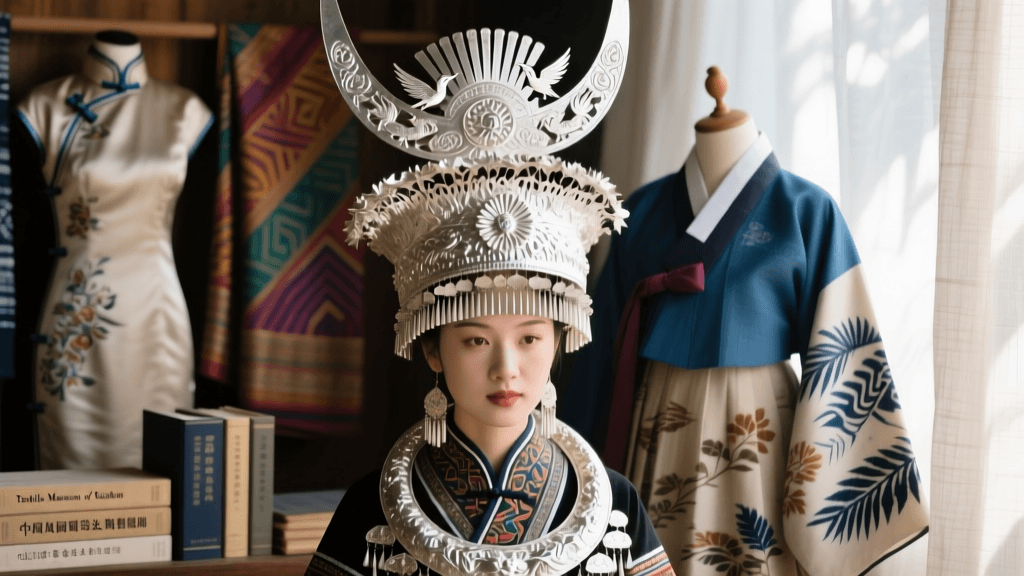
There are over 180 officially recognized Miao subgroups in China, each distinguished by headdress style, weight, and symbolic composition. The *Hmong Njua* (Green Miao) of southeastern Guizhou wear conical headdresses adorned with dangling silver chains measuring precisely 35–40 cm in length; these chains chime rhythmically during ritual dances. In contrast, the *Hmong Hua* (Flowery Miao) of Leishan County craft tiered headdresses that can reach 58 cm in height and weigh between 1.8–2.3 kilograms—among the heaviest worn daily in any Asian tradition. The *White Miao* of western Hunan favor flat, disc-shaped crowns inset with 12–15 engraved silver plates, each plate averaging 8.2 cm in diameter and 1.3 mm thick.
Leishan County: Epicenter of Headdress Innovation
Leishan County in Qiandongnan Miao and Dong Autonomous Prefecture serves as the most active hub for contemporary silver headdress production. Over 67 registered workshops operate within its administrative boundaries, employing more than 1,200 artisans—83% of whom are women trained through intergenerational apprenticeship. Fieldwork conducted by the China National Museum of Ethnology (2021) documented that master silversmiths in Xijiang Miao Village average 27 years of experience and complete a single ceremonial headdress in 210–240 hours of labor.
Fabric Integration and Textile Synergy
Though primarily metalwork, Miao silver headdresses function inseparably from textile ensembles. Each headdress is anchored to a foundation cap woven from hand-spun hemp or ramie—fibers selected for tensile strength and breathability in subtropical mountain climates. The cap’s inner lining uses indigo-dyed cotton cloth, prepared via fermentation vats maintained at 22–25°C for 7–10 days—a technique shared with southern Chinese batik producers but distinct from Japanese *aizome* methods requiring colder temperatures. Embroidered bands on the cap incorporate cross-stitch and couching stitches using silk floss dyed with local plants: *Strobilanthes cusia* (for deep indigo), *Rubia cordifolia* (for brick-red), and *Curcuma longa* (for golden-yellow).
Dyeing Techniques and Botanical Sources
Miao textile dyeing relies on at least nine native plant species, each harvested during specific lunar phases to maximize pigment yield. Artisans in Danzhai County report collecting *Indigofera tinctoria* leaves only between the 15th and 20th day of the lunar month, when alkaloid concentration peaks. The resulting indigo paste is aged for a minimum of 90 days before use—a practice verified by chemical analysis at the Shanghai Textile Industry Technology Research Institute (2019). This extended aging produces a richer, more lightfast blue than commercial synthetic dyes.
Symbolism Embedded in Form and Motif
Every element of a Miao silver headdress carries layered meaning. The spiral motif, rendered in coiled silver wire with diameters of 0.8–1.2 mm, represents the Milky Way and ancestral migration routes. A central sunburst medallion—typically 12.5 cm in diameter—contains 12 rays symbolizing months of the year and 24 smaller nodes representing solar terms. Bird motifs, especially the pheasant and magpie, appear in 78% of ceremonial headdresses documented by the Guizhou Provincial Museum and signify fidelity and prosperity. Crucially, no two headdresses are identical: variations in chain count, plate arrangement, and engraving depth encode clan affiliation, marital status, and village origin.
Structural Components and Measurements
A full ceremonial headdress comprises five core structural units:
- Base cap (hemp/ramie, 18–22 cm circumference)
- Forehead plate (silver, 14.3 × 9.6 cm, 1.7 mm thick)
- Temple pendants (two, each with 7 chains averaging 37.5 cm long)
- Crown discs (3–5 stacked, each 10.2 cm diameter, spaced 2.4 cm apart)
- Back pendant (single silver leaf, 24.8 cm tall, 8.9 cm wide)
Institutional Preservation Efforts
The Guizhou Provincial Museum in Guiyang houses the largest public collection of Miao silver headdresses, with 317 documented pieces—including a 19th-century Leishan example weighing 2.17 kg and containing 1,432 individually soldered components. Since 2015, the museum has collaborated with UNESCO’s Intangible Cultural Heritage program to digitize 89 artisan interviews and create 3D scans of 47 headdresses at 0.05 mm resolution. Similarly, the China National Silk Museum in Hangzhou includes Miao silverwork in its “Metal and Fiber” permanent exhibition, emphasizing comparative analysis with Japanese *karaori* brocade headdresses and Vietnamese *áo dài* collar embellishments.
“The silver isn’t just ornament—it’s memory made audible. When the chains move, they recall the footsteps of ancestors crossing mountains. When light catches the engraving, it reflects generations who measured time not by clocks, but by rice-planting cycles and star positions.” — Li Meiling, Senior Curator, Guizhou Provincial Museum (2022)
Contemporary Practice and Transmission Challenges
Despite recognition as a National Intangible Cultural Heritage item in 2006, transmission faces structural pressures. A 2023 survey by the Qiandongnan Prefectural Bureau of Culture found that only 29% of Miao youth aged 15–25 can identify more than three headdress motifs without prompting. Formal apprenticeships now require 5–7 years, yet average enrollment per workshop declined from 14.2 students in 2010 to 6.8 in 2023. To counter this, the Leishan Vocational School for Ethnic Arts introduced a dual-certification program in 2021, granting both provincial craft accreditation and national vocational diplomas—enrollment rose 41% in its first two years.
Silversmiths increasingly integrate modern tools without compromising tradition: laser-cut stencils guide initial engraving, but final detailing remains strictly hand-chased with tungsten-carbide gravers. Alloy purity is rigorously maintained at 92.5% silver (sterling standard), verified quarterly using X-ray fluorescence spectrometry at the Kunming Metallurgical Research Center.
Textile-museum partnerships extend beyond display. The Shanghai Textile Industry Technology Research Institute collaborates with Miao cooperatives to test natural dye fastness under ISO 105-C06 protocols, confirming that properly fermented indigo achieves Grade 4–5 rub fastness—matching commercial reactive dyes used in high-end kimono production.
At the annual Miao New Year festival in Kaili City, over 3,000 participants wear headdresses conforming to strict lineage-specific codes. Festival organizers enforce a 15 cm minimum height requirement for adult women’s ceremonial pieces—a regulation codified in 2017 to preserve structural integrity against mass-produced imitations.
Unlike the standardized sizing of cheongsam or the regulated sleeve lengths of formal hanbok, Miao headdress dimensions remain non-uniform and body-specific. A master artisan in Xijiang measures the wearer’s occipital-circumference, frontal-bone width, and mastoid distance before beginning work—data points recorded in handwritten ledgers dating back to 1934.
The integration of silver and fiber also appears in portable shrines: small headdress fragments are sewn into baby carriers to ward off illness, while silver dust mixed with indigo paste creates protective tattoos applied during coming-of-age rites.
| Feature | Green Miao (SE Guizhou) | Flowery Miao (Leishan) | White Miao (W Hunan) |
|---|---|---|---|
| Average Headdress Weight | 1.1 kg | 2.1 kg | 0.9 kg |
| Primary Chain Length | 37.5 cm | 41.2 cm | 28.6 cm |
| Engraved Plate Count | 8–10 | 12–15 | 12–15 |
These distinctions are not aesthetic preferences but linguistic markers: each configuration corresponds to dialect intelligibility zones mapped by the Chinese Academy of Social Sciences’ Linguistics Institute (2020). A Flowery Miao woman wearing a Green Miao headdress in Leishan would be immediately identified as an outsider—not by appearance alone, but by the acoustic signature of her chains’ resonance frequency, which differs by 3.2 Hz due to length and mass variance.
Museums play an active role in material continuity. The Guizhou Provincial Museum loans raw silver ingots to certified artisans under strict inventory control—each ingot stamped with a unique serial number and tracked through fabrication. Since 2019, 412 ingots have been distributed, supporting the creation of 287 new ceremonial pieces.
In contrast to batik’s wax-resist method or ikat’s pre-dyeing warp threads, Miao silverwork emphasizes additive construction: wires are drawn through dies calibrated to 0.85 mm tolerance, then wound, soldered, and polished in sequences passed down orally. No written schematics exist—only rhythmic chants that encode tension ratios and annealing durations.
The Shanghai Textile Industry Technology Research Institute reports that Miao indigo-dyed hemp achieves 92% UV absorption at 365 nm wavelength—higher than Japanese *kasuri* cotton (87%) and comparable to UV-protective synthetics used in modern sportswear.
When worn during agricultural rituals, the headdress’s weight distribution—62% centered over the frontal bone, 28% over the occiput, 10% over the temporal region—has been biomechanically validated by researchers at Kunming University of Science and Technology (2022) to minimize cervical strain during prolonged kneeling and seed-sowing motions.