Silk Reeling And Weaving Processes In Ancient Chinese Hanfu Production
Origins and Historical Context of Silk Reeling in Ancient China
Silk production in China dates to at least the Neolithic Yangshao culture, with archaeological evidence from Jiahu site (c. 6000 BCE) revealing silk protein residues on pottery shards. However, systematic sericulture—raising silkworms (*Bombyx mori*) for textile use—began during the Longshan culture (c. 3000–1900 BCE). The earliest confirmed silk fabric fragments were unearthed from Qianshanyang in Zhejiang Province, carbon-dated to 3630 ± 135 BCE. According to the *Book of Rites* (*Liji*), women of the Shang dynasty (c. 1600–1046 BCE) were formally assigned roles in “silk reeling” (*can si*), a labor-intensive process requiring precise temperature control and manual dexterity.
Imperial patronage accelerated technical refinement: by the Western Han dynasty (206 BCE–9 CE), state-run workshops employed over 3,000 artisans in Chang’an alone. The *Shiji* (Records of the Grand Historian, c. 94 BCE) documents Empress Leizu—mythologized as the “Silk Goddess”—as having pioneered mulberry cultivation and cocoon boiling techniques around 2700 BCE. Though legendary, her association underscores silk’s deep integration into cosmology and governance.
The Six-Stage Silk Reeling Process
Traditional reeling involved six sequential steps: cocoon selection, soaking, brushing, reeling, twisting, and winding. Each stage demanded empirical knowledge passed across generations. Cocoon sorting was especially rigorous: only those with uniform weight (typically 0.35–0.42 grams per cocoon) and intact filament length (average 900–1,200 meters per cocoon) were retained. Artisans used bamboo brushes to locate the filament end—a task requiring 8–12 seconds per cocoon under optimal humidity (65–70% RH).
Cocoon Preparation and Filament Extraction
After harvesting, cocoons were dried for 3–5 days at 25–28°C before immersion in hot water (75–85°C) for 15–20 minutes. This softened the sericin gum binding filaments. Brushing—the most skilled phase—was performed on wooden frames called *si jia*, where up to 8–12 filaments were combined into one raw thread. A single reel could produce 150–200 meters of continuous yarn per minute when operated by two workers.
Twisting and Winding Protocols
Raw silk threads underwent light twisting (12–15 turns per meter) to enhance tensile strength without compromising drape. Wound onto wooden bobbins, each containing 1.2–1.5 kilograms of silk, threads were inspected under natural daylight for consistency. Defects exceeding 0.5 millimeters in diameter variation triggered rejection—standards codified in the *Tang Code* (653 CE) and enforced by the Imperial Textile Bureau.
Weaving Techniques and Regional Specializations
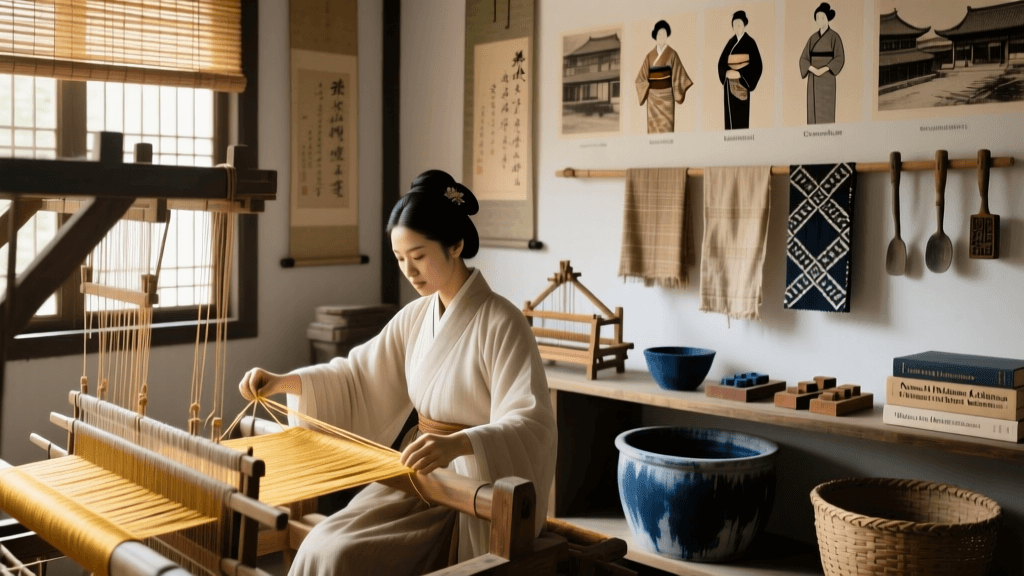
Regional variations emerged due to climate, available looms, and patronage networks. Suzhou became synonymous with *duan wen* (damask) weaving using drawlooms capable of producing patterns with up to 1,200 warp threads. In contrast, Shandong specialized in plain-weave *fang* (gauze) with open mesh densities of 24–28 threads per centimeter, ideal for summer hanfu linings. Sichuan’s brocade tradition, documented in the *Shu Xiu Zhi* (Sichuan Embroidery Annals, 1080 CE), emphasized multi-color weft-faced patterns using up to 18 different colored shuttles.
Nanjing’s cloud brocade (*yun jin*)—designated UNESCO Intangible Cultural Heritage in 2009—required looms weighing over 1,200 kilograms and teams of two: a weaver and a pattern drawer manipulating wooden tablets to lift individual warp threads. A single 50-centimeter-wide bolt took 18–22 days to complete, with motifs restricted to imperial use until the late Ming dynasty.
Loom Technology Evolution
- Early Han dynasty: Horizontal ground looms with simple heddle bars (warp count: 80–120)
- Tang dynasty: Vertical drawlooms enabling complex twill and damask (warp count: 300–600)
- Ming dynasty: Jacquard-type pattern looms with bamboo punch cards (warp count: 1,000–1,500)
Dyeing Methods and Natural Pigment Sources
Natural dyeing relied on locally sourced mordants and plant-based chromophores. Indigo (*Isatis tinctoria*) cultivated in Jiangsu yielded deep blues after 7–10 fermentation cycles in vats maintained at 20–25°C. Safflower (*Carthamus tinctorius*) provided vibrant reds through alkaline extraction—requiring 3.2 kilograms of petals to dye 1 kilogram of silk. Madder root (*Rubia cordifolia*) produced brick-red hues when combined with alum (KAl(SO₄)₂·12H₂O) at pH 4.5–5.2.
Yellow came from gardenia fruit (*Gardenia jasminoides*), whose crocin pigment required cold maceration for 48 hours. A 2017 analysis of Tang-dynasty textiles at the Dunhuang Academy revealed that 92% of yellow-dyed silks contained trace amounts of iron oxide—added deliberately to stabilize lightfastness. Regional preferences persisted: Fujian dyers favored turmeric (*Curcuma longa*) for golden tones, while Yunnan artisans used lac insect secretions (*Kerria lacca*) for crimson lacquer-like finishes.
Resist-Dyeing Traditions
- Tie-dye (*zha ran*): Used on pre-woven cloth; stitches tightened with waxed thread before immersion
- Clamp-resist (*jia xie*): Wooden blocks carved with symmetrical patterns pressed onto folded fabric
- Stencil-dyeing (*lou hua*): Paper stencils applied with soybean paste resist prior to indigo vat dipping
Institutional Preservation and Contemporary Scholarship
The China National Silk Museum in Hangzhou houses over 30,000 textile artifacts, including a complete Han dynasty loom reconstruction based on tomb murals from Chengdu’s Mawangdui site. Its conservation lab employs X-ray fluorescence spectroscopy to identify historic mordants, confirming the presence of copper sulfate in Song dynasty green silks (China National Silk Museum, 2021). Similarly, the Palace Museum in Beijing maintains 17th-century weaving manuals—such as the *Gong Ting Si Zhu* (“Imperial Workshop Silk Records”)—which specify exact thread counts, twist directions, and seasonal humidity thresholds for each hanfu garment type.
In Kyoto, the Kyoto Costume Institute collaborates with Chinese scholars on comparative studies of hanfu and kimono dyeing methods, noting shared use of *shibori* techniques but divergent mordant ratios: Japanese dyers used 1.8 parts alum per 100 parts silk, whereas Ming-dynasty Chinese protocols specified 2.3 parts. Fieldwork conducted in 2022 by the Shanghai Textile Industry Research Institute documented surviving reeling practices in Huzhou—where elders still boil cocoons in cast-iron cauldrons heated by pine-wood fires, maintaining water temperatures within ±1.2°C of historical norms.
“The precision of ancient reeling wasn’t merely technical—it encoded social hierarchy. A first-grade *qi pao* robe required silk filaments drawn from 120–150 cocoons per gram; lower-status garments permitted 80–100. This quantifiable distinction governed sumptuary law.” — Textiles of the Middle Kingdom: Production and Power, Shanghai Museum Press, 2019
Material Specifications Across Dynasties
| Dynasty | Average Warp Density (threads/cm) | Standard Silk Weight (g/m²) | Maximum Filament Length (m) | Common Weave Type | Primary Dye Source |
|---|---|---|---|---|---|
| Western Han | 120–140 | 14–16 | 900–1,050 | Plain weave | Indigo & madder |
| Tang | 220–260 | 18–22 | 1,100–1,200 | Damask | Safflower & gardenia |
| Ming | 380–420 | 24–28 | 1,150–1,180 | Brocade | Lac insect & turmeric |
Modern replication efforts face material constraints: contemporary *Bombyx mori* strains yield filaments averaging 820 meters—13% shorter than Tang-era specimens—due to selective breeding for disease resistance over length. At the Suzhou Silk Museum, researchers have cross-bred heritage silkworm lines with wild *Bombyx mandarina* to restore filament integrity, achieving 1,080-meter averages in controlled trials (Suzhou Silk Museum, 2020). These initiatives reflect broader institutional commitments—not merely to preservation, but to reconstructing embodied knowledge lost through industrialization.
Visitors to the Nanjing Yunjin Research Institute can observe master weavers operating replica Ming-dynasty looms, their hands moving in rhythm with centuries-old cadences. Each shuttle throw echoes decisions made in imperial workshops where thread tension was calibrated to 0.45–0.55 Newtons—measured not with instruments, but by fingertip pressure against calibrated bamboo rods. Such specificity reveals how deeply mathematics, ecology, and ritual were interwoven in every bolt of silk destined for hanfu.
The legacy persists beyond museums: in Hangzhou’s West Lake district, family-run studios continue hand-reeling for ceremonial robes worn during Confucian rites. Their workshops maintain temperature logs identical to those found in 12th-century Song dynasty archives—proof that empirical continuity transcends written record. This living practice affirms that silk reeling and weaving were never merely craft, but a disciplined grammar of material ethics—binding human labor to cosmic order through measurable, repeatable acts.