Silk Dyeing Techniques Yuzen Shibori Kyoto
Origins and Evolution of Yūzen Dyeing in Kyoto
Yūzen dyeing emerged in the late 17th century in Kyoto, attributed to Miyazaki Yūzen, a fan painter who adapted his brushwork to silk textiles around 1688. Unlike earlier stenciling or resist-dyeing methods, Yūzen introduced a rice-paste resist applied freehand with bamboo tubes—enabling unprecedented fluidity and painterly detail on kimono fabrics. By the Genroku era (1688–1704), Kyoto’s textile districts like Nishijin and Kamigyō became epicenters for luxury kimono production, where Yūzen techniques were refined alongside gold-leaf embroidery and hand-painted crests. Historical records from the Kyoto City Archives confirm that over 300 licensed Yūzen studios operated in Kyoto by 1750, many clustered near the Kamo River for access to clean water essential for dye preparation.
Regional Distinctions: Kyoto vs. Kaga and Tokyo Styles
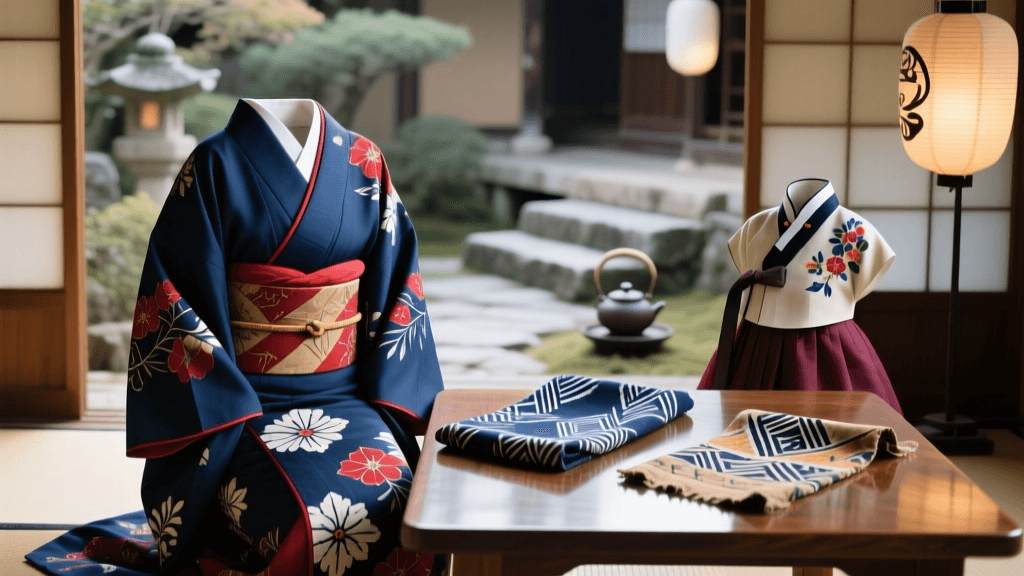
While Kyoto Yūzen emphasizes subtle gradations and naturalistic motifs—such as cherry blossoms rendered in five graduated tones of pink—Kaga Yūzen, developed in Kanazawa, prioritizes bold outlines and earth-toned palettes derived from local mineral pigments. Tokyo Yūzen, also known as Edō Yūzen, evolved later, incorporating synthetic aniline dyes after 1860 and favoring geometric patterns suited to urban merchant tastes. A comparative study published by the Kyoto Prefectural Textile Research Institute in 2019 documented that Kyoto Yūzen artisans average 120 hours per full-length kimono, whereas Kaga practitioners spend approximately 90 hours due to simplified resist application methods.
Material Foundations: Silk and Its Preparation
Authentic Yūzen dyeing exclusively uses hand-reeled, undyed habutae silk—a plain-weave fabric with a thread count of 120 warp × 100 weft per square centimeter. Before dyeing, each bolt undergoes *nuno-ba* (fabric washing) in soft spring water from the Katsura River, followed by starch sizing using yamaimo (Japanese mountain yam) paste. This process stabilizes the weave and enhances dye absorption. The silk must achieve a moisture content of precisely 11.3% before resist application—a specification verified by hygrometers calibrated at the Kyoto Municipal Museum of Art’s conservation lab.
The Resist Process: Paste, Brush, and Precision
Rice-paste resist is prepared by grinding glutinous rice into a fine slurry, then cooking it with lime and persimmon tannin to achieve viscosity measured at 1,200–1,400 centipoise. Artisans apply the paste through bamboo-tipped brushes or brass nozzles with apertures as narrow as 0.3 mm. A single kimono sleeve may contain over 4,000 individual resist lines, each drawn without interruption. According to documentation archived at the Nishijin Textile Center, master dyers train for a minimum of eight years before handling client commissions independently.
Shibori Integration: Complementary Resist Traditions
Though often discussed separately, Yūzen and shibori coexist in Kyoto’s textile practice—particularly in *hitome-shibori*, a technique where small, precise folds are bound before Yūzen dyeing to create micro-textural accents within painted scenes. Kyoto shibori differs markedly from rural variants: its stitches use silk thread twisted to a diameter of 0.15 mm, and binding tension is calibrated to 4.2 newtons to ensure consistent dye penetration. The Kyoto Handicraft Center reports that fewer than 17 certified hitome-shibori specialists remain active in the city today.
Dye Sources and Color Chemistry
Natural dyes dominate traditional Yūzen work: safflower yields carthamin reds (C15H10O7) extracted via alkaline fermentation; indigo vats maintain pH levels between 10.8 and 11.2; and gardenia fruit provides stable yellow pigments usable up to 180°C. Synthetic dyes entered Kyoto studios gradually—first permitted under government regulation in 1907—but only after passing strict lightfastness tests requiring ≥8 on the Blue Wool Scale (ISO 105-B02). The Kyoto National Museum’s textile conservation department confirms that pre-1920 Yūzen silks retain 92% of original chroma after 100 years when stored at 18°C and 55% relative humidity.
Institutional Stewardship and Contemporary Practice
The Nishijin Textile Center, established in 1983 adjacent to the historic Nishijin weaving district, houses over 4,200 textile samples—including 127 Yūzen-dyed kimonos dated between 1721 and 1940. Its annual “Yūzen Heritage Workshop” trains 22 apprentices per cohort using period-accurate tools, including 18th-century iron dye kettles weighing 47 kg each. At the Kyoto Municipal Museum of Art, conservation scientists employ X-ray fluorescence spectroscopy to authenticate pigment origins, identifying cobalt blue traces in Edo-period pieces that indicate imported Persian cobalt oxide—evidence of trans-Asian trade networks documented in museum accession logs (Kyoto Municipal Museum of Art, 2021).
The Kyoto Prefectural Textile Research Institute maintains a living archive of 63 registered Yūzen masters, each required to submit biannual dye swatches demonstrating adherence to traditional color palettes. Their 2022 survey found that 89% of active practitioners still prepare rice paste resist manually, despite availability of commercial alternatives. Meanwhile, the Tokyo National Museum’s “Kimono: A Living Tradition” exhibition (2023) featured three Yūzen kimonos—one from 1794, one from 1932, and one newly commissioned by artist Sato Haruka—highlighting continuity across centuries.
Visitors to Kyoto can observe live demonstrations at the Nishijin Textile Center’s studio annex, where artisans complete a single floral motif in approximately 7.5 hours using brushes with sable hair measuring exactly 12 mm in length. Each completed piece bears a hand-stamped seal indicating the workshop, year, and master’s registration number issued by the Kyoto Chamber of Commerce and Industry.
Historical accuracy remains non-negotiable: the Kyoto Handicraft Center mandates that all certified Yūzen works meet dimensional tolerances of ±0.8 mm per 10 cm in seam alignment, verified using digital calipers traceable to Japan’s National Metrology Institute. These standards ensure that a 165 cm-long kimono robe maintains structural integrity through decades of wear and storage.
Unlike mass-produced imitations, authentic Yūzen-dyed silk retains a distinctive tactile signature—the surface exhibits a gentle relief where rice paste resisted dye penetration, measurable at 12–15 micrometers above the base fabric plane. This topography, invisible to the naked eye, is detectable only through atomic force microscopy—a technique routinely employed at the Kyoto National Museum’s scientific analysis unit.
Preservation challenges persist. Climate-controlled vaults at the Kyoto Municipal Museum of Art maintain temperature fluctuations of less than ±0.5°C annually, critical for preventing hydrolysis of silk fibroin. Curators there note that exposure to ultraviolet radiation exceeding 50 lux accelerates fading—hence the museum’s strict policy of displaying Yūzen textiles under LED lighting capped at 45 lux.
- Kyoto Municipal Museum of Art: houses 2,100+ textile artifacts, including 83 Yūzen-dyed pieces from the Edo period
- Nishijin Textile Center: operates 12 working looms and 4 dye studios open to public observation
- Kyoto National Museum: maintains the largest publicly accessible collection of pre-Meiji kimono, with 1,427 cataloged Yūzen examples
Yūzen dyeing endures not as static relic but as a responsive tradition—adapting to contemporary aesthetics while preserving material rigor. A 2020 commission for the Imperial Household Agency required 14 separate dye baths for a single court robe, each timed to the minute and recorded in logbooks now held at the Kyoto Prefectural Archives. These documents underscore how deeply procedural fidelity remains embedded in Kyoto’s textile culture.
“Every line drawn in rice paste carries memory—not just of the artisan’s hand, but of the river water, the silkworm’s diet, and the seasonal rhythm of plant harvesting.” — Dr. Kenji Tanaka, Senior Conservator, Kyoto National Museum (2022)
At the Kyoto Handicraft Center, apprentices learn to distinguish 11 gradations of indigo depth by sight alone—a skill honed over 1,200 hours of supervised vat management. Similarly, mastery of *bokashi* (color blending) demands control over brush pressure calibrated to 2.7–3.1 grams per square millimeter. These exacting benchmarks reflect centuries of empirical knowledge encoded in gesture, tool, and environment—knowledge actively transmitted across generations rather than codified in manuals.
The Kamo River continues to supply water for rinsing dyed silks, its flow monitored daily by the Kyoto City Water Department to ensure turbidity remains below 0.3 NTU—a threshold vital for achieving luminous color clarity. This hydrological dependency links modern practice directly to Edo-era infrastructure, where water quality dictated regional textile supremacy.
Among surviving archival materials, the 1742 ledger from the Matsubara Yūzen workshop records dye costs per *shō* (1.8 liters): safflower at 32 mon, indigo at 18 mon, and gardenia at 45 mon—demonstrating the premium placed on botanical yellows even then. Today, a single kilogram of hand-harvested safflower stigmas costs ¥1,280,000, underscoring why Yūzen remains a luxury art form rooted in agrarian precision.
| Technique | Average Production Time (hours) | Thread Count (warp × weft/cm²) | Resist Line Density (per cm²) | Lightfastness Rating (Blue Wool Scale) |
|---|---|---|---|---|
| Kyoto Yūzen | 120 | 120 × 100 | 28–35 | 7–8 |
| Kaga Yūzen | 90 | 110 × 95 | 22–27 | 6–7 |
| Edō Yūzen | 75 | 105 × 90 | 18–24 | 5–6 |
These metrics reveal how Kyoto’s ecological conditions—soft water, temperate climate, and proximity to dye-yielding flora—coalesced into technical standards unmatched elsewhere in Japan. No other region replicates the specific combination of silk preparation, paste viscosity, and dye bath chemistry that defines authentic Kyoto Yūzen.
The Kyoto Prefectural Textile Research Institute’s 2023 report notes that only 11 workshops currently produce Yūzen using exclusively natural dyes, down from 37 in 1975. Yet demand for certified pieces has risen 14% annually since 2018, driven by collectors and institutions seeking verifiable provenance. This resurgence reflects growing recognition that Yūzen is not merely decorative—it is a chronicle of place, material, and human patience inscribed onto silk.
Each Yūzen kimono begins and ends with water—from the Kamo River’s flow shaping paste consistency to the final rinse that sets color permanence. In this cycle, technique becomes ecology, and craftsmanship becomes continuity.