Essential Guide to Kimono Accessories: Obi, Zori, Kanzashi
The Art of Kitsuke: Beyond the Kimono
The traditional Japanese kimono is globally recognized for its stunning textiles, elegant silhouettes, and profound cultural significance. However, the true mastery of kitsuke (the art of dressing) lies not just in the garment itself, but in the meticulous selection, layering, and arrangement of its accessories. From the structural support of the obi to the seasonal poetry of kanzashi hairpins, kimono accessories are functional, symbolic, and deeply rooted in Japanese aesthetics. For collectors, vintage enthusiasts, and those attending traditional events, understanding these elements is crucial for achieving an authentic and polished silhouette.
Historical context provided by the Victoria and Albert Museum's Asian collections reveals that the obi transformed from a narrow, functional cord in the 16th century to the wide, decorative centerpiece we see today. This evolution necessitated a whole new ecosystem of supporting accessories, each with specific measurements, materials, and rules of wear.
The Obi: The Focal Point of Japanese Dress
The obi is the sash that secures the kimono, but it also serves as the primary canvas for displaying wealth, taste, and formality. Selecting the correct obi requires an understanding of its dimensions and intended use.
Fukuro Obi (Formal Sash)
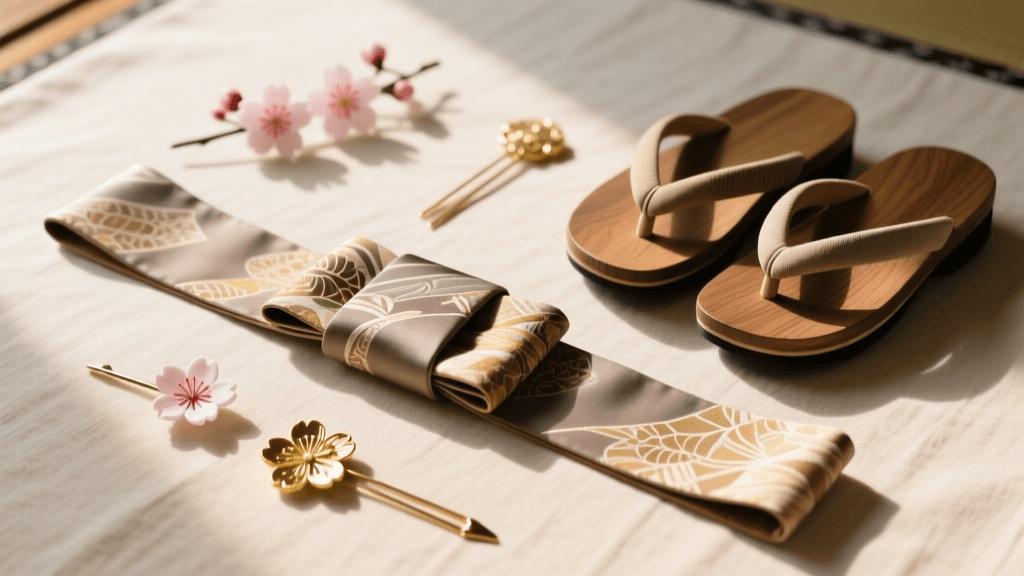
The fukuro obi is the most formal style worn by women today. It is typically woven with luxurious silk and metallic threads (gold or silver leaf). A standard fukuro obi measures approximately 31 cm in width and 430 cm to 450 cm in length. Because of its intricate brocade patterns and heavy weight, it is reserved for formal events such as weddings, tea ceremonies, and coming-of-age celebrations. Vintage fukuro obi in excellent condition can range from $150 to over $1,000, depending on the rarity of the weave and the presence of traditional motifs like cranes or pine trees.
Nagoya Obi (Semi-Formal and Everyday)
Invented in the 1920s for ease of dressing, the nagoya obi is pre-folded and stitched at the factory. It measures about 31 cm at its widest point but tapers to 15 cm for the section that wraps around the waist, while the back remains wide to form the popular taiko musubi (drum knot). Measuring roughly 315 cm in total length, it is the most versatile obi, suitable for everything from casual outings to semi-formal gatherings. Prices generally range from $50 for vintage silk pieces to $300 for contemporary, hand-dyed yuzen examples.
Hanhaba Obi (Casual Half-Width)
Measuring just 15 cm in width and around 350 cm in length, the hanhaba obi is strictly casual. It is most commonly paired with yukata (summer cotton kimonos) or komon (everyday patterned kimonos). Because it does not require complex padding or ties, it is highly recommended for beginners. These are highly affordable, often costing between $20 and $80.
The Unsung Heroes: Structural and Securing Accessories
A beautiful obi knot cannot hold its shape without a hidden architecture of supports. These small accessories are vital for a polished look.
- Obi-ita (Obi Board): A stiff, canvas or plastic-covered board inserted into the front of the obi to prevent the fabric from wrinkling when tied. They come in long and short variations, typically costing $10 to $25.
- Obi-makura (Obi Pillow): A small, padded cushion tied around the waist to give volume and shape to the taiko knot at the back. Standard sizes are about 10 cm in diameter.
- Obiage (Silk Scarf): A piece of silk crepe (chirimen) used to hide the obi-makura and add a pop of contrasting color beneath the main knot. It measures roughly 25 cm by 100 cm.
- Obijime (Braided Cord): A thick, braided silk cord tied over the center of the obi knot to secure everything in place. The color and thickness of the obijime dictate its formality; flat, woven cords are for daytime and casual wear, while thick, rounded cords with metallic accents are for formal evening wear.
- Koshihimo (Tying Sashes): Long, thin cotton or silk sashes used to tie the kimono tightly at the waist and hips before the obi is applied. A dresser typically needs three to four koshihimo per outfit.
Footwear Fundamentals: Zori and Tabi
Footwear in traditional Japanese dress is highly specialized, designed to protect the kimono hem while complementing the overall aesthetic.
Zori Sandals
Zori are flat, slip-on sandals made from various materials, including vinyl, brocade, leather, and woven tatami rush. Unlike Western footwear, zori are sized in centimeters (typically ranging from 22.0 cm to 25.5 cm for women). A crucial styling rule is that the heel should slightly overhang the back of the sandal by about 1 to 2 cm. This intentional overhang prevents the long kimono hem from dragging on the ground and becoming soiled. Formal zori feature thick, multi-layered soles and are often covered in the same brocade as the fukuro obi. Expect to pay $40 for basic vinyl zori and upwards of $200 for handcrafted, formal brocade pairs.
Tabi Socks
Tabi are the iconic split-toe socks worn with zori. They are fastened at the ankle using kohaze (metal clasps). Standard tabi feature either 4 or 5 kohaze; 5-kohaze tabi are generally considered more formal and provide a smoother line up the calf. They are sized exactly to the foot (e.g., 23.5 cm) to prevent wrinkling. White cotton tabi are mandatory for formal wear, while patterned or colored tabi are reserved for casual fashion and yukata.
Kanzashi: Seasonal Poetry in the Hair
Kanzashi are traditional hair ornaments that elevate the hairstyle (nihongami). The most famous variety is tsumami kanzashi, crafted from meticulously folded squares of silk to resemble flowers. The wearing of kanzashi is governed by strict seasonal rules. For example, cherry blossom motifs are worn exclusively in early April, while wisteria is worn in May, and maple leaves in November. Wearing a seasonal motif out of turn is considered a faux pas in traditional circles. Authentic, handcrafted silk tsumami kanzashi are works of art, often costing between $80 and $300 per piece.
Kimono Accessory Quick Reference & Buyer's Guide
The following table provides a structured overview for collectors and buyers looking to build a comprehensive kimono wardrobe.
| Accessory | Primary Function | Standard Dimensions | Formality Level | Est. Cost (USD) |
|---|---|---|---|---|
| Fukuro Obi | Formal waist sash | 31cm x 430cm | High | $150 - $1,000+ |
| Nagoya Obi | Semi-formal/Everyday sash | 31cm (tapered) x 315cm | Medium | $50 - $300 |
| Hanhaba Obi | Casual half-width sash | 15cm x 350cm | Low | $20 - $80 |
| Zori (Formal) | Footwear for events | 22cm - 25cm (Length) | High | $100 - $250 |
| Tabi (5-Kohaze) | Split-toe formal socks | Exact foot size | High | $25 - $60 |
| Obijime | Securing the obi knot | ~150cm length | Varies | $30 - $120 |
Care, Storage, and Preservation
Proper maintenance of kimono accessories is essential, particularly for vintage collectors. Textile preservation guidelines from the Smithsonian National Museum of Asian Art emphasize the importance of proper storage for silk and metallic accessories to prevent oxidation and fiber degradation.
Obi Care: Unlike kimonos, which are folded flat, formal obi with metallic threads should be loosely rolled around acid-free cardboard tubes to prevent permanent creasing and the cracking of gold leaf. Store them in breathable cotton bags or tatoushi (traditional paper wrappers) in a cool, dry environment.
Zori Maintenance: Zori with tatami or cork bases are highly susceptible to humidity. Store them in a well-ventilated area with silica gel packets to prevent warping and mold. The vinyl straps (hanao) can be wiped clean with a damp cloth, but avoid harsh chemicals that may dry out the material.
Tabi and Kohaze: Wash white cotton tabi gently by hand and air dry them in the shade to prevent yellowing. Over time, the metal kohaze clasps may loosen or the cotton loops (ukazuri) may fray. Replacement kits are widely available and can be sewn on at home to extend the life of the garment.
Conclusion
The world of kimono accessories is vast, intricate, and deeply rewarding. The Metropolitan Museum of Art's Department of Asian Art frequently highlights how historical sumptuary laws drove the innovation of hidden accessories and intricate hair ornaments, allowing commoners to express wealth and aesthetic sensibility subtly. Today, whether you are assembling a formal ensemble for a tea ceremony, curating a vintage collection, or simply exploring the rich textile history of Japan, understanding the nuances of the obi, zori, and kanzashi is the key to unlocking the full beauty of traditional Japanese dress.