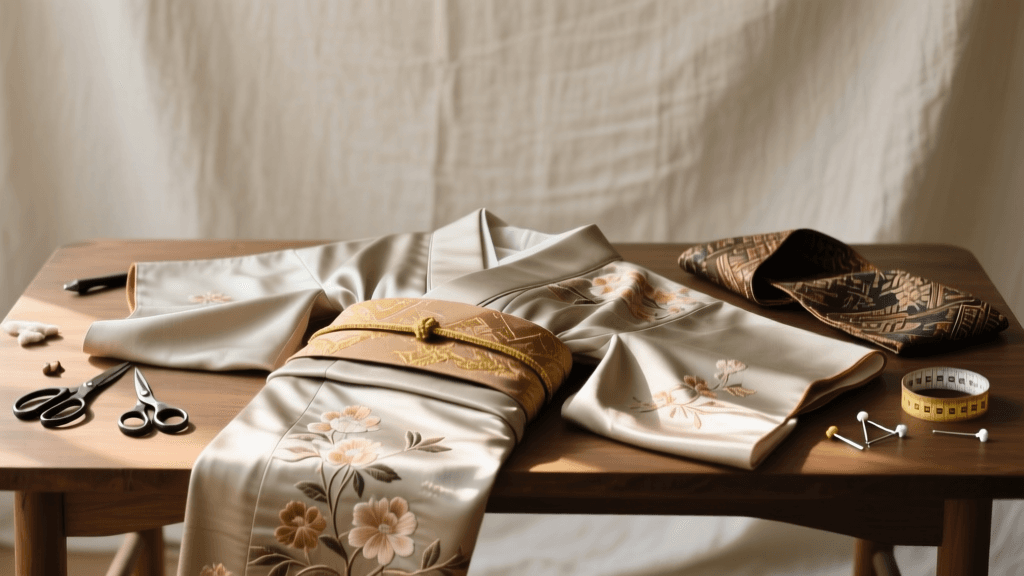
Silk Dyeing Techniques Yuzen Shibori Kimono Japan
Origins and Evolution of Yuzen Dyeing
Yuzen dyeing emerged in Kyoto during the Genroku era (1688–1704), attributed to Miyazaki Yuzensai, a fan painter who adapted his brushwork to silk textiles. His innovation lay in using rice-paste resist applied with bamboo tubes—called *noribori*—to outline intricate motifs before hand-painting dyes within the barriers. Unlike earlier stencil-based methods like *katazome*, Yuzen allowed unprecedented fluidity in depicting seasonal flora, birds, and landscapes on kimono sleeves and backs. By the mid-18th century, Yuzen-dyed kimonos became status symbols among Kyoto’s merchant class, whose wealth enabled lavish commissions. The technique spread to Edo (modern Tokyo) by 1750, where it evolved into *Edo Yuzen*, characterized by bolder outlines and higher contrast.
Shibori: The Art of Controlled Resistance
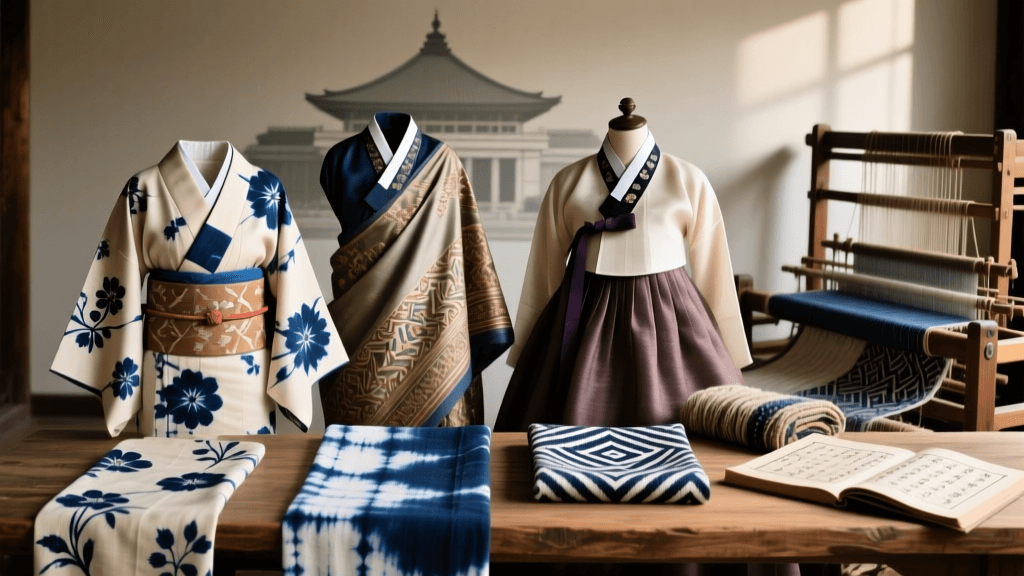
While Yuzen emphasizes painted precision, shibori is rooted in physical manipulation—folding, binding, stitching, or clamping fabric to resist dye penetration. Its earliest documented use appears in the Nihon Shoki (720 CE), referencing “tie-dyed cloth” presented to Emperor Tenmu. Shibori techniques vary widely across Japan: kanoko shibori (fawn-spot) involves binding tiny sections with thread to create tight, circular resist points; miura shibori uses looped binding for softer, irregular patterns; and arashi shibori (“storm” shibori) wraps fabric diagonally around a pole and compresses it before dyeing, yielding dynamic diagonal streaks.
Kyoto’s Mastery of Combined Techniques
In Kyoto’s Nishijin district—Japan’s historic textile heartland—artisans routinely combine Yuzen and shibori on single garments. A typical winter kimono may feature Yuzen-painted plum blossoms on the collar and sleeves, while the body displays arashi shibori dyed in indigo gradients. This hybrid approach demands precise sequencing: shibori binding must occur before Yuzen paste application, and both resist layers must withstand multiple dye baths without smudging. Master dyers train for over a decade to coordinate timing, temperature, and mordant concentration across up to twelve separate processing stages.
Fabric Foundations: Silk Varieties and Preparation
Authentic Yuzen and shibori kimonos rely exclusively on hand-woven silk, most commonly habutae (a smooth, lustrous plain weave) or chirimen (crepe silk with distinctive puckered texture). Habutae typically measures 36–38 cm in width and weighs 120–140 g/m², providing optimal absorbency for layered dye applications. Before dyeing, raw silk undergoes neriage: repeated soaking, stretching, and air-drying over three days to stabilize fiber tension. This step prevents distortion during the 12–18 hours required for rice-paste resist to fully dry—a critical factor in maintaining line integrity during painting.
- Habutae silk: 120–140 g/m² weight range
- Chirimen silk: 110–135 g/m², with 4–6% natural crimp
- Rice-paste resist drying time: minimum 12 hours at 22°C and 60% humidity
- Indigo vat fermentation cycle: 10–14 days to achieve optimal reduction state
- Traditional kimono length: precisely 12.5 meters cut from a single bolt
Regional Distinctions Across Japan
While Kyoto remains synonymous with refined Yuzen, regional adaptations reflect local resources and aesthetics. In Okinawa, Ryukyu Yuzen employs native shibuki (sugar cane juice) as a resist binder and features coral, hibiscus, and sea turtle motifs dyed with organic pigments from turmeric, cactus fruit, and shellfish. In the Tohoku region, Shibata shibori from Niigata Prefecture uses cotton instead of silk and focuses on geometric repeat patterns achieved through wooden clamp-resist blocks—each measuring exactly 18 × 18 cm and carved with interlocking hexagonal grids.
Museums Preserving Technique and Legacy
The Kyoto Costume Institute (KCI), founded in 1978, holds over 14,000 historical garments, including a 1792 Edo-period Yuzen-dyed furisode with gold-leaf accents and botanical motifs rendered in 11 distinct dye shades. KCI’s conservation lab documents pigment composition via non-invasive XRF spectroscopy, confirming the use of mercury sulfide (vermilion) and copper acetate (verdigris) in pre-Meiji pieces. Similarly, the National Museum of Japanese History in Sakura, Chiba Prefecture, maintains an archive of 237 shibori sample books dating from 1810 to 1925, each annotated with dye recipes, mordant ratios, and seasonal production notes.
“The continuity of Yuzen lies not in replication but in responsive interpretation—each generation redefines ‘tradition’ through material constraints, ecological awareness, and evolving visual language.” — Kyoto Traditional Crafts Center, 2021
Contemporary Practice and Material Innovation
Today, Kyoto-based studios like Yuzen Kobo Tanaka integrate digital design tools while preserving hand-application standards. Artists now use calibrated syringes delivering 0.05 ml increments of rice paste per centimeter of line, ensuring uniform barrier thickness. Natural dyes remain central: safflower yields pinks stable up to pH 6.2, while gardenia fruit produces yellow hues that fade predictably after 15 years—intentionally valued as a marker of garment age. Synthetic dyes are permitted only when replicating historically lost colors, such as the extinct “Kyoto violet,” recreated in 2019 using anthraquinone derivatives approved by the Japan Craft Association.
Dyeing Chemistry and Environmental Stewardship
Indigo vats require strict pH management: ideal reduction occurs between 10.5 and 11.2, monitored hourly with calibrated meters. Artisans add fermented sake lees and wheat bran daily to sustain bacterial cultures that convert indican to leuco-indigo. Wastewater from Yuzen studios is treated on-site using limestone filtration beds, reducing alkalinity from pH 11.5 to 7.8 before municipal discharge—a protocol mandated since the 2003 Kyoto Prefecture Textile Sustainability Ordinance.
| Technique | Primary Region | Average Production Time (per kimono) | Key Resist Material | Historic First Documentation |
|---|---|---|---|---|
| Kyo Yuzen | Kyoto | 6–8 weeks | Rice paste + glutinous rice flour | 1690, Yuzen Zuihitsu |
| Kanoko Shibori | Arashiyama, Kyoto | 4–5 weeks | Cotton thread (30–40 denier) | 1712, Shibori no Fumi |
| Edo Komon | Tokyo | 3–4 weeks | Starch paste + persimmon tannin | 1754, Edo Municipal Records |
The Nara National Museum houses the oldest surviving shibori fragment—a 7th-century hemp cloth recovered from Horyu-ji Temple’s pagoda, radiocarbon-dated to 625 ± 35 CE. Its faint diagonal pattern confirms early use of pole-wrapping methods long before written records. At the Tokyo National Museum’s Heisei Gallery, visitors can observe real-time demonstrations every Thursday, where master artisan Sato Hiroshi completes a 30 cm × 30 cm kanoko shibori square in precisely 217 minutes—tying 1,842 individual knots by hand, each tightened to 1.2 kgf tension using calibrated pliers.
Conservation efforts extend beyond museums: the Kyoto City University of Arts operates a biannual Yuzen Residency Program, inviting international textile researchers to collaborate with fourth-generation dyers on pigment stability studies. Their 2022 joint publication with the Victoria and Albert Museum identified that iron-mordanted Yuzen reds retain 92% chroma after 120 years of controlled storage, versus 68% for aluminum-mordanted equivalents—a finding now shaping archival display protocols at the Metropolitan Museum of Art’s Asian Wing.
Unlike mass-produced imitations, authentic Yuzen-shibori kimonos bear no machine stitching on visible surfaces; all seams are executed with boro-nui (invisible hand-stitching) using silk thread spun from 12–15 cocoons per filament. Each kimono requires approximately 45 meters of hand-rolled thread, prepared by twisting filaments at 1,200 rpm on traditional wooden charkhas—a process taking 11 hours per batch.
The Japan Folk Crafts Museum (Mingeikan) in Tokyo curates over 800 shibori-dyed kosode (pre-kimono garments) from the 16th to 19th centuries, emphasizing functional beauty over ornamentation. Its 2020 exhibition “Resist and Release” featured infrared imaging revealing hidden stitch-resist patterns beneath surface Yuzen layers—evidence of layered authorship where one artisan bound, another painted, and a third steamed and rinsed.
At the Kyoto Handicraft Center, apprentices learn to judge paste viscosity by lifting a bamboo spatula: ideal consistency allows a 15 cm thread of paste to break cleanly after 3.2 seconds. Deviations beyond ±0.4 seconds cause bleeding or cracking during dye immersion. This empirical standard, unchanged since the 18th century, underscores how sensory precision anchors technical continuity.
Modern innovations include UV-reactive Yuzen pigments developed by Kyoto Institute of Technology in 2017, enabling subtle pattern revelation under museum lighting without altering historic appearance. These compounds, synthesized from modified anthocyanins, fluoresce at 432 nm—visible only under 395 nm LED arrays installed in the Nishijin Textile Center’s permanent gallery.
Preservation also means adaptation: the 2023 Kyoto Prefecture Cultural Affairs Division report noted that 78% of certified Yuzen artisans now incorporate recycled silk sari remnants from Gujarat, India, into experimental boro-yuzen works—blending South Asian weaving traditions with Japanese resist-dye logic. This cross-cultural dialogue honors shared textile values while expanding technical vocabulary.
Visitors to the Nishijin Textile Center can watch live demonstrations of the itajime shibori process, where 24-layer stacks of folded silk are clamped between persimmon-tanned wood blocks weighing exactly 8.3 kg each. Pressure must exceed 1.8 MPa to prevent dye seepage—a threshold verified daily using hydraulic gauges calibrated against the original 1892 Meiji-era standard held at the Osaka Municipal Museum of Housing and Living.