The Inclusive Guide to Kimono for Every Body and Gender
Introduction to Inclusive Kimono Fashion
The kimono is universally recognized as a masterpiece of Japanese textile art and cultural heritage. However, a common misconception among international enthusiasts and tourists is that the kimono is a rigid garment, strictly tailored to a singular, traditional Japanese body type and a strict gender binary. In reality, the kimono is an incredibly adaptable, modular garment. Its straight-line construction and reliance on wrapping, folding, and tying make it uniquely suited for diverse body types, including petite, plus-size, and tall individuals, as well as those exploring gender-inclusive and androgynous styling.
According to the Victoria and Albert Museum's extensive kimono archive, the garment has continuously evolved over centuries, adapting to shifting societal norms, body shapes, and cultural exchanges. Today, the modern kimono renaissance is heavily focused on inclusivity. Whether you are preparing for a traditional tea ceremony, attending a summer matsuri, or participating in a Kyoto rental experience, understanding how to manipulate the kimono's architecture allows anyone to wear this iconic garment with confidence, comfort, and profound respect for its origins.
Decoding Kimono Measurements for Diverse Bodies
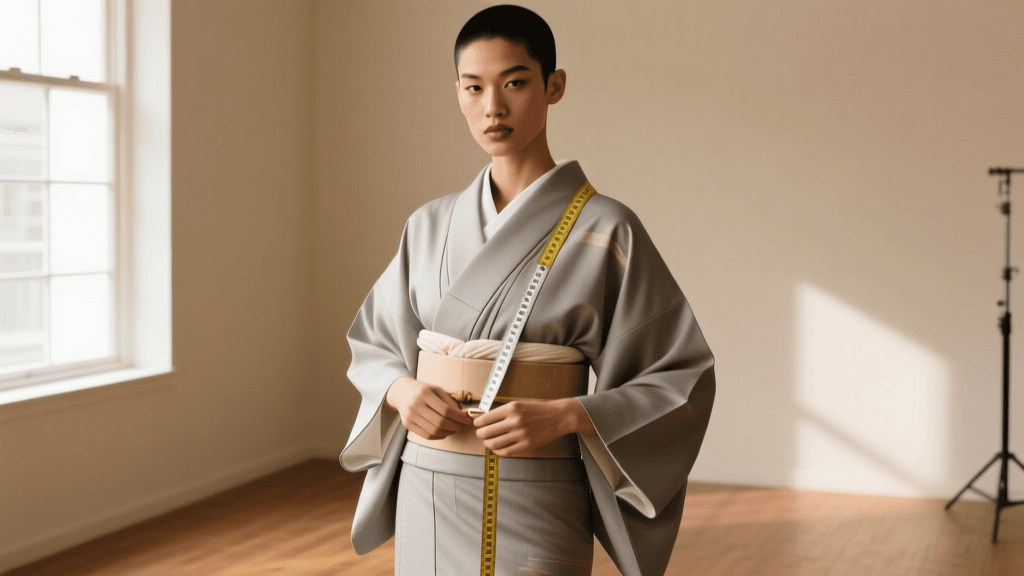
Unlike Western clothing, which is cut to follow the contours of the body, the kimono is cut in straight panels from a single bolt of fabric (a tanmono). The fit is achieved through how the fabric is wrapped and folded. To style a kimono for non-standard body types, you must understand three critical measurements:
- Yuki (裄): The distance from the center back of the neck, over the shoulder, to the wrist. This determines sleeve length.
- Mitake (身丈): The total back length of the garment from the base of the neck to the hem. For women, this is usually equal to the wearer's height, as the extra length is folded at the waist.
- Hizatake (髙): The measurement from the waist to the ankle, crucial for ensuring the hem falls correctly after the waist fold (ohashori) is created.
For individuals whose proportions fall outside standard retail sizing, custom tailoring (order-made) or strategic styling adjustments are necessary. As noted by cultural experts at Tofugu's comprehensive guide to Japanese traditional wear, understanding these foundational metrics is the first step toward democratizing kimono fashion for a global audience.
Styling for Different Body Types
Petite Frames
For petite wearers (generally under 150 cm or 4'11"), the primary challenge is managing excess fabric without creating a bulky, overwhelming silhouette. The traditional waist fold, or ohashori, can become excessively thick if the kimono is too long. Solution: Opt for a kimono with a shorter mitake that requires only a minimal fold. When tying the koshihimo (waist ties), use thin, elasticized ties rather than thick cotton ones to reduce bulk. Choose smaller, more delicate obi knots, such as the bunko (bow knot), and avoid overly wide, stiff obi belts that can visually cut the torso in half and shorten the legs.
Plus-Size and Curvy Silhouettes
The traditional kimono aesthetic idealizes a cylindrical, streamlined silhouette, which can be challenging for individuals with pronounced busts, wide hips, or a fuller waist. The secret to a flawless plus-size kimono fit is not compression, but strategic padding. By filling in the natural dips of the body (such as the small of the back and the hollows of the hips), you create a smooth, tubular canvas. This prevents the obi from slipping down and stops the fabric from pulling awkwardly across the bust. Furthermore, plus-size wearers should ensure their yuki (sleeve length) is adequate; if the sleeves are too short, the garment will look ill-fitted and restrict arm movement.
Tall and Broad-Shouldered Builds
Tall individuals often struggle with the ohashori. If the kimono is too short, the waist fold will sit uncomfortably high, or worse, be entirely absent, which is traditionally considered improper for women's formal wear. Solution: Tall wearers should seek out hikizuri (trailing hems) or modern custom-length garments. For broad-shouldered individuals, standard yuki measurements may cause the back panels to pull apart, exposing the undergarments. Wearing a slightly wider haneri (decorative collar) and ensuring the back seam is perfectly centered helps maintain structural integrity and visual balance.
Breaking the Binary: Gender-Inclusive Kimono Styling
Historically, the divide between menswear and womenswear in Japanese fashion was delineated by color, pattern, sleeve shape, and obi width. Men's kimono feature shorter, squared sleeves (kakusode), muted colors or subtle geometric patterns, and a narrow, stiff obi tied in a simple kai-no-kuchi knot. Women's kimono feature long, swinging sleeves (furisode for unmarried women, tomesode for married), vibrant motifs, and wide, elaborate obi.
Today, the rise of gender-inclusive (jendaresu) fashion has beautifully blurred these lines. Non-binary and gender-nonconforming individuals are pioneering new styling techniques that honor the garment's history while expressing personal identity.
"The kimono is fundamentally a wrapped garment; it does not inherently possess a gender. The gendering of the kimono is a result of societal styling rules, which are entirely open to reinterpretation." — Modern Kyoto Stylists
Androgynous Styling Tips:
- The Hakama: Pairing a solid-colored kimono with a pleated hakama skirt creates a striking, scholarly silhouette that is historically rooted in samurai and university student attire, yet reads as beautifully androgynous today.
- Obi Selection: Choose a medium-width hanhaba obi. It provides the structural support of womenswear but can be tied in the sleek, minimalist knots typical of menswear.
- Collar Depth: The 衣紋抜き (eri-nuki), or the pulling down of the back collar, is a hallmark of feminine elegance. Leaving the collar closer to the nape of the neck creates a more masculine or neutral posture.
Organizations like the Japan National Tourism Organization (JNTO) increasingly highlight diverse kimono experiences, noting that many progressive rental shops in Tokyo and Kyoto now offer gender-neutral styling consultations, allowing visitors to mix and match traditional elements regardless of gender identity.
The Architecture of Silhouette: Padding and Undergarments
Achieving the perfect kimono fit relies heavily on what happens beneath the silk. The traditional cylindrical shape ensures the obi sits flush against the body, preventing back pain and garment slippage. Below is a guide to the essential padding and undergarment tools used to adapt the kimono to various body types.
| Tool / Material | Placement | Primary Purpose | Best For Body Type |
|---|---|---|---|
| Sarashi (Cotton Binding) | Bust / Waist | Smooths and flattens curves; provides a secure base layer. | Curvy, Plus-Size, Trans-masculine |
| Hip Pads (Towel or Foam) | Hips / Waist Dip | Fills the hollow above the hips to prevent obi from sliding down. | Pear-shaped, Petite, Plus-Size |
| Tenugui (Cotton Towel) | Small of the Back | Supports the lower back and fills the spinal dip for a straight drape. | All Body Types (Essential) |
| Datejime (Wide Under-Obi) | Over the Ohashori | Secures the waist fold and flattens bulk before the main obi is tied. | Petite, Plus-Size |
For plus-size individuals, using a tightly wrapped sarashi around the bust not only honors the traditional flat-chested aesthetic but also provides immense physical support, acting much like a modern sports bra. For petite frames, rolling a small tenugui towel and placing it at the small of the back ensures the heavy obi does not force the wearer into an uncomfortable, slouching posture.
Practical Guide: Renting and Buying for Non-Standard Sizes
If you are traveling to Japan and plan to rent a kimono, it is vital to communicate your needs in advance. Standard rental shops typically stock garments that fit individuals between 150 cm and 165 cm (4'11" to 5'5") with a maximum hip measurement of around 100 cm (39 inches).
For Plus-Size Travelers: Seek out specialized rental boutiques in Kyoto (such as Okamoto or Wargo) that explicitly advertise "Size Free" or carry 2L, 3L, and 4L sizes. These shops utilize wider tanmono fabrics and extra-long obi belts. Expect to pay a premium of roughly 2,000 to 4,000 JPY ($15 to $30 USD) for specialized plus-size fitting services.
For Tall Travelers: Many standard rental kimono will fall above the ankle on individuals over 175 cm (5'9"), which is considered a fashion faux pas. Look for shops offering hikizuri (formal trailing kimono) or modern two-piece kimono sets, which separate the top and bottom halves to guarantee perfect hem placement regardless of height.
Buying Vintage: The vintage kimono market is a goldmine for diverse bodies. Because vintage garments were hand-sewn, they can be entirely taken apart, washed, and re-sewn to accommodate different yuki and mitake measurements. When shopping online or in Kyoto's antique markets, always measure your personal yuki and compare it to the garment's listed dimensions, allowing for a 2-3 cm margin of error.
Conclusion
The beauty of the kimono lies not in its ability to force the wearer into a specific mold, but in its architectural flexibility to honor the wearer's unique form. By understanding the mechanics of measurements, the art of strategic padding, and the rich history of gender-fluid styling, anyone can experience the profound elegance of Japanese traditional wear. Whether you are petite, plus-size, tall, or navigating the spectrum of gender expression, the kimono is a canvas waiting to be wrapped, tied, and styled in your own authentic image.