Ancient Greek Chiton & Roman Stola Sewing Guide 2026
The 2026 Revival of Classical Antiquity Garments
The intersection of ancient European folk dress and modern historical reenactment has reached a fever pitch in 2026. As sustainability and "slow fashion" dominate the European cultural festival circuit, reconstructing classical garments has become a cornerstone for heritage enthusiasts and textile artists alike. Unlike the highly tailored garments of the later medieval and Renaissance periods, the foundational dress of ancient Greece and Rome relied entirely on the sophisticated draping of rectangular woven textiles. Understanding the mechanics of the Ionic chiton and the Roman stola is essential for anyone looking to accurately represent classical antiquity in contemporary cultural festivals, theatrical productions, or living history museums.
In this comprehensive 2026 guide, we will explore the historical context, precise measurements, and step-by-step construction techniques required to recreate these iconic garments. Whether you are sourcing premium European flax linen for a Greek chiton or weaving the distinctive woolen borders of a Roman stola, this guide provides the actionable details necessary for historical accuracy.
Understanding the Ionic Chiton
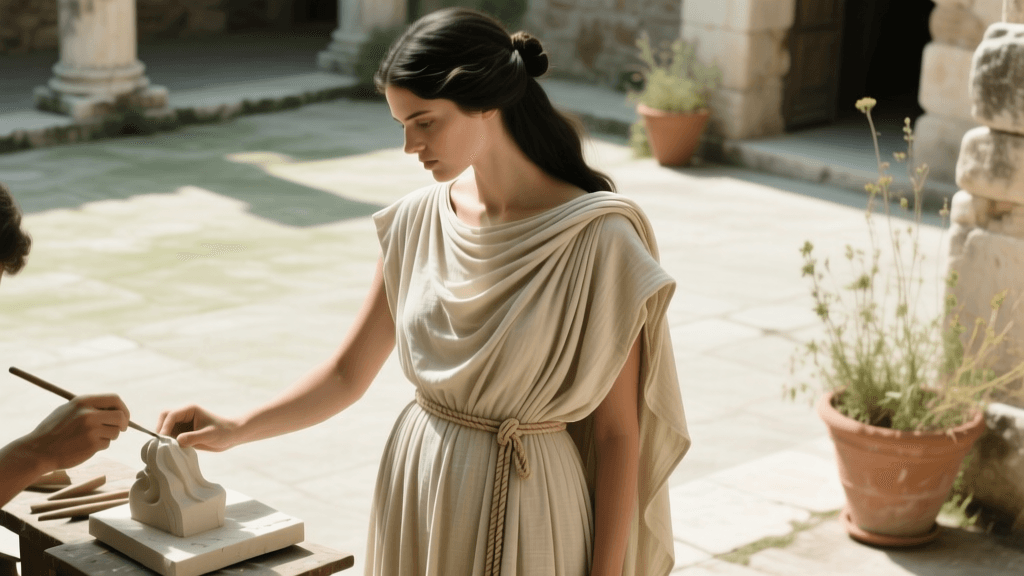
The chiton was the fundamental body garment for both men and women in ancient Greece, but the Ionic variant, which gained prominence around the 6th century BCE, is particularly celebrated for its elegance and complex draping. According to the World History Encyclopedia, the Ionic chiton was typically made of lightweight linen, allowing for deep, flowing folds that contrasted sharply with the heavier, woolen Doric peplos. The garment was essentially a large rectangle of fabric, folded around the body and pinned at the shoulders, creating a sleeve-like effect without any actual tailoring or cutting of armholes.
Fabric Selection and Yardage for 2026
In the 2026 textile market, sourcing historically accurate linen requires navigating the current European flax harvest cycles. Premium Belgian and Normandy linens remain the gold standard for the Ionic chiton. For a historically accurate drape, you must select a lightweight, semi-sheer linen with a weight of approximately 120 to 150 grams per square meter (GSM). Heavier linens will not produce the characteristic fine pleats and delicate kolpos (blousing) seen in classical marble statuary.
Calculating Your Fabric Yardage:
- Width: Measure your full arm span from wrist to wrist. Add 12 to 18 inches (30 to 45 cm) to this measurement to allow for the deep side folds and the characteristic blousing over the belt.
- Length: Measure from the highest point of your shoulder down to the floor, then add 12 inches (30 cm) to allow for the kolpos (the overfold created by belting).
- Standard Requirement: For an average-sized adult woman in 2026, this typically translates to a single piece of fabric measuring roughly 2.5 meters wide by 2 meters long.
The Roman Stola: Symbol of the Matrona
Transitioning from the Hellenic world to the Roman Republic and Empire, the stola emerges as the definitive garment of the Roman citizen woman. While the Greek chiton was worn by both sexes, the Roman stola was strictly reserved for married women (matronae) and served as a powerful visual marker of social status, modesty, and legal standing. As detailed by the World History Encyclopedia, the stola was worn over a tunica interior and was distinguished by its unique structural elements, most notably the instita (a woven band at the hem) and the shoulder straps.
Constructing the Instita and Limbus
The most critical element of the stola is the instita, a decorative, often brightly colored or gold-threaded woven band that bordered the bottom hem. In 2026, historical reenactors often struggle to replicate this without resorting to modern sewn-on ribbons, which lack historical authenticity. For true accuracy, the instita should be tablet-woven or inkle-woven separately and then whip-stitched to the hem of the stola. Additionally, the stola frequently featured a limbus, a contrasting colored border at the top edge, which was visible when the garment was belted and bloused.
Unlike the linen-heavy Greek chiton, the Roman stola was frequently crafted from lightweight wool crepe or, for the ultra-wealthy patrician class, imported Coan silk. In the current 2026 market, lightweight merino wool challis or high-quality Tencel-wool blends offer the best historically accurate drape while remaining breathable for summer heritage festivals.
Comparative Analysis: Chiton vs. Stola vs. Peplos
To ensure your reconstruction is historically accurate, it is vital to understand the structural differences between the major classical garments. The following table outlines the key distinctions for quick reference during your material sourcing and pattern planning.
| Garment | Primary Fabric | Fastening Method | Social Significance |
|---|---|---|---|
| Doric Peplos | Heavy Wool | Single large pins (fibulae) at shoulders | Traditional, conservative Greek dress |
| Ionic Chiton | Lightweight Linen | Multiple small pins or buttons along arms | Elegant, cosmopolitan, worn by both sexes |
| Roman Stola | Wool Crepe or Silk | Shoulder straps (instita), belted high | Exclusive to married Roman citizen women |
Step-by-Step Draping and Construction Guide
Because these garments are not tailored, the "construction" is primarily in the hemming, the weaving of the borders, and the art of the drape. Follow these steps to achieve a museum-quality silhouette.
- Prepare the Textile: Wash and press your linen or wool. Finish the raw edges using a traditional rolled hem or a blanket stitch if you are portraying a lower-class citizen. For patrician portrayals, a nearly invisible hand-rolled hem is mandatory.
- The Overfold (Apoptygma): For the Ionic chiton, fold the top edge of the fabric down by 12 to 18 inches before draping. This creates the deep chest drape seen in classical sculptures. The Roman stola generally did not feature this deep overfold, relying instead on the high belting to create volume.
- Shoulder Pinning: The Ionic chiton requires multiple fastening points along the upper arm. Use historically accurate bronze or silver bow fibulae. Space them evenly, approximately 3 inches apart, pulling the fabric through the pin to create the "sleeve" effect. The Metropolitan Museum of Art's Heilbrunn Timeline of Art History provides excellent visual references for the spacing of these pins on surviving Hellenistic bronzes.
- Belt and Blouse: Tie a woven wool or leather cord belt around the waist or under the bust. Pull the fabric up and over the belt to create the kolpos. Ensure the blousing is even in the front and slightly longer in the back to mimic the natural drape of classical statuary.
Sourcing Authentic Textiles and Hardware in 2026
The landscape of historical reenactment supplies has evolved significantly by 2026. Mass-produced costume jewelry is no longer acceptable for high-level historical accuracy. When sourcing hardware such as fibulae (brooches) and belt buckles, look for artisans utilizing lost-wax casting techniques with solid bronze or brass alloys. Several specialized forges in Italy and Greece now offer custom-cast museum replicas based on specific archaeological finds from the Agora and the Roman Forum.
For textiles, avoid modern synthetic blends at all costs. The 2026 European flax shortage has driven up the price of pure linen, with premium yardage now averaging €45 to €60 per meter. To manage costs without sacrificing accuracy, many reenactors are turning to historically accurate hemp-linen blends, which offer a nearly identical drape and texture to classical linen while being more resilient to the rigors of outdoor festival wear.
Conclusion
Reconstructing the Ionic chiton and the Roman stola is a masterclass in the elegance of simplicity. By focusing on the quality of the drape, the accuracy of the woven borders, and the proper use of historical hardware, you can bring the rich textile traditions of classical antiquity to life. As the 2026 heritage festival season approaches, taking the time to source the correct lightweight linens and wool crepes will ensure your garments move, fold, and flow exactly as they did in the ancient Mediterranean world.