Draft a Traditional Romanian Ia Blouse: Zero-Waste Patterns for 2026
The Geometry of Ancestral Sewing
The traditional Romanian Ia (pronounced 'ee-ah') is experiencing a massive renaissance in 2026. Driven by the global slow-fashion movement and a renewed interest in ancestral zero-waste pattern drafting, artisans and home sewists are turning to Eastern European folk dress for sustainable construction techniques. Unlike modern pattern making, which relies on curved armscyes and shaped bodices that generate significant textile waste, the Ia is constructed entirely from rectangles and squares. This mathematical approach to garment making honors the historical constraints of the loom while offering a masterclass in sustainable sewing for 2026.
The techniques associated with the Ia, particularly the intricate altița (shoulder smocking), have been globally recognized for their cultural importance. According to the UNESCO Intangible Cultural Heritage registry, the traditional practices surrounding this garment represent a profound connection to community identity and ecological mindfulness. In 2026, adapting these heritage techniques to modern body types and contemporary fabric widths requires a deep understanding of the underlying geometry.
The Geometry of the Ia: Rectangular Pattern Drafting
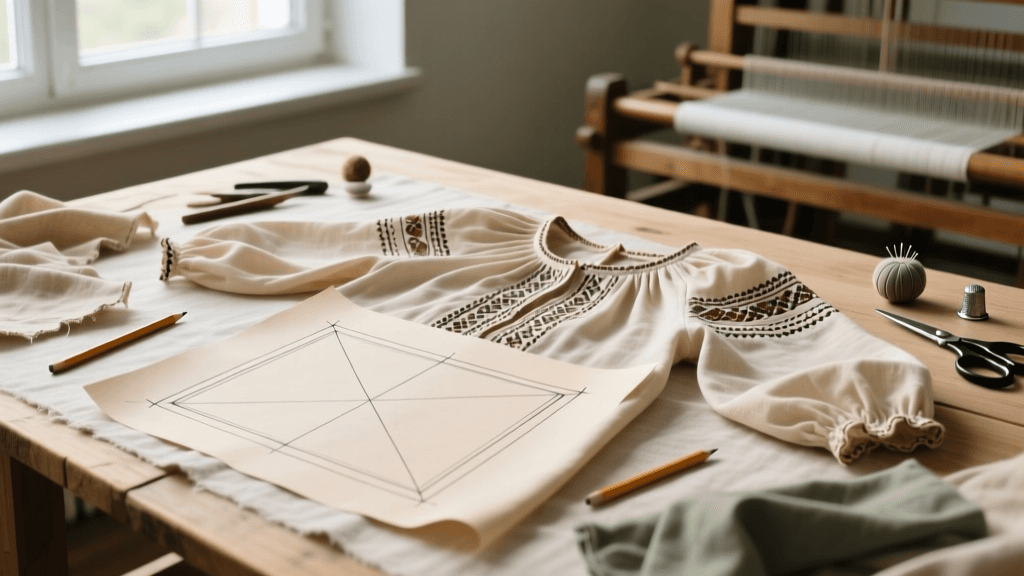
Historically, the width of the fabric was dictated by the width of the weaver's loom, typically ranging from 40 to 60 centimeters. To avoid wasting a single thread of precious handwoven hemp or linen, the garment was designed using the exact loom width. Today, commercial linen and cotton fabrics are typically woven at 140 cm to 150 cm widths. To maintain the zero-waste ethos in 2026, pattern drafters must mathematically divide modern fabric widths to mimic historical loom constraints.
| Component | Quantity | Dimensions (cm) | Purpose |
|---|---|---|---|
| Front/Back Panels | 2 | 70 x 110 | Main bodice and hem |
| Sleeves | 2 | 70 x 60 | Voluminous bishop sleeves |
| Gussets (Pavă) | 2 | 15 x 15 | Underarm mobility |
| Cuffs (Măneșuță) | 2 | 10 x 25 | Wrist gathering |
| Neckline Bindings | 2 | 5 x 40 | Drawstring casing |
By nesting these rectangular pieces within a 140 cm wide fabric layout, you can achieve a 98% fabric yield. The remaining 2% consists of small triangular offcuts from the neckline, which are traditionally repurposed into tassels or quilted patchwork.
Sourcing Materials in 2026: Linen, Hemp, and Thread
The foundation of any authentic folk dress is the textile. In 2026, the market for heritage fibers has expanded, but quality varies wildly. For an authentic Ia, you must avoid heavily processed, chemically softened linens. Instead, seek out mid-weight (180-200 gsm) European flax linen or traditional Romanian hemp blends. According to the Victoria and Albert Museum's textile archives, the interplay of light on slightly slubbed, unbleached fibers is what gives historical smocking its three-dimensional depth.
- Base Fabric: 3 meters of 100% European Flax Linen (180 gsm), pre-washed at 60°C to account for shrinkage. Current 2026 pricing averages $28-$35 per meter from certified heritage mills.
- Embroidery Floss: DMC Pearl Cotton (Size 8 and 12) or hand-spun silk threads. The 2026 trend favors botanical dyes, particularly madder root (red) and woad (blue).
- Needles: John James Tapestry Needles (Size 22 or 24) to navigate the linen's weave without piercing and breaking the warp threads.
The Altița and Încreț: Mastering the Smocking Techniques
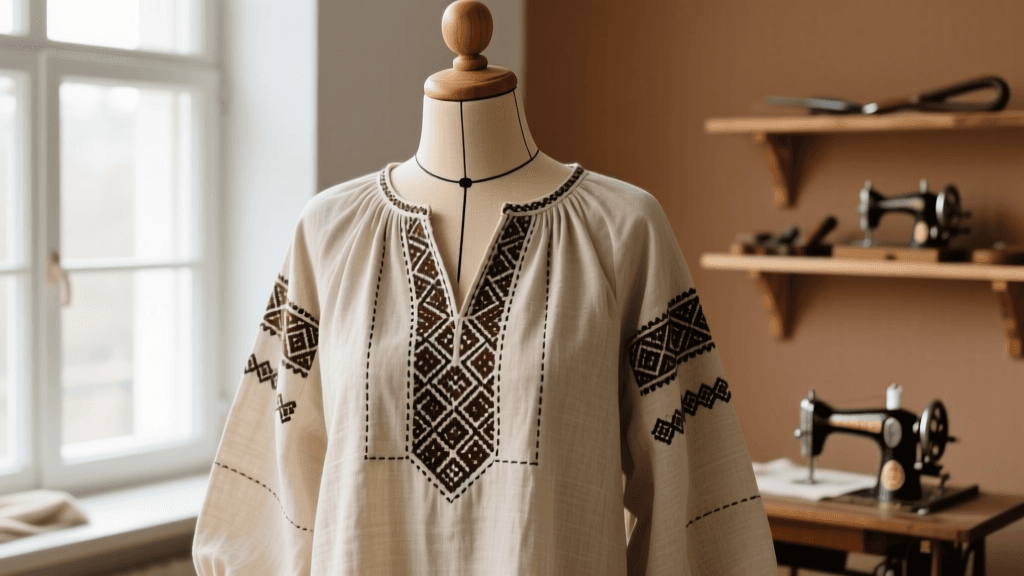
The defining feature of the Romanian Ia is the altița—a dense, rectangular block of smocking and embroidery located on the upper sleeve, just below the shoulder seam. Below the altița lies the încreț, a gathered section that transitions the wide sleeve into the structured shoulder.
Drafting the Altița Grid
The altița is not merely decorative; it is a structural gathering technique that replaces the modern set-in sleeve. To construct it, you must first mark a precise grid on the upper 20 cm of both sleeve rectangles.
- Mark horizontal lines every 5 mm using a water-soluble fabric pen.
- Mark vertical lines every 5 mm, creating a perfect square grid.
- Using a contrasting basting thread, weave through the intersections to create a drawstring grid.
Once the grid is basted, pull the threads simultaneously to gather the fabric into tight, uniform pleats. In 2026, many sewists use a technique called 'couching' to secure these pleats, laying thick silk threads over the gathers and stitching them down with tiny, invisible stitches. This creates the raised, textured appearance characteristic of the Carpathian mountain regions.
When mapping your embroidery onto the altița grid, historical accuracy meets personal expression. Traditional motifs include the 'sun wheel' (representing agricultural cycles), the 'river' (symbolizing the flow of life), and the 'tree of life' (connecting the earthly and spiritual realms). In 2026, contemporary makers are adapting these geometric grids to map local flora and personal heritage symbols, utilizing the 5mm square structure as a pixelated canvas for storytelling.
Executing the Încreț (The Gathering)
The încreț serves as the bridge between the rigid altița and the flowing lower sleeve. It is typically worked in a honeycomb smocking pattern. Using a heavy linen thread, stitch a series of diagonal catch-stitches that pull the vertical pleats together in alternating rows. This creates a flexible, stretchy mesh that allows the arm to move freely while maintaining the dramatic volume of the bishop sleeve.
Assembly and Finishing: Traditional Seams and Necklines
Once the sleeves are smocked and embroidered, the assembly begins. Because the Ia relies on straight lines, the seams are an opportunity for structural reinforcement and decorative finishing.
The Felled Seam (Tighel)
Historical garments were subjected to rigorous daily labor, requiring seams that would not fray. The traditional Romanian felled seam involves sewing the rectangles right-sides together, trimming one seam allowance to half its width, folding the wider allowance over the trimmed edge, and topstitching it down. In 2026, this technique is highly prized in the sustainable fashion community for its durability and clean interior finish, eliminating the need for modern sergers or synthetic overlocking threads.
Inserting the Underarm Gusset (Pavă)
Inserting the underarm gusset, or pavă, is often the most daunting step for modern sewists accustomed to curved armscyes. The pavă is a 15cm x 15cm diamond-shaped piece (cut from a 15x15 square on the bias) that joins the side seam of the bodice to the underarm seam of the sleeve. To insert it cleanly in 2026, use a technique called 'pivot stitching.' Sew the bodice side seam up to the gusset insertion point, leave the needle down in the fabric, pivot, and sew the first edge of the diamond. Repeat this pivoting process for all four sides of the gusset. This creates a highly mobile, stress-resistant underarm joint that allows for unrestricted movement, a crucial feature for historical agrarian labor and modern comfort alike.
The Drawstring Neckline (Gură)
The neckline of the Ia is a simple rectangle slashed into the front bodice panel, finished with a narrow binding that doubles as a casing for a braided drawstring. The drawstring, or bentiță, is often braided from the same linen yarn used for weaving the fabric. To finish the ends, traditional wooden beads or handmade linen tassels are attached. This adjustable neckline ensures the garment can be worn comfortably across various body types and layered over modern or historical undergarments.
The 2026 Revival: Wearing and Caring for the Ia
The modern revival of the Ia is not about creating museum replicas; it is about integrating ancestral wisdom into contemporary wardrobes. In 2026, styling the Ia involves pairing its voluminous, zero-waste silhouette with tailored, structured pieces—such as high-waisted wool trousers or A-line midi skirts—to balance the proportions.
Caring for hand-smocked linen requires specific attention. Never machine wash a finished Ia. Instead, soak it in cool water with a pH-neutral detergent designed for heritage textiles. Lay it flat on a drying rack, reshaping the smocked altița while damp to ensure the pleats dry in their structured formation. Ironing should only be done on the reverse side using a pressing cloth and high steam, avoiding direct heat on the raised embroidery.
By mastering the rectangular construction and smocking techniques of the Romanian Ia, modern makers are doing more than sewing a garment; they are preserving a zero-waste philosophy that predates the industrial revolution. As we navigate the environmental challenges of 2026, the geometric precision and sustainable ethos of European folk dress offer a timeless blueprint for the future of fashion.