2026 Seoul Hanbok Construction Masterclass: Enrollment Guide
The Evolution of Traditional Garment Education in 2026
As the global fashion industry pivots toward sustainability and zero-waste design, the ancient art of Hanbok construction has emerged as a vital area of study for contemporary tailors, fashion historians, and cultural preservationists. In 2026, learning to craft a traditional Korean Hanbok is no longer confined to multi-year apprenticeships in rural villages. Seoul has become a bustling hub for intensive, English-friendly masterclasses and seminars that teach the precise geometry, flat-pattern cutting, and natural dyeing techniques required to build these iconic garments from scratch.
Whether you are a bespoke tailor looking to integrate traditional Asian draping into your portfolio, or a textile student seeking hands-on experience with heritage crafts, the 2026 Seoul Hanbok Construction Masterclass programs offer unparalleled access to master artisans. This comprehensive guide breaks down the top seminars available this year, the core techniques you will learn, and the exact steps required to enroll.
Why Study Hanbok Construction in Seoul Right Now?
The year 2026 marks a significant milestone in Korean cultural heritage education. With recent grants from the Korean Craft and Design Foundation, several premier institutions have expanded their international outreach, offering translated curriculums and specialized short-term visas for foreign artisans. Unlike Western tailoring, which relies heavily on darts, complex seaming, and three-dimensional draping to contour the body, traditional Hanbok construction utilizes a revolutionary flat-pattern system. The garments are cut in straight lines and assembled to create volume through strategic layering and tying, resulting in a zero-waste cutting process that modern sustainable fashion brands are desperately trying to replicate.
Furthermore, studying in Seoul provides direct access to the Gwangjang Market and Dongdaemun textile districts, where students can source authentic myeongju (traditional silk) and modern hemp blends at wholesale prices. The integration of heritage techniques with 2026's eco-conscious textile innovations makes this the most exciting time to study Korean garment making.
Top 3 Hanbok Making Workshops in Seoul (2026 Cohort)
Choosing the right seminar depends on your current skill level, budget, and the amount of time you can dedicate to your studies. Below is a comparison of the most highly rated Hanbok construction programs accepting international students for the 2026 academic year.
| Institution | Program Name | Duration | 2026 Tuition (USD) | Primary Focus Area |
|---|---|---|---|---|
| Korean Craft & Design Foundation (KCDF) | Intensive Heritage Tailoring Seminar | 4 Weeks | $2,850 | Historical accuracy, hand-sewing, and natural dyeing |
| Bukchon Hanok Artisan Guild | Modern Jeogori & Chima Masterclass | 2 Weeks | $1,400 | Contemporary adaptations, machine finishing, and styling |
| Sookmyung Traditional Arts Center | Comprehensive Garment Certificate | 12 Weeks | $6,500 | Advanced patterning, menswear (baji), and outerwear (durumagi) |
1. KCDF Intensive Heritage Tailoring Seminar
The Korean Craft and Design Foundation offers the most rigorous, historically accurate program available. This four-week intensive is taught by designated Intangible Cultural Heritage masters. Students spend the first week learning the philosophy of traditional flat cutting and practicing basic stitches. Weeks two and three are dedicated entirely to constructing a traditional women's jeogori (upper garment) and chima (skirt) using hand-woven silk. The final week focuses on goreum (the iconic chest bow) tying techniques and natural indigo (jjok) dyeing. This seminar is best for advanced sewists and fashion historians.
2. Bukchon Hanok Artisan Guild Masterclass
Located in the heart of Seoul's historic village, this two-week seminar bridges the gap between ancient techniques and 2026's modern wardrobe needs. The curriculum focuses on how to adapt the traditional Hanbok silhouette for everyday wear without losing its structural integrity. You will learn how to interface modern fabrics, use industrial sewing machines for hidden seams, and integrate hidden pockets into the voluminous chima. According to Visit Seoul's cultural tourism board, this specific workshop has become a favorite among international boutique owners looking to launch heritage-inspired ready-to-wear lines.
3. Sookmyung Traditional Arts Certificate
For those seeking a deep, academic dive, the 12-week certificate program at Sookmyung covers the entire spectrum of Korean traditional dress, including menswear (baji and jeogori), children's ceremonial wear (kkachi jeogori), and winter outerwear (durumagi). The tuition includes all raw materials, custom-fitting sessions with live models, and a final runway showcase.
Deconstructing the Jeogori: Core Patterning Techniques
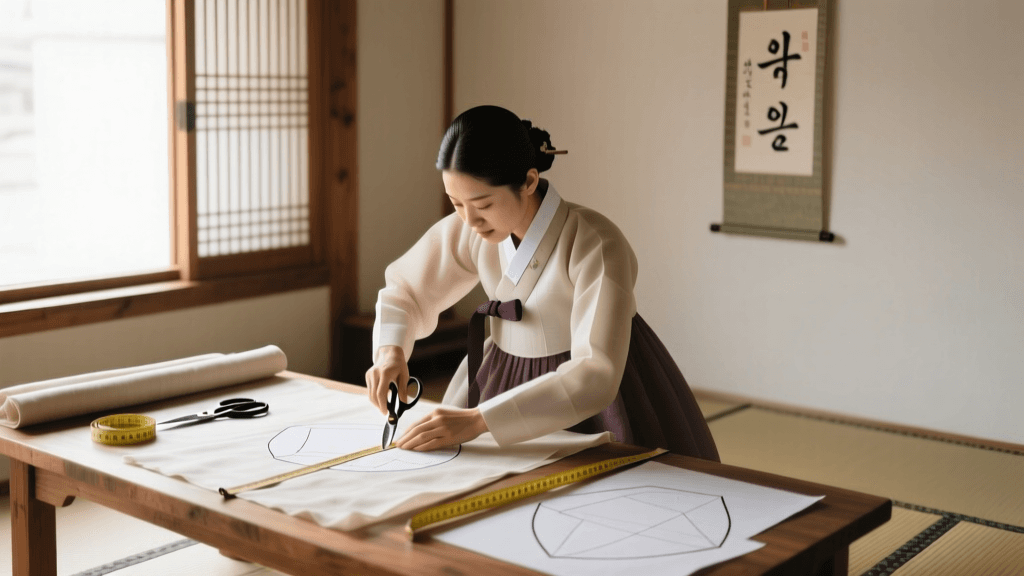
The cornerstone of any Hanbok seminar is mastering the jeogori. Unlike a Western bodice, the jeogori does not use bust darts or waist suppression. The 2026 masterclasses emphasize the mathematical precision required to draft this garment using only straight lines and specific geometric curves.
- The Baerae (Sleeve Curve): The most challenging aspect of the jeogori is the baerae, the curved underarm seam that connects the sleeve to the body. Students learn to draft this curve using a traditional bamboo ruler, ensuring that when the arms are lowered, the fabric folds elegantly without pulling at the shoulder.
- The Git (Collar): The collar must be cut on a precise bias to allow it to lie flat against the neck while maintaining a stiff, structured V-shape at the front. Seminars teach the application of simji (traditional paper interfacing) to achieve this structure without modern plastic fusibles.
- The Kkeutdong (Contrasting Cuffs): You will learn the exact measurement ratios for attaching contrasting silk cuffs to the sleeves, a technique historically used to denote the wearer's marital status and social class.
'The beauty of the Hanbok lies in its negative space. We do not force the fabric to hug the body; we create an architectural space between the skin and the silk that allows the wearer to breathe and move with grace.' — Master Artisan Park, 2026 KCDF Guest Lecturer.
Essential Tools and 2026 Material Sourcing
While most Seoul seminars provide basic sewing kits, international students are advised to bring or purchase specific tools to properly execute traditional techniques. The 2026 recommended tool list includes:
- Heavy-Duty Silk Shears (10-inch): Essential for cutting through multiple layers of crisp myeongju silk without fraying the edges.
- Traditional Brass Weights: Used instead of pins to hold delicate, historically accurate fabrics in place during the cutting process to prevent permanent puncture marks.
- Bone Folder and Awl: Crucial for creasing seams and turning the intricate, narrow tubes of the goreum (chest ties).
- Wooden Clapper (Dangcheol): Used in conjunction with a steam iron to flatten thick seam allowances, a mandatory step in achieving the razor-sharp edges seen in museum-quality Hanbok.
For material sourcing, your instructors will guide you through the labyrinthine alleys of the Gwangjang Market. In 2026, there is a massive surge in demand for mosi (ramie) woven with recycled metallic threads, a contemporary innovation that honors the UNESCO-recognized heritage of Korean weaving while appealing to modern aesthetic sensibilities. Expect to budget an additional $200 to $400 USD for premium silks and natural dyes outside of your base tuition.
Application Logistics and Visa Requirements
Enrolling in a Seoul-based Hanbok seminar requires careful logistical planning. For programs lasting less than 90 days, many international students from visa-waiver countries can attend under the standard tourist entry, provided the seminar is classified as a 'cultural experience' rather than formal academic enrollment. However, for the 12-week Sookmyung certificate, you must apply for a D-4 (General Trainee) or C-3 (Short-Term Study) visa.
Applications for the 2026 spring and autumn cohorts typically close three months prior to the start date. You will need to submit a brief portfolio or statement of intent detailing your sewing experience and your goals for studying traditional Asian garments. Language barriers are minimal in the top-tier programs, as the KCDF and Bukchon Guild now employ dedicated bilingual teaching assistants who translate technical patterning terms in real-time.
Final Thoughts on Preserving Heritage Crafts
Participating in a Hanbok construction masterclass in 2026 is more than just a sewing workshop; it is an immersion into a philosophy of design that respects the human form and the environment. By mastering the flat-pattern geometry and zero-waste cutting methods of traditional Korean dress, you are equipping yourself with sustainable design solutions that the future of global fashion desperately needs. Whether you choose the rigorous historical accuracy of the KCDF or the modern adaptations of the Bukchon Guild, the skills you acquire in Seoul will permanently elevate your approach to garment making.