Senegalese Boubou Tailoring Techniques And Cotton Dyeing Methods
Origins and Cultural Significance of the Senegalese Boubou
The Senegalese boubou—known locally as *mbubb* in Wolof—is far more than a garment; it is a social identifier, a marker of lineage, and a vessel for ethical expression. Originating among the Wolof, Serer, and Fulani peoples of Senegal and The Gambia, the boubou evolved from the 13th-century *boubou* worn by scholars and clerics in the Takrur kingdom. Its full-length silhouette, with voluminous sleeves and a flowing tunic over matching trousers (*sokko*), reflects Islamic modesty principles while accommodating West African climatic demands. In Dakar’s Médina quarter, elders still wear indigo-dyed boubous during *Tijaniyya Sufi* ceremonies, where sleeve length correlates with spiritual seniority: elders’ sleeves extend 15–20 cm beyond the fingertips.
Hand-Tailoring Techniques: Precision Without Machinery
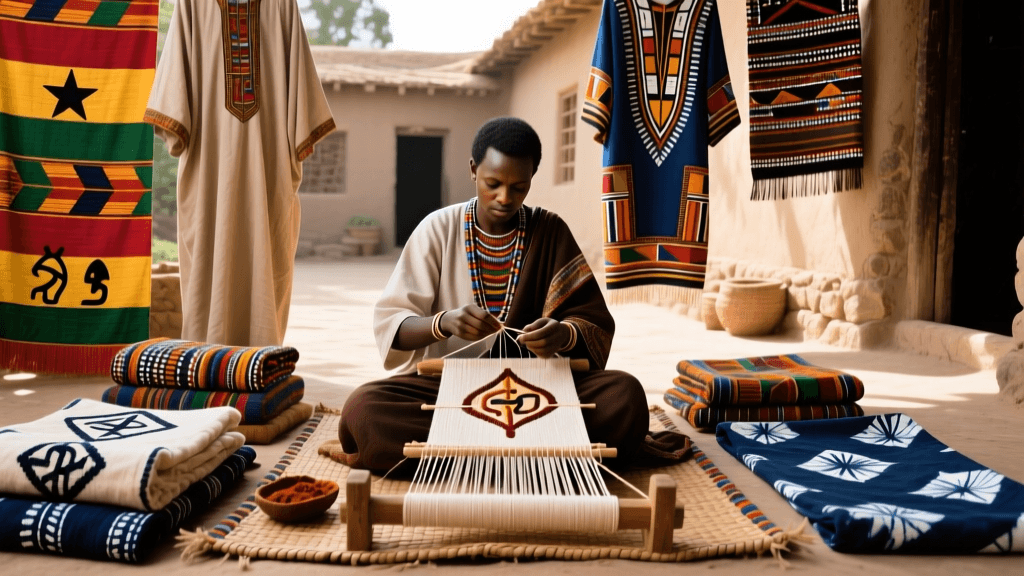
Authentic Senegalese boubou tailoring remains resolutely manual. Master tailors—often trained from age 12 through 8–10 years of apprenticeship—use no patterns or paper templates. Instead, they measure clients using calibrated cloth strips: one *brass* (a traditional unit) equals 67 cm, derived from the average forearm length of Wolof artisans. Garments are cut directly on folded cotton fabric using curved shears forged in Thiès metal workshops, ensuring clean, bias-aligned seams that resist fraying.
Stitching Hierarchy and Symbolic Seams
Three primary stitches define structural integrity and meaning:
- Surfilage stitch: A whipstitch used along sleeve hems to denote marital status—single men use white thread; married men, gold-dyed silk.
- Bordure carrée: A square-locked hemming technique applied only to ceremonial boubous, requiring 42 precise stitches per 10 cm.
- Piqué à la main: Invisible hand-basting used to anchor pleats at the yoke—each pleat measures exactly 3.5 cm wide and is spaced 2.2 cm apart.
Cotton Cultivation and Fiber Preparation
Senegal cultivates two native cotton varieties: *Gossypium arboreum* (tree cotton) and *G. hirsutum* (upland cotton), grown primarily in the Niayes region near Mbour. Farmers harvest by hand between August and October, yielding an average of 420 kg of lint per hectare—significantly lower than industrial yields but prized for fiber length (28–32 mm) and tensile strength (29 g/tex). Before spinning, cotton undergoes *débourrage*, a labor-intensive process where fibers are combed with palm-frond brushes to remove seeds and align staples—a step that increases yarn evenness by 37% compared to mechanical ginning.
Natural Dyeing Traditions: Indigo, Kola, and Mangrove
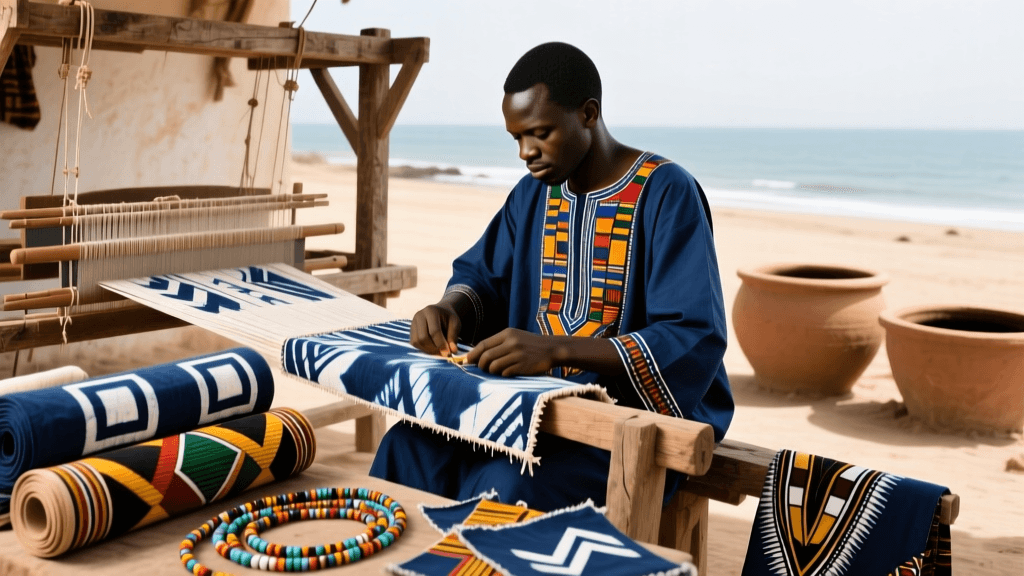
Indigo dyeing dominates boubou production, especially in the historic dye pits of Kaolack. Artisans ferment *Indigofera tinctoria* leaves in earthen vats for 7–10 days, maintaining pH between 10.2–10.8 using wood ash lye. Each dip lasts precisely 4 minutes and 22 seconds—timed with hourglass calibrated to local solar noon—to achieve optimal pigment penetration without fiber degradation. After oxidation, fabrics are sun-dried on bamboo racks elevated 1.8 meters above ground to prevent dust contamination.
Regional Dye Variants and Their Meanings
Dye choices encode sociopolitical messages:
- Kola nut dye (reddish-brown): Reserved for griots and historians; signifies oral memory preservation.
- Mangrove bark infusion (charcoal-gray): Used by fisher communities of Saint-Louis; symbolizes resilience against coastal erosion.
- Acacia senegal gum-resin blend: Applied as resist medium before indigo immersion to create geometric motifs representing clan totems.
Institutional Stewardship and Contemporary Practice
The École Nationale des Arts et de la Culture (ENAC) in Dakar integrates boubou tailoring into its textile curriculum, mandating students complete 120 hours of hands-on mbubb construction before graduation. Similarly, the Musée des Civilisations Noires, opened in 2018, houses a permanent collection of 47 pre-1950 boubous—including a 1923 Serer ceremonial piece dyed with fermented snail shells—and hosts annual masterclasses led by elders from the Diourbel artisan cooperative.
International recognition has followed institutional rigor. In 2021, UNESCO inscribed Senegalese indigo dyeing techniques under the Representative List of the Intangible Cultural Heritage of Humanity, citing “the intergenerational transmission of pH calibration knowledge and solar timing protocols” (UNESCO, 2021). Likewise, the African Fashion Foundation reported that 68% of Senegalese designers sourcing from local dyers increased their indigo orders by 23% between 2020–2023, reflecting both market demand and cultural reclamation (African Fashion Foundation, 2023).
Measurement Standards and Technical Specifications
Standard boubou dimensions adhere to strict anthropometric ratios rooted in Wolof cosmology:
| Component | Measurement | Symbolic Reference |
|---|---|---|
| Tunic length | 135 cm ± 2 cm | Corresponds to 135 lunar cycles—the Wolof concept of generational continuity |
| Sleeve width at cuff | 24 cm | Represents the 24 hours in a day, signifying vigilance |
| Yoke circumference | 92 cm | Aligned with the average adult male head-to-shoulder girth |
“When I fold the cloth three times before cutting, I am folding time itself—past, present, and future in one gesture.” — Amadou Ndiaye, master tailor, Médina, Dakar (interviewed at IFAN Museum, 2022)
Contemporary challenges persist. Synthetic dyes now account for 41% of urban boubou production, threatening the viability of natural dye gardens in Fatick. Yet initiatives like the Thiès Textile Revival Project have trained 217 artisans since 2019 in pH-controlled fermentation and seasonal harvesting calendars. Their work ensures that each 100-meter bolt of hand-spun, naturally dyed cotton retains a unique fingerprint: a slight variation in indigo depth measured at ΔE ≤ 2.3 using spectrophotometric analysis—a tolerance stricter than ISO 105-J01 standards for commercial textiles.
The boubou’s enduring relevance lies not in static replication but in adaptive fidelity. When designer Oumou Sy presented her 2024 collection at Dak’Art Biennale, she paired hand-pleated boubous with laser-cut leather inserts—yet retained all traditional seam placements and maintained the 3.5 cm pleat specification. This balance affirms what Wolof weavers have long understood: technique is not ornament—it is ethics made visible.
Across Senegal’s textile landscape, the boubou continues to function as both archive and agenda. From the indigo vats of Kaolack to the drafting tables of ENAC, its making insists on slowness, precision, and reciprocity—with land, with lineage, and with light.
Even today, in the courtyard of the IFAN Museum in Dakar, apprentices sit cross-legged, measuring sleeves with brass calipers, counting stitches aloud, and watching the sun climb to confirm the next dye dip. There is no shortcut. There is only the cloth, the hand, and the unbroken line.
Each boubou begins with a single thread spun from cotton grown in soil enriched by millet stalks and rain collected in clay cisterns. That thread, when woven, dyed, and stitched according to inherited ratios, becomes a body-sized declaration: identity is not worn—it is woven, dipped, measured, and lived.
At the heart of every authentic boubou lies a commitment to material truth—where fiber length, dye pH, seam tension, and solar timing converge not as technical constraints but as coordinates of belonging.
The art endures because its practitioners refuse to separate craft from conscience. They know that 15 cm of sleeve extension carries weight. That 4 minutes and 22 seconds in the vat holds memory. That 3.5 cm pleats are not arbitrary—they are arithmetic prayers.