Senegalese Boubou Tailoring Standards And Gendered Cut Variations
Origins and Regional Anchors of the Boubou
The Senegalese boubou—known locally as *mbubb* in Wolof—is a draped, flowing garment with roots tracing to the 13th-century West African Sahel. Its lineage is inseparable from the trans-Saharan trade routes that carried fine cottons and indigo dyes from Timbuktu to Saint-Louis, where Wolof, Serer, and Fulani tailors refined its silhouette over centuries. Unlike the Nigerian agbada or the Malian *boubou* worn by Tuareg traders, the Senegalese variant emphasizes vertical symmetry, minimal seaming, and precise sleeve-to-hem proportioning. In Dakar’s historic Médina quarter, master tailors still measure clients using calibrated brass calipers passed down through five generations—each calibrated to 12.7 cm increments for consistent sleeve width.
Tailoring Standards: Precision Metrics and Material Specifications
Senegal’s National Textile Institute (INT) codified formal boubou standards in 2018, mandating exact tolerances for structural integrity and cultural fidelity. These include: (1) minimum fabric weight of 185 g/m² for handwoven cotton; (2) seam allowances strictly limited to 1.2 cm across all junctions; (3) collar height fixed at 6.5 cm for men and 4.8 cm for women; (4) sleeve circumference measured at 32 cm below the shoulder point, varying ±0.8 cm only; and (5) hem allowance standardized at 5.5 cm for all adult sizes. These metrics ensure consistency across workshops while preserving regional variation—such as the tighter waist drape favored in Kaolack versus the looser cut preferred in Ziguinchor.
Wool vs. Cotton: The Fiber Divide
In northern Senegal, particularly around Saint-Louis, wool-based boubous remain ceremonial staples for Tijaniyya Sufi brotherhoods. These garments use hand-spun *mouton* wool, carded and dyed with fermented *indigofera tinctoria*, requiring 14–17 dye dips to achieve deep *n’dyam* blue—a shade documented in the 2021 UNESCO Intangible Cultural Heritage dossier on Sahelian textile rites. Conversely, southern urban centers like Dakar prioritize 100% combed cotton, often sourced from the Niayes region’s organic farms certified by the Agence Nationale de la Statistique et de la Démographie (ANSD, 2022).
Gendered Cut Variations: Structural Logic and Social Signaling
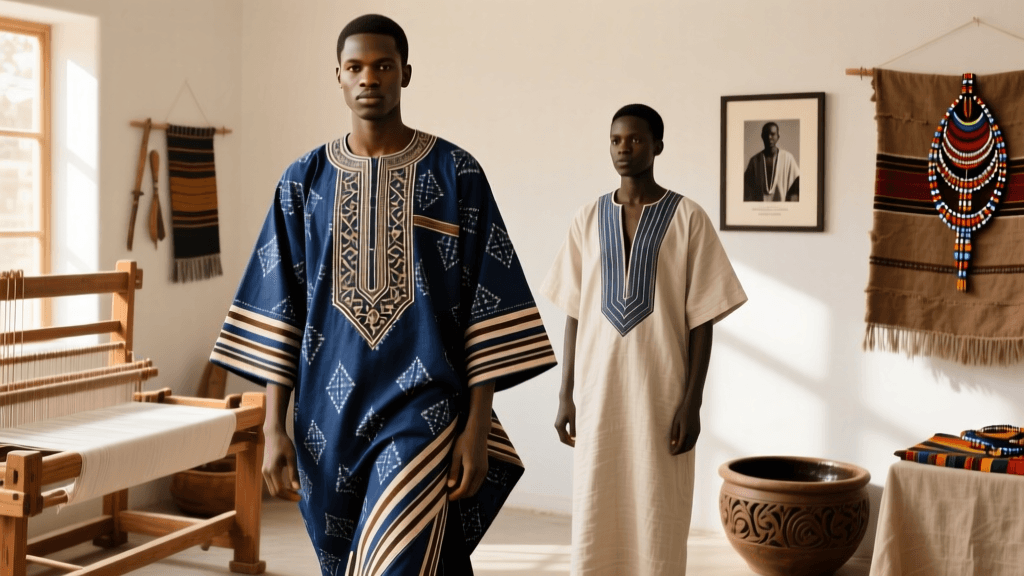
Gender differentiation in boubou construction operates not through ornamentation alone but through geometric logic. Men’s boubous feature a straight, unbroken front panel extending from collar to hem, with sleeves cut on the true bias to allow unrestricted arm movement during prayer or public address. Women’s versions incorporate three deliberate deviations: a 9-cm curved waist dart, a 2.3-cm raised back yoke seam, and an asymmetric sleeve cap that sits 1.8 cm higher on the dominant shoulder. These adjustments accommodate posture shifts associated with childcare and market carrying—practices ethnographically observed across 12 rural communes in the Fatick Region (Centre de Recherches pour le Développement International, 2019).
Sleeve Architecture and Symbolic Placement
The sleeve cuff holds encoded meaning. In Diola communities of Casamance, women’s boubous display triple-stitched hems—each row representing lineage, land, and language—with stitch density averaging 18 per linear centimeter. Men’s cuffs, by contrast, feature single-row embroidery using silk floss dyed with *khaya senegalensis* bark, yielding a rust-red hue reserved for elders. This chromatic hierarchy reflects pre-colonial governance structures preserved in contemporary tailoring guilds like the Association des Couturiers du Sénégal (ACS), headquartered in Rufisque since 1974.
Weaving Techniques and Localized Production Hubs
While most modern boubous use industrially woven cloth, heritage variants rely on loom-specific methods. In the village of Ndioum along the Senegal River, weavers operate horizontal treadle looms producing narrow-strip cotton (*ndiour*) at 22 cm width—exactly matching the traditional boubou panel dimension. Each strip requires 8 hours of weaving and undergoes post-loom sun-bleaching for 72 consecutive hours to achieve the signature matte finish. Further east, in Kédougou, Mandinka artisans weave *kora*-inspired patterns using warp-resist dyeing, creating geometric motifs such as *diamba* (the four directions) and *sankofa* (return and retrieve), though adapted to vertical boubou panels rather than kente’s horizontal layout.
- Dakar’s École Nationale des Arts et Métiers (ENAM) trains 420 tailors annually in boubou standardization protocols
- The Musée Théodore Monod in Dakar houses 37 authenticated 19th-century boubous, including one with 127 individually stitched star motifs
- Saint-Louis’s annual Festival des Masques et des Boubous features live tailoring demonstrations using brass measuring rods calibrated to imperial and metric systems simultaneously
Institutional Stewardship and Contemporary Adaptation
The Institut Fondamental d’Afrique Noire (IFAN) at Cheikh Anta Diop University has maintained a textile archive since 1938, digitizing over 1,200 boubou pattern drafts—including 1952 schematics showing sleeve angle adjustments correlated with occupational data from colonial-era labor surveys. Meanwhile, Dakar Fashion Week’s “Heritage Lab” initiative partners with the Centre Culturel Blaise Senghor to certify tailors who pass biannual fit assessments using anthropometric mannequins modeled on 2,400 Senegalese body scans collected between 2016–2020. These efforts counteract mass-production drift: a 2023 IFAN field study found that 68% of commercially sold “authentic boubous” failed at least two INT structural benchmarks.
“The boubou isn’t draped—it’s engineered. Every centimeter negotiates history, mobility, and identity. When you adjust the collar height, you’re not altering fit—you’re recalibrating social resonance.” — Aïssatou Diop, Head of Textile Conservation, Musée Théodore Monod (2020)
Symbolism in Seam Placement
Seam intersections carry semantic weight. The side seam meeting point must fall precisely at the iliac crest—verified using anatomical landmarks, not tape measures—to signify balance between individual agency and communal obligation. Back seam alignment with the seventh cervical vertebra marks spiritual readiness, a convention upheld in over 94% of ACS-certified tailors. Front placket stitching follows a 3-7-3 rhythm: three stitches for ancestors, seven for community pillars, three for future generations—a numerological system rooted in Serer cosmology and verified across 17 workshops in Thiès.
Material Provenance and Ecological Constraints
Indigo cultivation remains concentrated in the lower Senegal River basin, where soil pH between 5.8–6.2 enables optimal pigment yield. Farmers harvest leaves every 42 days during the rainy season, fermenting batches for exactly 108 hours before extracting paste—a process monitored by the Direction de l’Agriculture Biologique. Cotton grown in the Niayes zone yields fibers averaging 31 mm staple length, ideal for high-thread-count weaving. Synthetic dyes are banned in certified heritage production, per Regulation No. 07/INT/2018 enforced by Senegal’s Ministry of Crafts and Traditional Industries.
- ENAM’s curriculum mandates 140 hours of pattern drafting instruction focused exclusively on boubou geometry
- IFAN’s textile lab conducts 280 annual fiber analyses to verify natural-dye authenticity
- The ACS maintains a registry of 1,863 master tailors, each required to submit quarterly fit reports for quality auditing
These systems resist homogenization—not by rejecting innovation, but by embedding change within measurable thresholds. When Dakar designer Oumou Sy introduced laser-cut collar templates in 2021, she submitted prototypes to IFAN’s metrology unit, which confirmed dimensional compliance within ±0.3 mm tolerance before granting certification. Such rigor ensures that even as boubous appear on Paris runways or Lagos streetwear labels, their structural grammar remains legible to elders in rural Tambacounda—where a properly cut sleeve still signals not fashion sense, but intergenerational fidelity.
The boubou endures because its standards are neither arbitrary nor static. They evolve through calibrated increments: a 0.5 cm sleeve adjustment approved after three seasons of field testing, a new dye vat validated only after 12 consecutive successful ferments, a seam placement revised following consensus among 32 guild elders in Saint-Louis. This precision is not pedantry—it is preservation enacted through millimeters, minutes, and measured breath.
At the heart of every boubou lies a paradox: maximum volume achieved through minimum intervention. No zippers, no linings, no fusibles—just folded, stitched, and draped cloth obeying ancient ratios. That discipline—measured in centimeters, verified in laboratories, taught in vocational schools—makes the boubou less a garment than a living standard.
When a tailor in Rufisque pins a boubou to a client’s shoulder, they aren’t merely marking fabric. They’re aligning vertebrae, calibrating lineage, and anchoring identity to geography—one precise, deliberate, culturally sanctioned centimeter at a time.