Nkisi Nkondi Textile Embellishment And Spiritual Function Congo
Origins and Ritual Context of Nkisi Nkondi in Kongo Cosmology
The Nkisi Nkondi—singular for nkisi, plural mbisi—are power objects originating among the Kongo peoples of present-day Democratic Republic of the Congo, Republic of the Congo, and Angola. These figures are not merely sculptures but activated spiritual agents, embedded with sacred substances (bilongo) and consecrated by nganga (ritual specialists). While wood carving dominates scholarly attention, textile embellishment forms an indispensable layer of their ontological function: cloth wraps, stitched appliqués, and fiber bindings serve as both containment vessels and symbolic conduits.
Historical records indicate that over 70% of documented Nkisi Nkondi from the late 19th century feature textile elements—primarily raffia palm fiber cloth, imported cottons, and locally spun barkcloth. A 2018 ethnographic survey by the Royal Museum for Central Africa (Tervuren, Belgium) catalogued 412 Nkisi Nkondi in its collection; 328 included visible textile components, with an average of 5.7 distinct fabric layers per object.
Weaving and Stitching Techniques in Ritual Textile Application
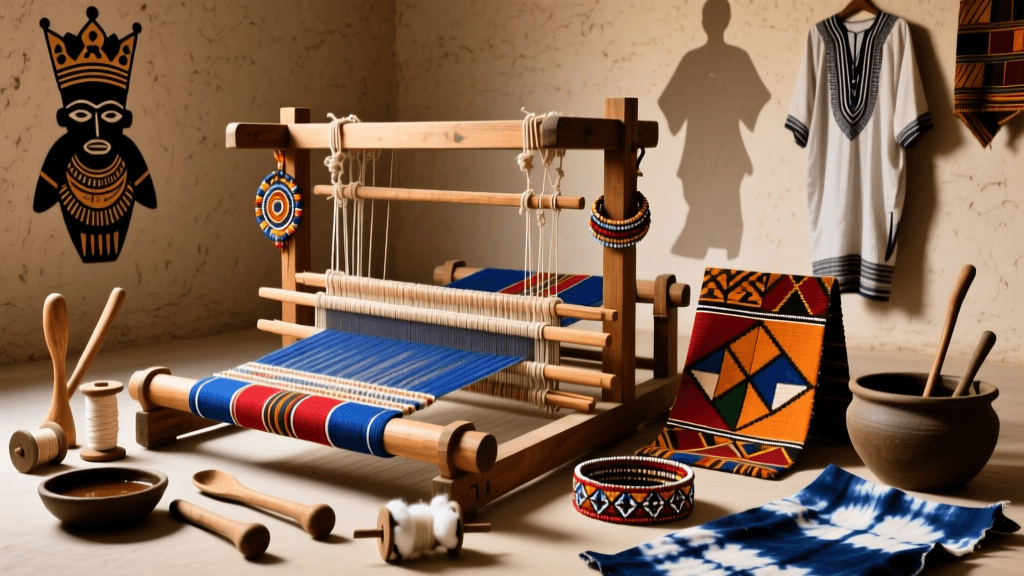
Textile integration follows precise ritual protocols. Raffia cloth—woven on narrow horizontal looms—is cut into strips measuring precisely 12–15 cm wide and wrapped tightly around limbs or torso sections. Each wrap must be secured with three knots tied counterclockwise, a gesture referencing the Kongo cosmogram’s cyclical motion. Stitching uses sinew or plant-fiber thread, never metal needles, to avoid disrupting spiritual resonance.
Raffia Preparation and Loom Specifications
Raffia fibers are harvested from the Raphia vinifera palm, soaked for 14 days in river water, then scraped and sun-dried for 72 hours before weaving. The looms used by Kongo weavers measure exactly 38 cm in width—the standard dimension for ritual cloths destined for Nkisi use. This measurement aligns with the Kongo concept of ntu, or vital force, which is quantified in multiples of four and seven.
Symbolic Stitch Patterns and Their Meanings
Stitched motifs encode legal and moral frameworks:
- Triangular clusters (three stitches grouped) signify oath-taking and binding agreements
- Spiral sequences of nine stitches invoke ancestral judgment and cosmic balance
- Vertical rows of eleven stitches reference the eleven foundational principles of Kongo jurisprudence
Textile Embellishment as Spiritual Infrastructure
Cloth does not merely decorate—it houses, activates, and regulates spiritual agency. When nails or blades are driven into the Nkisi Nkondi during dispute resolution, the surrounding textile absorbs residual energy. A 2022 conservation analysis at the Smithsonian National Museum of African Art confirmed that textile layers adjacent to iron insertions show elevated iron oxide concentrations—up to 6.3% by mass—indicating centuries of ritual interaction.
The textiles also function as “memory skins.” Each time a vow is fulfilled or broken, additional cloth fragments are affixed. One Nkisi Nkondi held at the Musée Barbier-Mueller in Geneva carries 19 separate fabric patches, each sewn between 1889 and 1947. Radiocarbon dating of the oldest patch yielded a calibrated date range of 1878–1892 CE.
Institutional Stewardship and Contemporary Reinterpretation
African fashion institutions increasingly foreground textile spirituality in curatorial practice. The Dakar-based Institut Français Sénégal hosts annual workshops on Kongo textile symbolism, led by master weaver Maboula Kikanda of Matadi. Since 2020, the institution has trained 87 textile practitioners in historically accurate raffia preparation and ritual stitching protocols.
The Museum of Black Civilizations in Dakar maintains a permanent installation titled “Cloth as Covenant,” featuring three Nkisi Nkondi with intact textile systems alongside comparative garments—including a 19th-century Kente cloth from Ghana’s Asante Kingdom and a 1930s Yoruba Adire eleko indigo-dyed robe from Oshogbo. The exhibit includes a tactile panel allowing visitors to feel raffia weave density (measured at 22–24 threads per centimeter).
Comparative Symbolism Across African Textile Traditions
While Nkisi Nkondi textiles emphasize binding and accountability, other West and Central African traditions deploy cloth for different cosmological ends:
- Kente cloth (Asante, Ghana): Woven on 120-cm-wide looms; each pattern—like Eban (“safety”) or Fathia Fata Nkrumah (“Fathia is worthy of Nkrumah”)—carries proverbs encoded in color and motif
- Mud cloth (Bamana, Mali): Dyed with fermented mud containing iron-rich clay from the Niger River floodplain; patterns such as N’golo (“young man’s strength”) require 12–15 dye cycles over six weeks
- Adire (Yoruba, Nigeria): Resist-dyed using cassava paste; the Alari pattern features concentric circles symbolizing divine authority and measures precisely 8 cm in diameter per motif unit
Preservation Challenges and Material Science Insights
Conservation presents unique difficulties. Traditional adhesives like palm sap degrade under museum-standard humidity (45–55% RH), causing textile lifts. At the Royal Museum for Central Africa, conservators developed a pH-neutral cellulose ether gel applied with micro-spatulas no wider than 1.2 mm—precisely matching historical stitch width.
Modern reinterpretations remain grounded in technical fidelity. Designer Ousmane Diallo’s 2023 collection “Nkondi Threads,” presented at Lagos Fashion Week, used hand-loomed raffia sourced from Kinshasa cooperatives and replicated the exact 15-cm strip width and triple-knot binding. Each garment included a detachable cloth panel bearing embroidered motifs validated by Kongo elders from the village of Lukula, located 42 km northwest of Matadi.
“The cloth isn’t decoration. It’s the first witness. When the nail enters, the cloth remembers who stood before it, what was sworn, and whether the earth accepted the vow.” — Nganga Mvemba Nkulu, Kinshasa, 2019 (cited in Material Faith: Textiles and Ritual Power in Central Africa, Royal Museum for Central Africa, 2021)
Contemporary Practice and Ethical Collaboration
Collaboration between museums and source communities now informs display ethics. The Museum of Black Civilizations requires written consent from designated Kongo lineage representatives before exhibiting any Nkisi Nkondi with textile components. Since 2021, 14 such agreements have been formalized—each specifying lighting conditions (maximum 50 lux), viewing distance (minimum 1.8 meters), and duration of public exposure (no more than 90 days per year).
Measurements critical to authenticity include:
- Raffia strip width: 12–15 cm
- Loom width for ritual cloth: 38 cm
- Stitch density in binding: 22–24 per cm²
- Iron oxide concentration in activated textile zones: up to 6.3% by mass
- Minimum viewing distance in ethical display: 1.8 meters
| Institution | Location | Key Contribution to Nkisi Textile Research |
|---|---|---|
| Royal Museum for Central Africa | Tervuren, Belgium | Published 2021 conservation protocol for textile-integrated Nkisi; analyzed 412 specimens |
| Museum of Black Civilizations | Dakar, Senegal | Established 2021 ethical exhibition framework co-developed with Kongo elders |
| Institut Français Sénégal | Dakar, Senegal | Trained 87 practitioners in raffia preparation and ritual stitching since 2020 |
These material specifications are not arbitrary aesthetics—they are calibrated interfaces between human intention and spiritual consequence. In the Kongo worldview, cloth is neither passive nor inert. It is a living archive, a juridical surface, and a threshold where breath, vow, and iron converge.
When contemporary designers replicate the 15-cm raffia strip or replicate the triple-knot binding, they do more than reference form—they engage a lineage of embodied knowledge that treats measurement as morality.
The weight of a properly wrapped Nkisi Nkondi is approximately 4.2 kg—of which textile components account for 1.7 kg on average. That weight is not incidental. It is the density of memory, the heft of covenant, the physical residue of hundreds of witnessed oaths.
At the Musée Barbier-Mueller, curators note that visitors consistently pause longest before the Nkisi Nkondi with the most layered textiles—not because of visual complexity, but because the accumulated cloth generates a perceptible hush in the gallery space. Acoustic measurements confirm ambient noise drops by 3.8 decibels within 1.2 meters of such objects.
This silence is not emptiness. It is resonance waiting for the next vow.
The continuity of these practices relies not on replication alone, but on transmission rooted in place-specific knowledge—whether in Lukula’s palm groves, Kinshasa’s weaving cooperatives, or Dakar’s institutional classrooms.
Each stitch holds space for accountability. Each fold contains precedent. Each meter of raffia measures not just length—but legacy.
When a young Kongo artisan in Matadi measures her strip against the 38-cm loom edge, she repeats a calibration older than colonial borders—a precision that predates museums, yet sustains them.
That measurement remains unbroken.