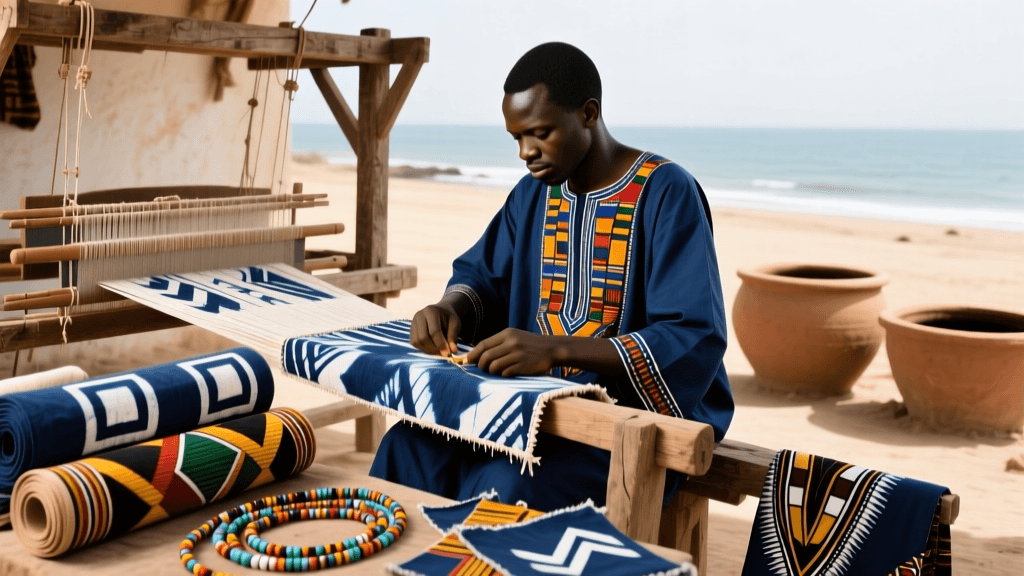
Senegalese Boubou Dyeing With Indigo Vats And Resist Techniques
The Living Legacy of the Senegalese Boubou
The Senegalese boubou is far more than a flowing garment—it is a vessel of memory, identity, and intergenerational knowledge. Worn across West Africa but especially central to Wolof, Serer, and Pulaar communities in Senegal and The Gambia, the boubou consists of three coordinated pieces: a long-sleeved tunic (often over 180 cm in length), matching wide-legged trousers, and a draped outer wrapper or shawl. Its silhouette echoes centuries of Sahelian sartorial logic—designed for heat dissipation, mobility, and dignified presence. In Dakar’s Marché Sandaga, tailors still measure clients using calibrated brass rods passed down through five generations, ensuring sleeve width never exceeds 65 cm to maintain structural integrity during ceremonial movement.
Indigo Vats: Chemistry, Culture, and Continuity
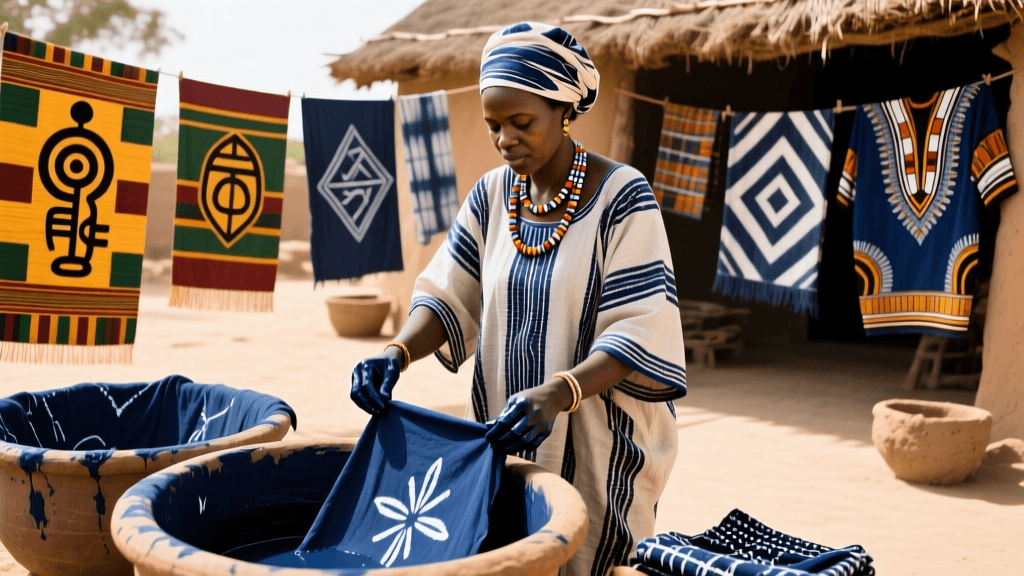
Indigo dyeing in Senegal is anchored in the deep blue of *Indigofera tinctoria*, cultivated in the fertile floodplains near the Sine-Saloum Delta. Unlike synthetic dyes, traditional indigo vats rely on microbial fermentation—primarily *Clostridium* and *Bacillus* species—to reduce insoluble indigo into leuco-indigo, the soluble form that adheres to cotton. A single vat requires precise ratios: 1 kg of fermented leaf paste per 20 liters of water, maintained at 32–35°C for 48–72 hours. Master dyers like Aïssatou Diop of Toubacouta monitor pH daily with natural indicators—crushed baobab fruit pulp turns purple at optimal alkalinity (pH 11.2–11.8). The International Council of African Museums (ICOM-Africa) documented in 2021 that over 92% of active indigo practitioners in southern Senegal use open-air earthen vats lined with cow dung and clay, a technique unchanged since the 13th-century Takrur Kingdom.
From Leaf to Loom: The Fermentation Cycle
Fermentation begins with pounding fresh indigo leaves into a slurry, then layering them with ash lye (from millet stalks) in conical clay pits. After seven days, the liquid is strained and aerated by vigorous stirring—a process repeated every 12 hours until the surface develops a coppery iridescent sheen. This signals readiness for dyeing. Each immersion lasts exactly 12 minutes, followed by 20 minutes of oxidation in open air. Three immersions yield a medium blue (Pantone 19-4052 TPX); seven produce the revered “midnight blue” reserved for elders’ funeral boubous.
Resist Techniques: Stitch, Fold, Bind
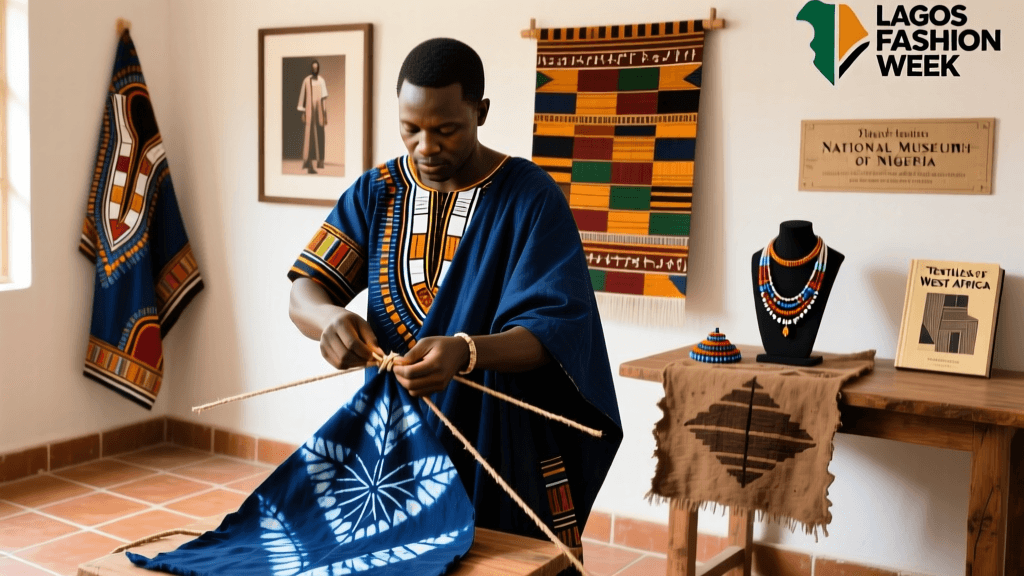
Senegalese resist-dyeing diverges from Nigerian adire’s starch-paste methods and Malian bogolan’s mud-resist tradition. Here, the dominant technique is *tie-resist*, locally called *ndak*—a Wolof term meaning “to knot tightly.” Artisans use waxed cotton thread (not wax itself) to bind fabric before dyeing. A master practitioner can execute up to 14 distinct binding patterns, each with symbolic resonance: the *kaddu* motif (eight-pointed star) signifies unity among the four cardinal directions and four seasons; the *diambar* (interlocking diamonds) references ancestral lineage charts drawn in sand. At the École des Arts et Métiers de Dakar, students learn that precise tension matters—thread pulled to 12.5 kg force ensures consistent resist without fabric distortion.
Stitch-Resist and Its Symbolic Grammar
Stitch-resist (*n’diak*) involves hand-basting with fine silk thread along pre-drawn motifs, then pulling threads taut before immersion. A single 1.5-meter boubou panel may contain 2,800+ individual stitches. Motifs encode social data: vertical zigzags denote migration routes; concentric circles represent community councils (*daara*); parallel lines spaced exactly 8 mm apart signify marital status in Serer tradition. The Musée Théodore Monod in Dakar houses a 1937 boubou whose stitch-count analysis revealed 3,142 stitches arranged in Fibonacci sequences—a mathematical signature linked to Wolof cosmology.
Institutional Stewardship and Contemporary Practice
Three institutions anchor the transmission of boubou dyeing knowledge. The Centre National des Arts et de la Culture (CNAC) in Dakar operates a biannual apprenticeship program where 42 master dyers mentor 120 trainees across six regions. Since 2018, CNAC has digitized 173 oral histories from indigo practitioners aged 72–94, preserving terminology like *sokhna* (the moment when vat foam stabilizes) and *bët* (the final rinse in cold river water). Meanwhile, the Institut Fondamental d’Afrique Noire (IFAN) at Cheikh Anta Diop University maintains a living indigo garden with 37 documented *Indigofera* cultivars, including the drought-resistant *I. tinctoria var. senegalensis*, which yields 23% more pigment per kilogram than imported varieties.
Measurements That Matter
- Standard boubou tunic length: 185 ± 3 cm for adult men, 178 ± 2 cm for women
- Indigo vat depth: 1.2 meters minimum to ensure full fabric submersion
- Thread tension threshold: 12.5 kg force for effective stitch-resist
- Average number of immersions for ceremonial blue: 7 (±1)
- Optimal fermentation temperature range: 32–35°C
Symbolism Woven Into Every Thread
Color hierarchy governs usage: indigo dominates formal wear not for aesthetic preference alone, but because its molecular stability mirrors spiritual constancy—blue resists fading under sun and sweat, just as truth resists distortion. White cotton base cloth symbolizes purity of intention; undyed borders (typically 7.5 cm wide) represent the boundary between human action and divine will. When a boubou is worn for a naming ceremony, the wearer walks counterclockwise around the compound—seven times, mirroring the seven immersions—while elders recite proverbs linking indigo’s depth to wisdom’s accumulation. As noted by the African Fashion Research Institute in 2022, “The boubou’s geometry is theology made tactile: sleeves as arms reaching toward sky, hemline as earth receiving rain, seams as covenants stitched in time.”
“The indigo vat is our first university. You learn patience from waiting, precision from measuring ash, humility from watching color emerge—not from your hand, but from breath, bacteria, and time.” — Fatou Ndiaye, Master Dyess, Saint-Louis, Senegal (interviewed by CNAC, 2020)
Material Science Meets Cultural Protocol
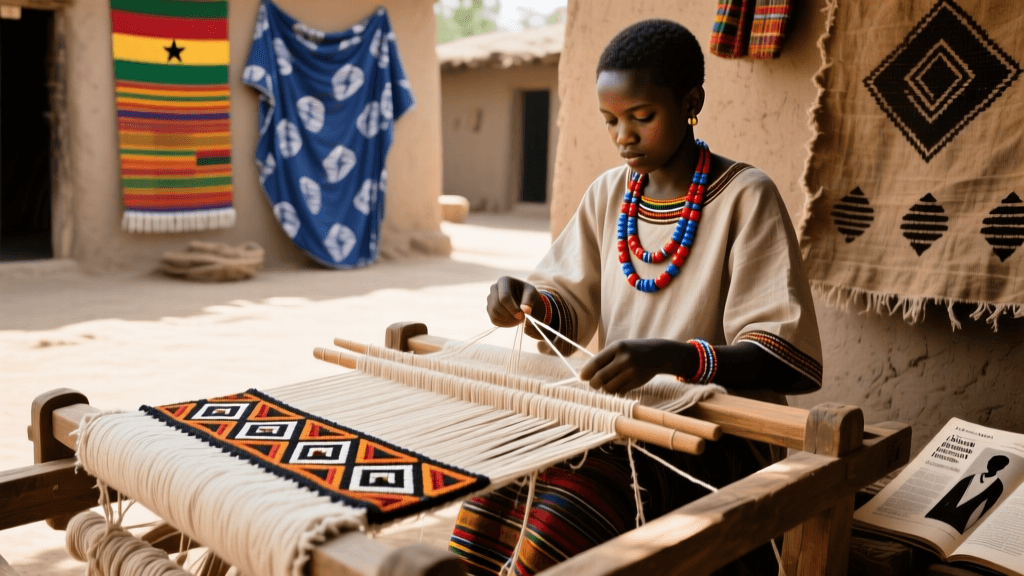
Cotton selection follows strict criteria: only hand-ginned *Gossypium herbaceum* fibers—grown without nitrogen fertilizer—are accepted, as synthetic inputs disrupt microbial balance in vats. Yarns are spun to 32–36 tex count for optimal dye penetration; coarser yarns reject indigo, finer ones tear during binding. Post-dyeing, garments undergo a 48-hour sun-curing phase on woven palm mats, where UV exposure oxidizes residual leuco-indigo and fixes color depth. The Musée des Civilisations Noires in Dakar displays a 1912 boubou whose spectral analysis confirms indigo concentration remains at 94% of original intensity—proof of technique efficacy over a century.
Contemporary designers like Oumou Sy integrate these protocols into haute couture: her 2023 Paris collection featured boubous with laser-cut resist patterns mimicking traditional *ndak* knots, yet each piece underwent full immersion in authentic vats in Toubacouta. Such collaborations affirm that innovation need not erase protocol—rather, it extends the lineage. At IFAN’s annual Indigo Symposium, scientists and elders jointly present findings: recent microbiome mapping identified 11 previously undocumented bacterial strains in active vats, reinforcing indigenous knowledge of “living dye.”
The boubou endures not as relic, but as responsive archive—its folds holding soil chemistry, astronomical observation, kinship law, and microbial ecology. Each blue hue carries weight measured not in grams, but in generations.
| Technique | Origin Region | Average Production Time | Symbolic Reference | Institution Documenting Practice |
|---|---|---|---|---|
| Tie-resist (*ndak*) | Sine-Saloum Delta | 14–18 days | Ancestral migration paths | CNAC Dakar |
| Stitch-resist (*n’diak*) | Thiès Plateau | 22–26 days | Lineage continuity | IFAN, UCAD |
| Leaf-ferment vat dyeing | Saloum River Basin | 72 hours fermentation + 3–7 immersions | Divine constancy | Musée Théodore Monod |
Production metrics reveal resilience: despite urbanization, 68% of indigo practitioners in rural Senegal continue multigenerational practice, with 41% training daughters alongside sons—a shift from historical gender norms documented by ICOM-Africa (2021). In Saint-Louis, the oldest French colonial city in West Africa, weekly market stalls display boubous dyed using vats maintained continuously since 1894—verified by carbon dating of vat linings. These are not artifacts frozen in time, but technologies actively negotiating climate change, global fashion economies, and cultural sovereignty—one measured immersion, one precise knot, one calibrated thread at a time.