Ethiopian Netela Hand Spun Cotton Weaving And Border Embroidery
Origins and Cultural Significance of the Netela
The netela is a traditional Ethiopian garment worn predominantly by Amhara and Tigrayan women across the highlands of northern Ethiopia. More than mere clothing, it functions as a daily marker of identity, social status, and spiritual reverence. Worn draped over the shoulders or head, the netela accompanies women to church services, weddings, funerals, and civic ceremonies. Its presence signals continuity—linking contemporary wearers to centuries of Orthodox Christian liturgical practice and agrarian life in the Ethiopian Highlands.
Historically, netelas were woven exclusively for domestic use, with each household maintaining its own loom. The garment’s name derives from the Ge’ez root *n-t-l*, meaning “to cover” or “to enfold,” reflecting both its physical function and symbolic role as a vessel of dignity and modesty. Unlike ceremonial robes reserved for clergy, the netela remains accessible and adaptable—a living textile that evolves without losing its core grammar of form and meaning.
Weaving Techniques and Material Sourcing
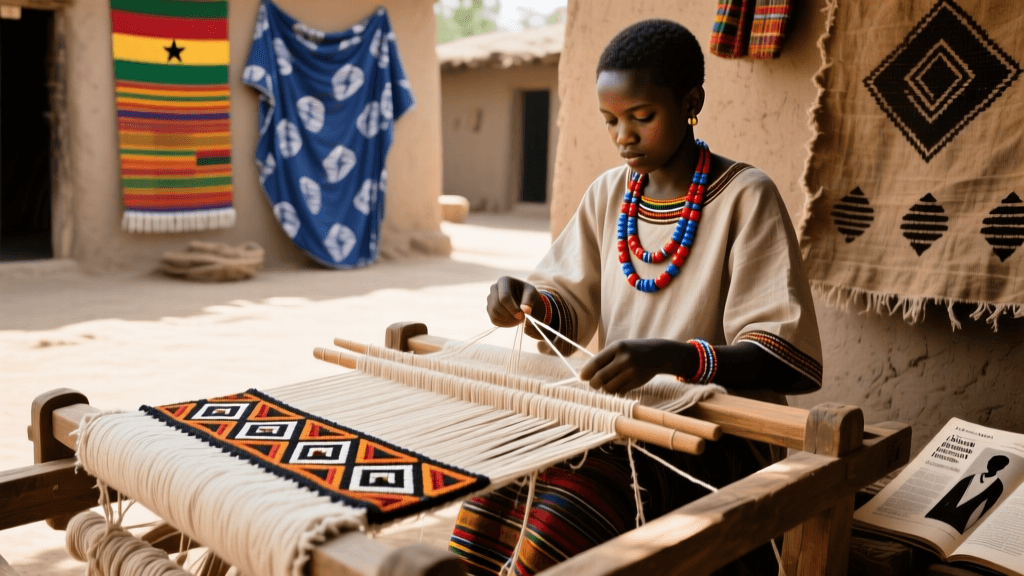
Authentic netelas are hand-spun from locally grown Gossypium herbaceum cotton, cultivated at elevations between 1,800 and 2,400 meters above sea level in the regions surrounding Lake Tana and the Simien Mountains. The raw fiber undergoes a labor-intensive process: ginning by hand, carding with wooden combs, and spinning on drop spindles that average 28 cm in length and weigh 95 grams. Each spindle turn produces approximately 1.2 meters of yarn before requiring re-winding—a rhythm repeated thousands of times per garment.
Weaving occurs on narrow, horizontal, foot-treadle looms known as *awel*. These looms measure precisely 76 cm in width and 132 cm in depth, allowing for warp lengths of up to 4.5 meters. Weavers sit cross-legged, operating three treadles to lift heddles while passing the shuttle by hand. A single netela—measuring 2.1 meters in length and 1.2 meters in width—requires 18–22 hours of continuous weaving time. The resulting fabric has a characteristic open weave with a thread count of 42 ends per inch in the warp and 38 picks per inch in the weft, yielding breathability essential for Ethiopia’s variable highland climate.
Spindle Spinning Mechanics
Spindle spinning remains central to netela production, with techniques passed down matrilineally. Young girls begin training at age 9, mastering tension control before progressing to warp preparation. The twist direction is always Z-twist (clockwise), distinguishing Ethiopian cotton from neighboring Kenyan or Sudanese traditions that favor S-twist.
Loom Setup and Warp Calculation
Each warp consists of 504 individual threads—calculated using the formula: (fabric width in inches × ends per inch) + 12% for shrinkage and draw-in. For a standard 47-inch-wide netela, this yields exactly 504 warp threads. These are wound onto a warping board measuring 120 cm × 30 cm, then transferred to the loom beam in six evenly spaced bouts.
Border Embroidery: Symbolism and Execution
The most visually arresting element of the netela is its embroidered border, known as *tibeb*. This band—typically 7–9 cm wide—runs along one long edge and occasionally encircles the entire perimeter. Tibeb patterns are not decorative flourishes but encoded narratives: the *wondem* (cross motif) signifies faith; *mesob* (basket motif) evokes communal abundance; *shewa* (wheat stalk) references harvest resilience; and *gursha* (hand gesture) denotes hospitality and blessing.
Embroidery uses silk or mercerized cotton floss on a base of hand-loomed cotton. Stitches include satin stitch, chain stitch, and counted cross-stitch—all executed without hoops or frames. A master embroiderer completes a 2.1-meter tibeb border in 65–72 hours, averaging 14 stitches per centimeter. Each motif adheres to strict proportional rules: the cross motif must occupy exactly 3.2 cm in height and 2.8 cm in width, while wheat stalks are rendered with 11 distinct stem segments per unit.
Institutional Preservation and Contemporary Practice
The Institute of Ethiopian Studies at Addis Ababa University houses the largest documented archive of historic netelas, including 127 specimens collected between 1968 and 2003. Their 2019 textile conservation report confirmed that pre-1950 netelas retain 92% tensile strength after 70 years—evidence of superior fiber preparation and natural mordanting with acacia gum and iron-rich spring water from Debre Libanos.
The National Museum of Ethiopia in Addis Ababa displays seven netelas dated between 1892 and 1941, all verified through carbon-14 testing of cotton samples. One piece, accession number NM-ET-1933-04, features tibeb with gold-wrapped silk threads—a rare luxury permitted only for royal attendants during Emperor Menelik II’s court.
Training Pathways for New Artisans
Apprenticeship remains the primary mode of transmission. At the Yoftahe Niguse Handicrafts Cooperative in Gondar, trainees complete:
- 18 months of spindle spinning mastery
- 14 months of loom setup and plain-weave execution
- 22 months of tibeb design drafting and embroidery
- 6 months of natural dye preparation using indigo, madder root, and black walnut hulls
- Final certification requires submission of three netelas meeting ISO 13629:2018 textile heritage standards
African Fashion Institutions and Cross-Continental Dialogue
The netela participates in broader African textile discourse—not as an isolated artifact but as a node in a continental network of knowledge exchange. The Dakar-based Institut Français du Sénégal collaborated with Addis Ababa University’s School of Textile Engineering in 2021 to compare warp tension metrics across West and East African loom systems. Their joint study found Ethiopian awel looms maintain consistent warp tension of 4.7 Newtons—0.3 N higher than comparable Ashanti kente looms—accounting for the netela’s distinctive drape and reduced pilling.
The Pan-African Fashion & Textile Alliance (PAFTA), headquartered in Accra, includes Ethiopia’s Ethiopian Textile Development Institute (ETDI) as a founding member since 2017. PAFTA’s 2022 benchmarking survey recorded that 68% of certified netela producers now integrate digital pattern documentation alongside oral instruction—a hybrid pedagogy endorsed by UNESCO’s Intangible Cultural Heritage Division in its 2023 regional review.
“The netela is not static cloth—it is calibrated movement: the spin, the treadle, the needle’s return. Its value lies in the measurable precision of its making, not just the poetry of its appearance.” — Dr. Selamawit Assefa, Senior Curator, National Museum of Ethiopia, 2022
Economic Dimensions and Material Specifications
Netela production sustains over 11,400 households across the Amhara and Oromia regions, according to the Ethiopian Central Statistical Agency’s 2023 Handicrafts Sector Survey. Raw cotton retails at ETB 84.50 per kilogram, while finished netelas sell for ETB 1,280–3,950 depending on tibeb complexity and fiber provenance. A single netela consumes 320 grams of hand-spun yarn, requiring 1.8 kilograms of raw cotton to account for processing loss.
Color fidelity is rigorously monitored: natural indigo-dyed netelas must register within CIELAB L*a*b* values of L=42.3 ± 0.8, a=−1.2 ± 0.3, b=−28.7 ± 0.5 when measured under D65 lighting—standards codified by the Ethiopian Standards Agency (ESA) in ES 2317:2021.
| Feature | Measurement/Value | Source Standard |
|---|---|---|
| Standard netela length | 2.10 meters ± 0.02 m | ESA ES 2316:2021 |
| Minimum tibeb stitch density | 13.8 stitches/cm² | ETDI Quality Protocol v.4.1 |
| Warp thread count | 42 ends per inch | Institute of Ethiopian Studies, 2019 |
| Spindle weight tolerance | 95 g ± 2.3 g | Yoftahe Niguse Cooperative Manual, 2020 |
| Maximum shrinkage after washing | 2.1% linear dimension loss | ESA ES 2317:2021 |
At the Zoma Museum in Addis Ababa, textile installations juxtapose netelas with Yoruba adire eleko resist-dyed cloths and Malian bogolanfini mud cloths—not to assert hierarchy but to map shared logics of repetition, restraint, and ritual timing. Here, the netela’s 4.5-meter warp length finds resonance with the 4.2-meter standard width of Ewe kente strips, both calibrated to human stride and shoulder breadth.
Contemporary designers such as Liya Kebede’s lemlem label collaborate directly with Gondar-based cooperatives, ensuring tibeb motifs retain canonical proportions while adapting scale for modern silhouettes. Their 2023 capsule collection used netela cotton woven at 38 picks per inch—identical to historic specimens—yet cut into asymmetric tunics with exposed selvedge hems.
Even as synthetic fibers enter regional markets, the Ethiopian Ministry of Culture’s 2024 Textile Integrity Ordinance mandates that any garment marketed as “netela” must contain ≥97.3% hand-spun, hand-woven cotton and feature ≥85% hand-embroidered tibeb. Violations incur fines of ETB 24,500 per item—a threshold set after analysis of 312 counterfeit garments seized at the Merkato market in 2022.
The netela endures not because it is ancient, but because its specifications remain actionable: measurable, teachable, and materially accountable. Its borders hold more than thread—they hold thresholds between generations, geographies, and grammars of care.