Seasonal Hanfu Guide: Fabrics and Styles for China's Climates
The Climatic Canvas: Adapting Hanfu to China's Vast Geography
China's geographical expanse encompasses some of the most extreme and varied climates on Earth. From the sub-zero, dry winters of Harbin in the northeast to the sweltering, hyper-humid summers of Guangzhou in the south, traditional Chinese clothing was never a static monolith. Hanfu, the traditional dress of the Han Chinese, evolved over three millennia as a highly sophisticated, climate-responsive wardrobe system. For modern enthusiasts and cultural practitioners, understanding the intersection of seasonal fabrics, structural layering, and regional weather patterns is essential for wearing Hanfu comfortably and authentically year-round.
The foundational philosophy guiding traditional Chinese dress is Tian Ren He Yi (Heaven and Humanity as One). This principle dictates that human attire should harmonize with the natural environment and the shifting seasons. Rather than forcing the body to adapt to the clothing through artificial climate control, historical garments utilized specific textile weaves, fiber types, and modular layering techniques to regulate body temperature naturally.
Spring: Transitional Layering in the Jiangnan Region
Spring in China, particularly in the culturally rich Jiangnan (Yangtze River Delta) region, is characterized by mild but highly fluctuating temperatures and the famous 'plum rain' season. The key to spring Hanfu is adaptable layering and moisture-wicking fabrics.
Recommended Fabrics and Weights
Mid-weight silks are the cornerstone of spring attire. Look for Crepe de Chine or Shioze silk in the 16 to 19 momme (mm) range. These fabrics provide enough structure to drape elegantly while remaining breathable. For more casual or daily wear, high-quality cotton-linen blends (around 140-160 GSM) offer excellent temperature regulation during unpredictable spring breezes.
Styles and Silhouettes
- Ruqun (Blouse and Skirt): A classic cross-collared blouse paired with a flowing skirt allows for easy ventilation if the afternoon sun breaks through.
- Beizi (Open-Front Jacket): A lightweight, knee-length open jacket worn over the Ruqun. It provides an extra layer of warmth for chilly mornings but can be easily slipped off or left open as temperatures rise.
Summer: Beating the Humid Heat of the South
Summers in Southern China and the Sichuan Basin are notoriously hot and humid. Historical records show that ancient Chinese textile artisans developed incredibly complex, open-weave fabrics specifically to combat this oppressive heat. The Metropolitan Museum of Art notes that Chinese silk weaving evolved complex gauze techniques, such as Luo and Sha, which were highly prized for summer court wear due to their structural stability and exceptional airflow.
Recommended Fabrics and Weights
Avoid heavy silks and synthetic blends entirely. Instead, seek out Xia Bu (summer ramie), a traditional plant fiber that is naturally cool to the touch, stiff, and highly resistant to moisture. For silk, raw silk (Shantung) and lightweight gauze (under 12 momme) are ideal. If choosing linen, ensure it is under 100 GSM to prevent the garment from clinging to the skin when damp.
Styles and Silhouettes
- Tanling Ruqun (U-Neck Blouse): Popular in the Tang Dynasty, the U-neckline exposes the collarbones and chest, maximizing airflow to the body's core.
- Bijia (Sleeveless Vest): Worn over a thin inner layer, the Bijia provides the aesthetic of layered Hanfu without the insulating heat of long sleeves.
- Bamboo Accessories: Incorporate woven bamboo or rattan belts and hairpins, which do not retain heat like metal or heavy plastics.
Autumn: Crisp Air and Structural Windproofing
As autumn settles over Northern and Central China, the air becomes crisp, dry, and windy. The focus shifts from ventilation to windproofing and retaining core body heat without causing overheating during midday sun.
Recommended Fabrics and Weights
Transition to heavier silks (22+ momme), silk brocades, and wool-silk blends. Brocade, with its dense, multi-layered weave, acts as an excellent windbreaker. Thicker cottons and early-season wool crepes are also historically accurate and highly practical for autumnal wear.
Styles and Silhouettes
- Aoqun (Lined Jacket and Skirt): The Ao is a jacket that typically features a lining. In autumn, a single-layered cotton or silk lining provides just enough insulation for brisk evenings.
- Liling (High Collar): Ming Dynasty-style high collars protect the neck and upper chest from biting autumn winds, a crucial area for maintaining body heat in traditional Chinese medicine.
- Pifeng (Cape): A sleeveless or short-sleeved cape draped over the shoulders, perfect for adding a layer of warmth that can be easily removed when moving indoors.
Winter: Insulation and Elegance in the North
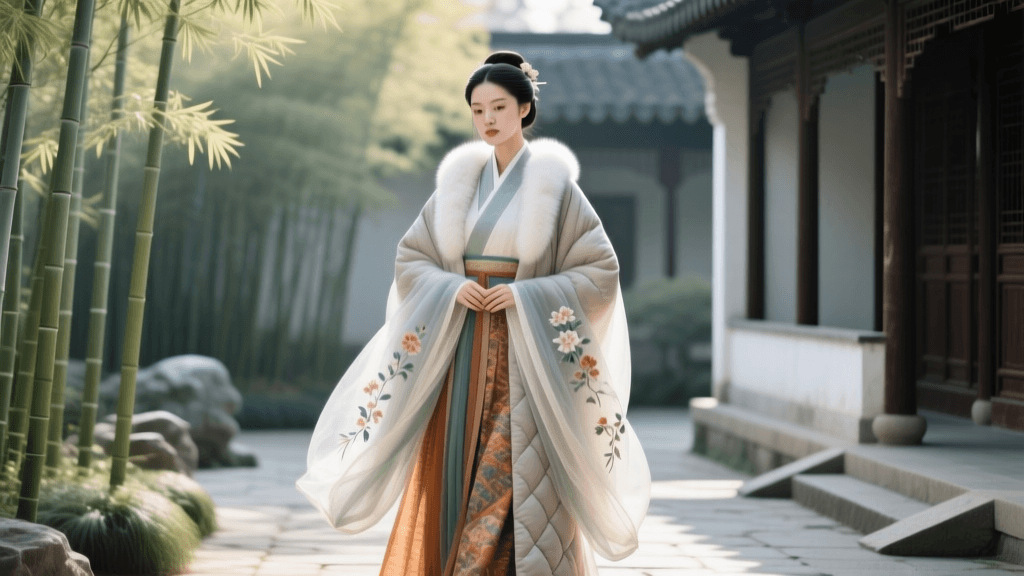
Winters in Beijing and the Northeast are brutal, featuring sub-zero temperatures and dry, biting winds. Winter Hanfu relies on volume, trapping air, and utilizing heavy, insulating natural fibers.
Recommended Fabrics and Weights
Silk velvet, heavy wool, and padded cotton are essential. Historically, fur trims (such as rabbit or fox) were used to line collars and cuffs to block drafts. Today, high-quality faux fur and thick, quilted cotton linings serve the same purpose ethically and effectively.
Styles and Silhouettes
- Padded Ao: Jackets stuffed with cotton batting or modern synthetic down alternatives. The wide sleeves of traditional Hanfu allow for thick underlayers without restricting movement.
- Piaofu (Cloak): A full-length, heavily lined cloak that wraps around the entire body, often secured with a decorative knot at the neck. It acts as a wearable blanket, trapping heat generated by the inner layers.
Seasonal Hanfu Fabric and Style Matrix
The following table provides a quick-reference guide for selecting the appropriate Hanfu configurations based on seasonal and regional climates.
| Season | Primary Fabric Types | Weight / Thickness | Recommended Styles | Ideal Climate Zone |
|---|---|---|---|---|
| Spring | Crepe de Chine, Cotton-Linen | 16-19 mm (Silk) / 140 GSM | Ruqun, Beizi (Open Jacket) | Jiangnan, Central Plains |
| Summer | Ramie (Xia Bu), Luo (Gauze) | Under 12 mm / Under 100 GSM | Tanling, Bijia (Vest) | Southern Coast, Sichuan |
| Autumn | Brocade, Wool-Silk Blends | 22+ mm / Heavy Cotton | Aoqun, Liling (High Collar) | North, Northeast |
| Winter | Silk Velvet, Padded Cotton, Wool | Quilted / Heavyweight | Padded Ao, Piaofu (Cloak) | Beijing, Harbin, High Altitude |
The Science of Silk and Plant Fibers
To truly master seasonal Hanfu, one must understand the raw materials. The mastery of sericulture and silk weaving is deeply embedded in Chinese history. According to the UNESCO Intangible Cultural Heritage archives, the traditional techniques of sericulture and silk craftsmanship in China involve not just the rearing of silkworms, but the complex manipulation of the thread to create varied textures. A single silk thread can be woven tightly to create a windproof brocade for winter, or twisted and spaced to create a porous gauze for summer.
Conversely, plant fibers like hemp and ramie were the backbone of summer wear for the broader populace before cotton became widespread. Ramie, in particular, has a natural stiffness that prevents the fabric from collapsing against the skin, creating a micro-climate of air between the garment and the body. This structural property makes high-quality ramie superior to even the finest cotton for high-humidity environments.
The Art of Layering: Zhongyi and Structural Airflow
No Hanfu outfit is complete without the Zhongyi (undergarment). The Zhongyi is not merely for modesty; it is a functional base layer that dictates the comfort of the entire ensemble.
'The outer garment displays the wearer's status and aesthetic refinement, but the inner garment protects the body and preserves the outer silk from the oils and sweat of the skin.' - Traditional Chinese Tailoring Proverb
In summer, opt for a Zhongyi made of bamboo viscose or ultra-fine ramie. These materials wick moisture away from the skin rapidly. In winter, modern Hanfu wearers often utilize thin, merino wool or silk-blend thermal base layers disguised beneath a traditional white cotton Zhongyi. This allows for historical accuracy on the outside while leveraging modern textile technology for survival in freezing temperatures.
Practical Buyer's Guide: Costs, Timing, and Care
When building a seasonal Hanfu wardrobe, timing your purchases and understanding fabric care is crucial for longevity and budget management.
- Cost Expectations: Authentic, high-momme silk Hanfu sets (Jacket and Skirt) typically range from $120 to $350 USD. Ramie and cotton sets are more accessible, generally falling between $45 and $90 USD. Heavy winter cloaks with intricate embroidery and quilted linings can exceed $400 USD.
- Purchasing Timing: Buy summer gauze and ramie sets in early spring (March/April) before the seasonal rush. Winter cloaks and padded jackets are best pre-ordered in late summer (August), as many specialized Hanfu brands operate on a made-to-order model that requires 30 to 45 days for production.
- Fabric Care: Never machine-wash silk gauze or brocade. Summer ramie can be hand-washed in cool water and laid flat to dry, which actually softens the fibers over time. Winter wool-blends should be dry-cleaned or spot-cleaned to maintain the structural integrity of the lining.
- Anti-Static Measures: In the dry winters of Northern China, silk and synthetic linings can generate immense static cling. Keep a travel-sized anti-static spray or a natural silk-friction bar in your bag to ensure your skirts drape properly rather than wrapping around your legs.
By respecting the historical wisdom of Chinese textile artisans and aligning your fabric choices with the realities of the local climate, Hanfu transforms from a mere costume into a deeply functional, living wardrobe. Whether you are navigating the humid streets of modern Shenzhen or attending a crisp autumn festival in Beijing, the right seasonal Hanfu ensures you do so with both historical elegance and physical comfort.